

Victory Metals links North Stanmore rare earths to secondary phosphate minerals
ED
Editorial
Cashu Finance·5 min read
TL;DR
- TIMA analysis identified secondary phosphate minerals hosting most of North Stanmore’s targeted heavy and magnet rare earths.
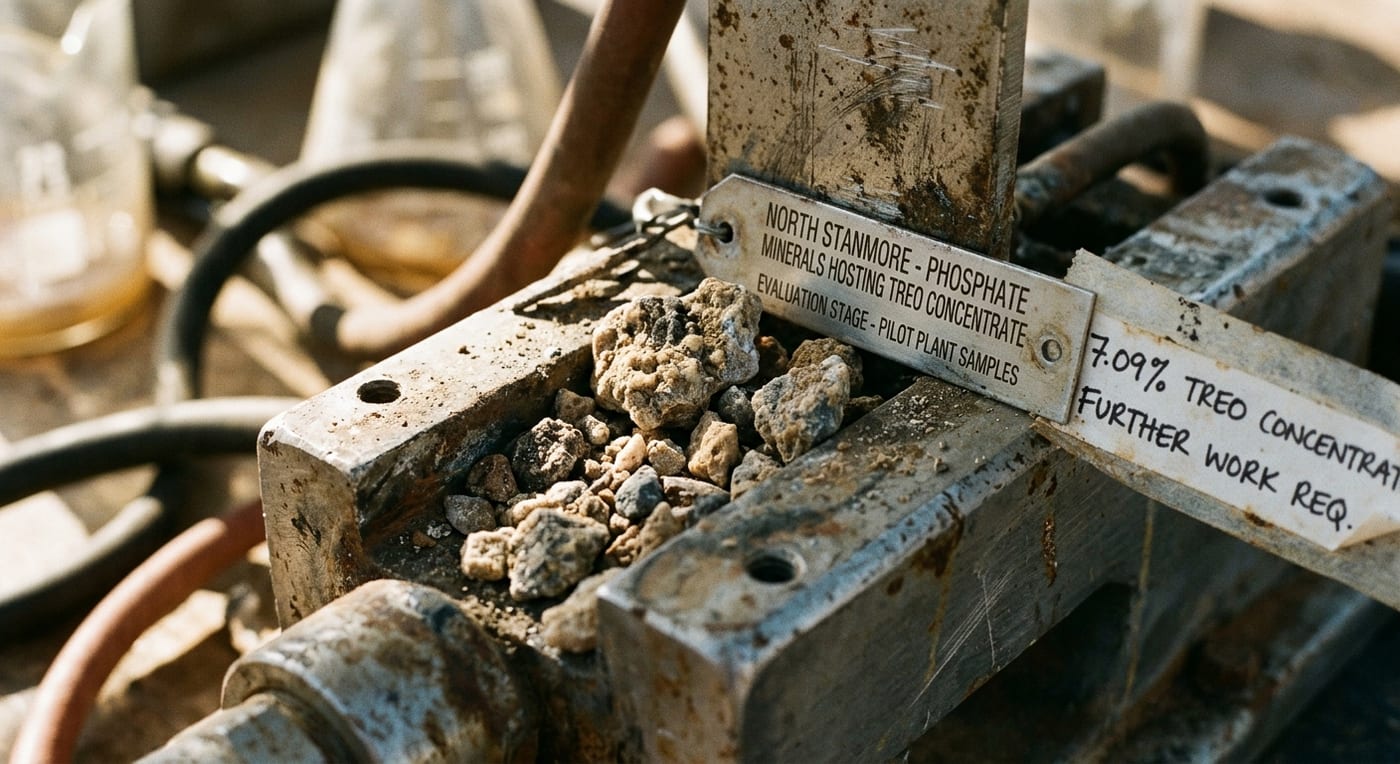
- Pilot plant testing produced a 7.09% TREO concentrate, while further work is still required to confirm recoveries and process economics.
- The updated JORC disclosure supports the Pre-Feasibility Study but leaves North Stanmore at an evaluation-stage development milestone.
Victory Metals has updated its North Stanmore rare earths announcement to add the JORC Code information required under ASX Listing Rules 5.6 and 5.7.1, giving the market a fuller technical basis for assessing the company’s latest mineralogical results. The updated announcement was released on August 4, 2026, and relates to an original announcement dated July 30, 2026. Victory said no other material changes were made.
The central finding is that a large share of the target rare earth value in the analysed concentrate is associated with hydrated secondary phosphate minerals rather than primarily with monazite and xenotime. The TESCAN Integrated Mineral Analyser study was completed by ALS Metallurgy on concentrate produced from Victory’s pilot plant, using a composite of 33 samples from 18 drill-hole locations.
What the updated announcement adds
The TIMA study classified 5.93 mass% of the analysed concentrate as secondary rare earth phosphate groups. That total comprised 2.11% churchite and similar minerals and 3.82% rhabdophane and similar minerals. Victory’s interpretation is that these phases host most of the project’s targeted heavy and magnet rare earths, including dysprosium, terbium, neodymium and praseodymium.
Indicative elemental deportment results show 86% of dysprosium and 82% of terbium reporting to the combined secondary phosphate system, while 88% of praseodymium and 91% of neodymium also report to those groups. The result is strategically relevant because it combines heavy rare earths associated with defence and high-temperature magnet applications with the light rare earths used in permanent magnets.
The company is also careful to describe the deportment numbers as indicative mineralogical estimates. The report identifies a high degree of uncertainty for praseodymium and neodymium and a very high degree of uncertainty for terbium and dysprosium. Victory says further analytical work, including improved phase-composition analysis, will be needed to refine the estimates and confirm how the minerals respond during processing.
Why the mineralogy matters
North Stanmore’s reported mineralogy differs from a conventional system dominated by primary monazite or xenotime. In the analysed concentrate, the secondary phosphate groups accounted for 5.93 mass%, compared with 1.13 mass% for the combined monazite and xenotime-type groups. Victory describes the secondary phases as hydrated products formed through natural weathering and redistribution within the regolith.
That distinction could influence the project’s processing route. Primary monazite and xenotime systems commonly require a mineral-cracking step before leaching, while Victory’s proposed North Stanmore flowsheet uses wet screening and flotation to reject quartz, feldspar and clay gangue before selective hydrometallurgical treatment. The company says concentrating the rare earth-bearing minerals into a smaller mass fraction could reduce the material requiring leaching, separation, purification and residue management.
The update also reports process observations that may have operating significance, although they remain subject to confirmation. Follow-up flotation testing using an alternative reagent produced superior metallurgical results at approximately half the cost of the earlier reagent. Further testing found equivalent performance at ambient temperature rather than the previously tested 50 degrees Celsius, potentially removing the need for heating systems. Tailings testwork has also indicated that the clay may be suitable for filtration and dry stacking.
Those findings are not equivalent to a completed process design. The TIMA study does not establish leach recovery, reagent consumption, impurity loading or final operating conditions. Representative variability testing, integrated mass-balance calculations, engineering design and the ongoing Pre-Feasibility Study will determine whether the proposed benefits can be reproduced across the resource.
From pilot plant results to project development
The mineralogical work builds on pilot plant performance reported in the same announcement. The pilot plant produced a concentrate grading 7.09% total rare earth oxides, or approximately 7.1% TREO, with 2.84% heavy rare earth oxides and a heavy rare earth oxide to total rare earth oxide ratio of 40%. This indicates that the wet-screening and flotation-led route can upgrade rare earth-bearing material into a smaller concentrate, but it does not by itself demonstrate commercial-scale recovery or profitability.
North Stanmore’s broader resource base provides the scale behind the development program. Victory reported an August 2025 Mineral Resource Estimate of 320.64 million tonnes, including 176.522 million tonnes in the Indicated category and 144.118 million tonnes in the Inferred category. The total resource averages 486 parts per million TREO and has an HREO to TREO ratio of 38%. As a Mineral Resource rather than an Ore Reserve, it does not establish that the material can be economically mined.
The project’s relevance extends beyond company-specific development plans. Australia’s critical minerals policy identifies rare earths as important to modern technologies, advanced manufacturing and defence applications, while the federal government’s Critical Minerals Strategic Reserve includes rare earth elements among its initial materials. Government policy is therefore supportive of supply-chain diversification, but policy support does not remove the technical, permitting, capital and market risks facing individual projects.
Victory’s earlier scoping study, released in March 2025, indicated funding requirements of approximately A$337 million, while also warning that the study was based on preliminary assessments and was not sufficient to support a development or investment decision. The latest mineralogy update improves the technical understanding of the ore and may help guide the Pre-Feasibility Study, but it does not change that development-stage status.
The most important next test is whether the secondary phosphate mineralogy translates into consistent recoveries, manageable reagent and impurity profiles, and a flowsheet that remains viable across representative samples. Until those questions are answered, North Stanmore should be viewed as a sizeable and technically distinctive rare earths project advancing through evaluation, rather than as a producing asset or a completed commercial operation.