

The ASX Company Beating Billion-Dollar Projects in the Lab
This article is disseminated on behalf of Mount Ridley Mines Limited
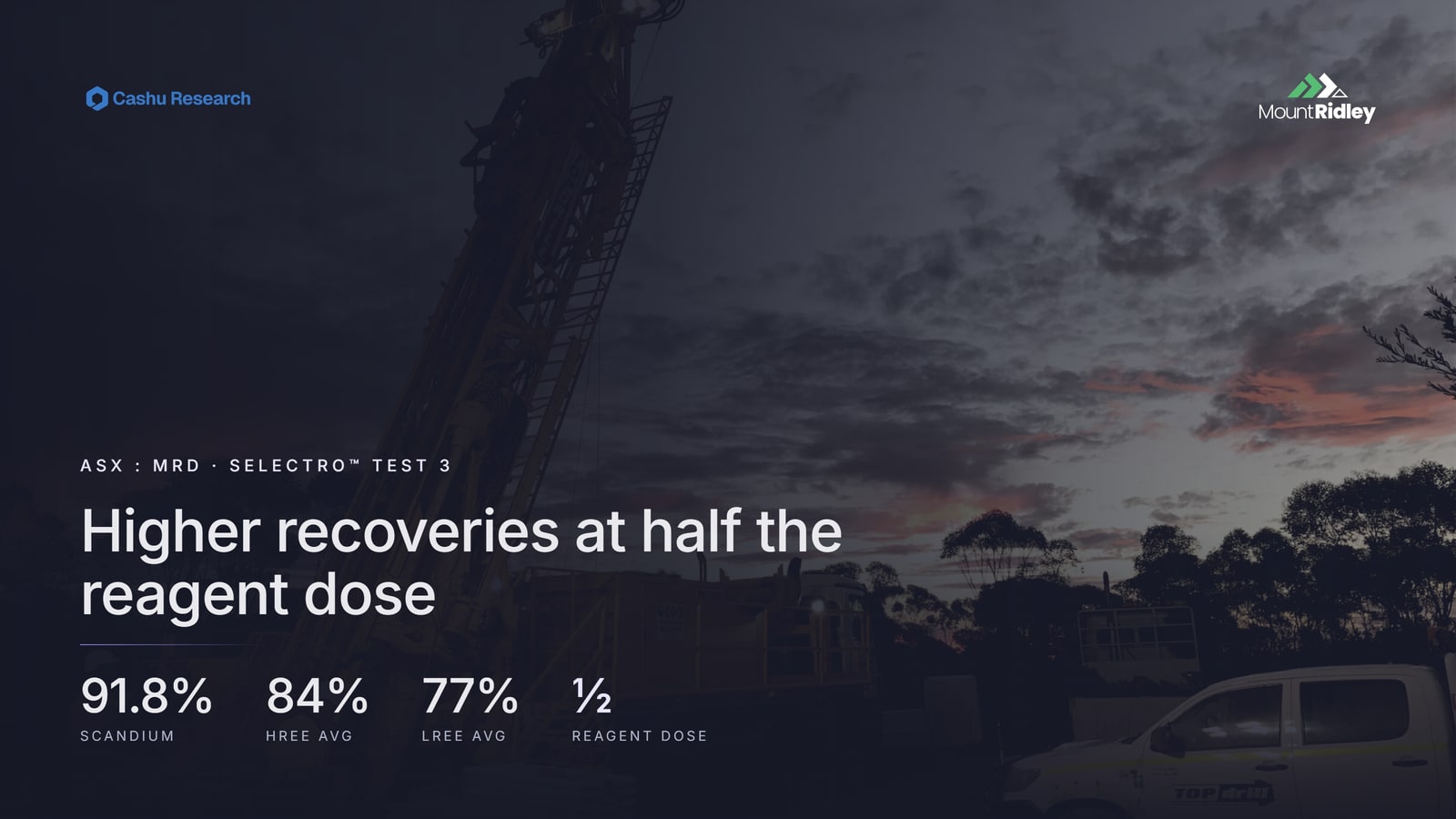
Mount Ridley halved the reagent dose and recovery went up. Selectro™ Test 3 hit 91.8% scandium recovery at ambient conditions, on ore one-eighth the grade of the sector benchmark, and we cannot find a listed company that has published a better number.
Read our full research note on Selectro Test 3 → Speculative Buy reiterated, A$0.144 target maintained.
In hydrometallurgy you buy recovery with reagent. More acid, more heat, more pressure, more metal in solution, and a cost curve that climbs with every point you extract.
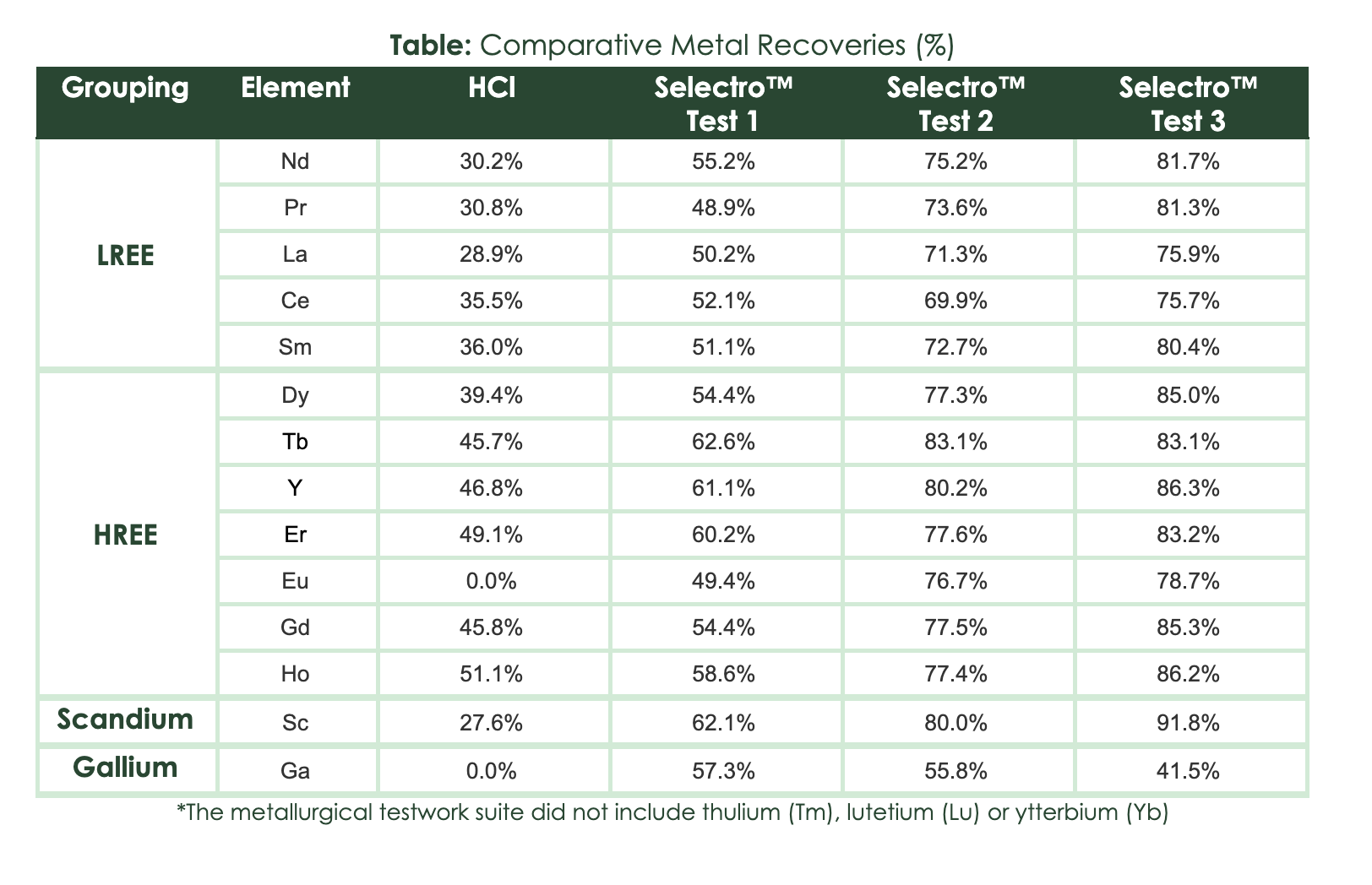
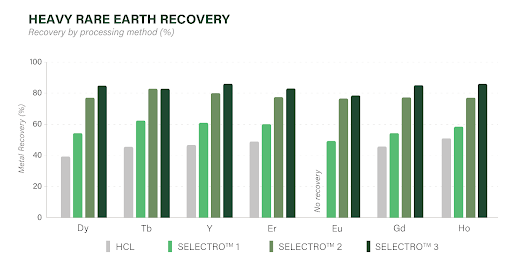
Mount Ridley Mines (ASX: MRD) just halved the reagent dose and recovery went up. Scandium rose from 80.0% to 91.8%. Heavy rare earths averaged 84%, from 78.5%. Light rare earths went from 72.5% to 77%. Same ore, same laboratory, same eight-sample composite, at half the reagent. Every rare earth element but terbium improved.
That is not a marginal result. It is a signal about mechanism.
What the numbers say
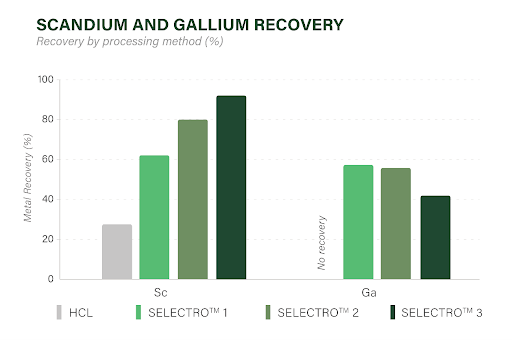
Against the hydrochloric acid baseline run on identical material, the gap is not incremental. HCl recovered 27.6% of the scandium. Test 3 recovered 91.8%. HCl recovered nothing at all from gallium and nothing from europium. Across the heavy rare earths HCl averaged around 40%; Test 3 averaged 84%, with yttrium and holmium both above 86%.
The context matters more than the headline. This was unbeneficiated feed: raw Grass Patch material, no flotation, no concentrate, no process optimisation. Maximum recoveries came in under four hours. The process runs at low temperature and atmospheric pressure in a closed loop that recycles its reagents. And the company has not yet found the lower limit of reagent concentration, so the dose may have further to fall.
Three tests now trace a clean line of 62.1%, then 80.0%, then 91.8%, achieved by adjusting the leaching regime rather than the feed. Gallium moved the other way at the lower dose, falling to 41.5% from 55.8%. That is not a flaw. Individual elements answer to reagent concentration differently, which means the process is tunable toward whichever metal the economics favour.
Nobody has published a better number
Sunrise Energy Metals (ASX: SRL) assumes 88% recovery in its March 2026 Syerston feasibility study, on 656ppm plant feed. Scandium International (TSX: SCY) has disclosed 70 to 80% at Nyngan on 409ppm feed. Both rely on high-pressure acid leaching: sulphuric acid in autoclaves at roughly 250°C, the nickel laterite flowsheet, which buys recovery with capital, acid and multi-year ramp-ups.
The two closest results make the point. Australian Mines (ASX: AUZ) reported 90.8% at Flemington, but on feed many times Grass Patch's grade and through that same autoclave sequence. Doubleview Gold (TSXV: DBG) has reported above 90% at its Hat deposit, at bench scale. Laboratory work on red mud has reached 90 to 95% in hot strong acid, but never commercial scale.
So the field clusters in the high 80s to low 90s, and every result that gets there needs heat, pressure, capital, or a far richer feed. Selectro™ reached 91.8% at atmospheric pressure, in under four hours, on 50ppm feed, with a recyclable reagent at half the dose of a month earlier. No autoclave. No acid make-up.
The rare earth comparison is arguably more striking. Ionic clay projects desorb rare earths at 80 to 90%, but only because the metal sits loosely adsorbed to clay and washes off. Grass Patch is not an ionic clay. TIMA work announced on 6 August put the rare earths in xenotime, crandallite and monazite: the textbook refractory phosphate hosts, which conventionally require a concentrate and a sulphuric acid bake at 250°C to crack.
Recovering 84% of the heavy rare earths from phosphate minerals at ambient conditions is the result that makes metallurgists stop, more than the scandium number does.
Why percentage points are worth so much here
Grass Patch hosts 47,357 tonnes of contained scandium within 946Mt at 50.1ppm, the largest publicly reported JORC scandium resource in the world. Against an inventory that size, recovery is the highest-leverage variable in the project.
At 91.8%, that inventory yields roughly 43,500 tonnes of recoverable scandium, against about 37,900 tonnes at the 80% our initiation assumed. An extra 5,600 tonnes, obtained without drilling a hole.
Scale it to a single percentage point and the arithmetic still lands. One point is about 474 tonnes of scandium metal, or roughly 725 tonnes of scandium oxide equivalent. Global production in 2025 was approximately 80 tonnes. One recovery point at Grass Patch is around nine years of current world supply.
Recovery gains also arrive at almost no incremental cost. Same pit, same haulage, same comminution. Every extra point drops through against a fixed cost base. What makes Test 3 unusual is that recovery rose while the reagent bill fell, and a halved dose halves the volume needing recycling. Both sides of the operating cost equation moved the right way at once.
That is what makes a 50ppm grade defensible in a world where Syerston mines 656ppm. Grass Patch cannot win on grade. It can win on scale, on multi-element credits from a single leach, and on a cost structure with no autoclave in it.
The licensing pathway
Selectro™ is wholly owned through MRD Tech, patent-pending, and separable from the orebody. Grass Patch is an asset with a grade and a capital requirement. Selectro™ is intellectual property with its own addressable market, and the two do not have to succeed together.
Validating Selectro™ on third-party feed is now a formal company next step. That single line moves licensing from a throwaway sentence to a plausible second business.
Almost every scandium-bearing stream on earth is low grade. Chinese titanium and nickel by-product liquors at 10 to 20ppm. Red mud from alumina refining. Nickel laterite tailings across New Caledonia, the Philippines and Indonesia. Nobody builds an autoclave for 20ppm material, which is why those streams sit untreated despite holding the metal the West is now scrambling for.
A closed-loop atmospheric leach pulling better than 90% scandium from 50ppm feed is the first process we know of that could make those streams worth treating. Their owners are large industrial companies with existing plants and existing feed: precisely the counterparty that pays a royalty rather than spending five years reinventing the chemistry. The rare earth side has the same shape, with a queue of stranded Australian clay-hosted deposits holding their metal in the same phosphate minerals Selectro™ has just leached at 84%.
The precedent is not hypothetical. Ionic Rare Earths built a technology arm around its Belfast separation IP, and that IP anchored a 50/50 Brazilian refining venture selected for a R$5bn government funding programme. Policy capital is hunting processing solutions, not just orebodies.
The near-term step is paid technical evaluation. A counterparty ships material, Mount Ridley runs it at Kelmscott. The revenue is immaterial; the signalling is not. One dataset on ore Mount Ridley does not own converts Selectro™ from a company-specific result into a technology.
The structure that matters is a licence with an upfront fee and a running royalty. Royalty income does not consume the balance sheet, is not correlated to Grass Patch's grade, and is not hostage to Mount Ridley's funding timeline. Markets also capitalise it differently: an inferred resource is valued on enterprise value per contained tonne with a heavy stage discount, a royalty stream on a multiple of cash flow. Toll processing and equity-for-technology structures capture more, but need a plant. The pitch to a licensee is simple arithmetic: a recovery uplift and a reagent cut at the same time, with the prospect of deleting an autoclave from the capital estimate.
What still has to happen
The process has to work on feed that is not Grass Patch. Every result to date comes from one eight-sample composite. The planned third-party validation is the test that matters; the Oak Ridge and Fraunhofer programmes disclosed in August are the first external checks.
The IP has to hold. The provisional filing dated 19 August buys until August 2027 to file internationally, and a serious licensee will want granted claims, not a priority date.
And bench recoveries have to survive a bulk sample and a pilot, with impurity behaviour and downstream separation quantified. A 91.8% leach recovery is not a 91.8% recovery to oxide. Gallium going backwards at the lower dose is a reminder the optimisation problem is multi-dimensional. All Grass Patch resources remain Inferred, there is no Ore Reserve and no
completed economic study, and further funding is likely.
Where this leaves it
We carry Selectro™ at zero. Our A$0.144 target was built on A$4,000 per tonne of contained scandium, modestly above the A$3,400 a same-stage peer commands, with nothing attributed to gallium, the rare earths, or the process itself.
Test 3 does not change the resource, so it does not change that arithmetic. What it changes is the probability the resource converts into a project, and that step has historically been worth A$15,000 to A$24,000 a tonne at peers who have taken it.
Three tests in, on unoptimised and unbeneficiated feed, Selectro™ has moved scandium recovery from 27.6% under conventional acid to 91.8% while the reagent requirement halved. A process delivering that on a 946Mt scandium resource, with licensing to third-party feed now an explicit next step, is not reflected in a market capitalisation of roughly A$57m.
The trigger to watch is a single announced third-party trial.
Read our full research note on Selectro Test 3 → Speculative Buy reiterated, A$0.144 target maintained.
Cashu Research initiated coverage on Mount Ridley Mines on 26 August 2026. The A$0.144 price target was set on 26 August 2026 and is maintained. Market capitalisation and share price references are as at 15 September 2026.
Cashu Technologies Pty Ltd is a Corporate Authorised Representative (AR No. 001318029) of Adviser Solutions Group Pty Ltd (AFSL 485946). This article has been commissioned and paid for by Mount Ridley Mines Limited. Results discussed are initial laboratory-scale testwork on unbeneficiated material and have not been reproduced on third-party material; Selectro™ reagent chemistry is proprietary and undisclosed. Recoverable-metal figures are Cashu Research estimates, not company guidance. Peer process descriptions are drawn from published feasibility studies and company disclosures and are simplified; recoveries cited for peers are study-basis figures on higher-grade feed and are not directly comparable to a bench test on 50ppm feed. This information is general in nature about speculative investments and does not constitute personal advice. It does not consider your objectives, financial situation or needs. Investing in exploration-stage mining companies involves a high degree of risk, including total loss of capital. Seek independent financial advice before making any investment decision. Past performance is not indicative of future performance.