

Tesla's Bold Move into Autonomous Transport
ED
Editorial
Cashu Finance·5 min read
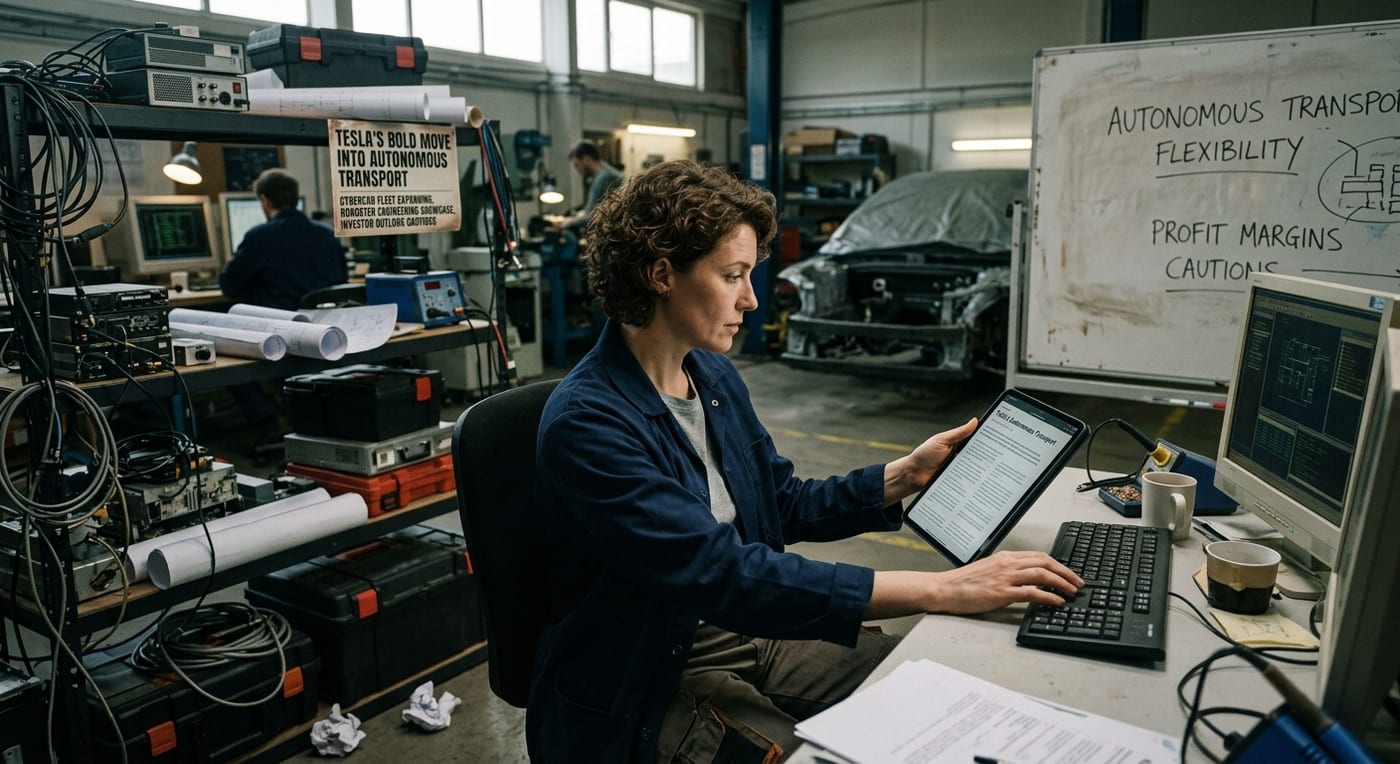
TL;DR
- Tesla expands its Cybercab fleet significantly.
- The Roadster showcases advanced engineering capabilities.
- Investor outlook remains cautious amidst profit margin pressures.
Tesla, Inc. (TSLA) is pushing the boundaries of innovation as it embraces an ambitious strategy in the autonomous transport sector with the launch of its revolutionary Cybercab initiative and the highly anticipated next-generation Roadster. As Tesla seeks to redefine mobility and operational efficiency, it navigates a complex landscape of regulatory scrutiny, competition, and evolving market dynamics. This exploration delves into Tesla's recent developments, illustrating how its initiatives not only mark a shift in technology but also aim to enhance its investor outlook amidst changing economic conditions.
The Cybercab Initiative: Transforming Urban Mobility
Tesla's Cybercab, an autonomous vehicle devoid of traditional driving controls, epitomizes a significant leap forward in urban mobility. This scooter-like vehicle capitalizes on Tesla's cutting-edge artificial intelligence capabilities, enabling it to operate without a driver. Tesla began public Cybercab rides in Austin earlier this year, and the fleet has rapidly expanded from fewer than 40 to over 300 vehicles in just one month. This remarkable growth underscores Tesla's commitment to revolutionizing the robotaxi sector. However, the lack of details regarding operational profits raises questions about the sustainability of this expansion.
Addressing this issue of profitability and operational efficiency will be paramount for Tesla as it continues to navigate the complexities of the autonomous vehicle market. The company’s ability to scale this model beyond Austin to cities like Dallas may serve as a crucial test of its technological reliability and profitability. Notably, Tesla's autonomous driving technology faces competition not only from traditional automakers but also from established players like Waymo, which offers significant operational experience in the autonomous ride-hailing business.
The ongoing regulatory scrutiny, particularly concerning the Cybercab's compliance with safety standards, adds another layer of complexity. Federal safety officials are currently reviewing allegations that Cybercabs exceeded speed limits in school zones, presenting potential operational hurdles that Tesla must address to ensure successful market penetration.
Roadster: A Showcase of Potential
In addition to the Cybercab, Tesla's recent unveiling of the next-generation Roadster signifies a bold step in promoting the company's engineering capabilities. Although Musk stated that the Roadster may not significantly impact Tesla's finances, its design and performance characteristics create a narrative that resonates with technology enthusiasts and potential talent recruits in engineering. At the product launch, the new Roadster showcased its extraordinary capabilities—including the ability to hover briefly, perform flips, and reach remarkable speeds—adding an exciting layer to Tesla's brand identity.
This high-performance vehicle, with an estimated 0-60 mph time of less than a second, serves not only as a testament to Tesla's engineering skills but also as an opportunity for market differentiation. The integration of SpaceX technology in the Roadster aligns with Tesla's broader aim to illustrate its commitment to innovation, providing a tangible example of how the company seeks to operate at the cutting edge of automotive engineering. Although the Roadster's production is slated for 2028, and legal uncertainties regarding street legality remain, the event successfully generated substantial hype and interest in Tesla's broader vision.
The Roadster's positioning as a halo car can play a vital role in shaping public perceptions of Tesla's technological leadership, particularly as the company strives to hire top talent in a competitive landscape.
Investor Sentiment and Future Prospects
Despite the excitement surrounding Tesla’s developments in autonomous vehicles and performance cars, investor sentiment remains mixed. Tesla reported a record of 486,532 vehicle deliveries in the recently concluded quarter. However, alongside this growth, concerns over profit margins persist. The disconnect between surging delivery numbers and pressure on margins will be a focal point for upcoming earnings calls, especially as the company accelerates its capital expenditures in anticipation of the expanding Cybercab fleet and Roadster production.
The transition towards higher capital expenditures, estimated to exceed $25 billion for 2026, is a necessary step to support Tesla's ambitious expansion plans in robotics and autonomous technologies, but it also stresses the balance sheet. Investors will be closely monitoring Tesla's ability to transform its increased output into profitability, as margins are a critical indicator of long-term sustainability and investment viability. In this context, the performance narratives surrounding both the Cybercab and Roadster will be vital to maintaining positive investor sentiment and appeasing the market's expectations.
The juxtaposition of Tesla's celebratory product reveals with the stringent reality of profitability reflects the complexities of a rapidly evolving industry. It also highlights the strategic importance of AI and autonomy in shaping not just Tesla’s operations but indeed the entire electric vehicle sector. With ongoing financial pressures and market challenges remaining visible on the horizon, stakeholders will be keen to assess Tesla's capability to translate ambitious visions into economic realities.
As Tesla navigates these challenges, its recent initiatives showcase an innovative drive to redefine transportation while balancing the pressures of profitability and competition. Investors and analysts will undoubtedly remain watchful, eager to see how these developments unfold and affect Tesla's standing in the automotive world moving forward. The same pressure is reflected in recent reporting on the issue, which helps explain why the company's pricing decisions remain under scrutiny.