

SpaceX's Stellar Financial Performance and Future Ambitions
ED
Editorial
Cashu Finance·5 min read
TL;DR
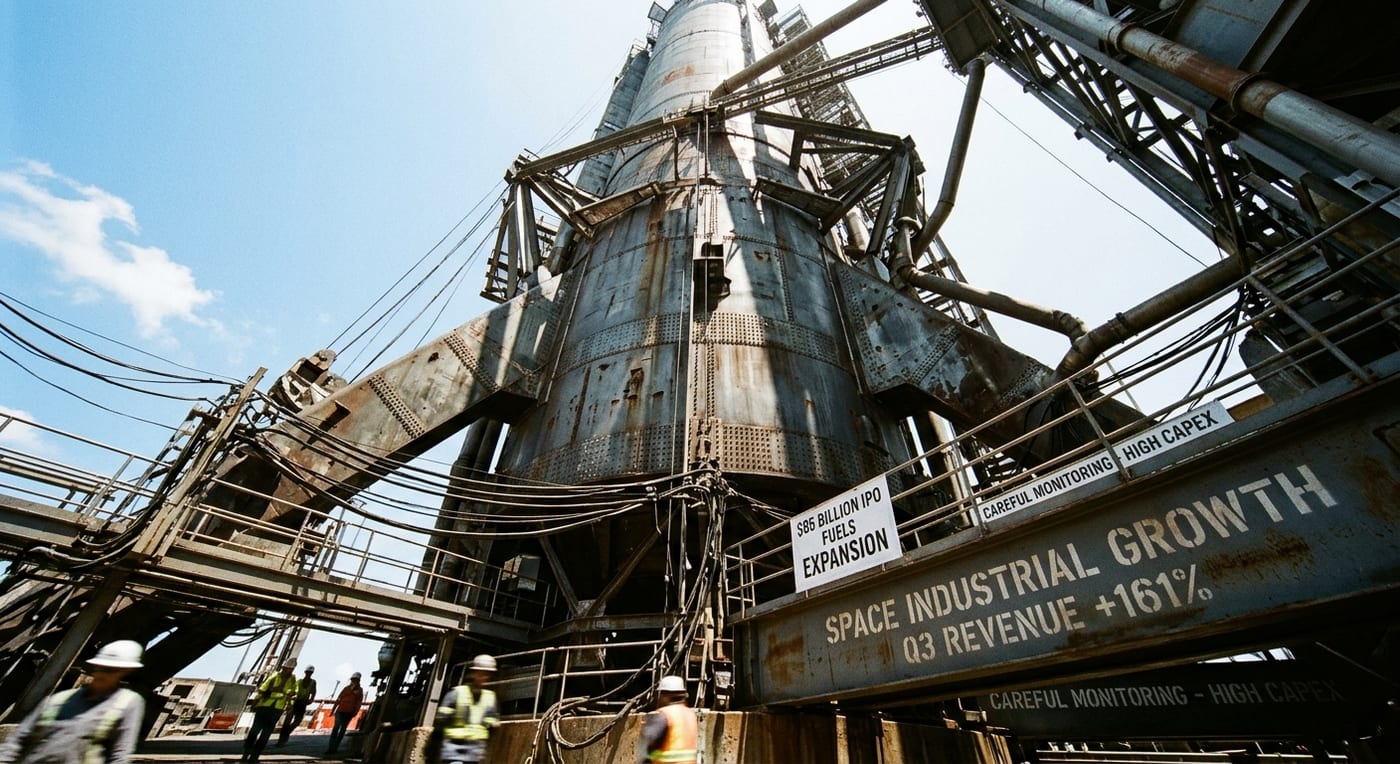
- SpaceX raised approximately $85 billion in its IPO, enabling massive growth.
- Revenue soared 161% year-over-year in Q3, marking significant success across all segments.
- Challenges remain due to high capital expenditures and market volatility necessitating careful monitoring.
Space Exploration Technologies Corp. (SPCX) has recently emerged as one of the most talked-about companies in the financial sector due to its remarkable growth trajectory following its IPO. The company, famously known as SpaceX, made headlines by raising approximately $85 billion during its historic initial public offering in June 2026. This financial windfall enabled SpaceX to not only bolster its current operations but also to set ambitious targets for its future, which include projections of annual sales between $500 billion and $1 trillion by the end of 2027.
The IPO appealed to aggressive growth-oriented investors, with SpaceX’s valuation skyrocketing to unprecedented levels. However, the journey since going public has been filled with ups and downs typical of high-stakes tech company IPOs. Understanding SpaceX’s operational performance, strategic focus, and market positioning is crucial for grasping where the company stands today and where it might head in the future.
Financial Performance Overview
In its most recent quarterly earnings report, SpaceX significantly outperformed investor expectations. The company posted a staggering revenue growth of 161%, reaching $14.6 billion in the third quarter of 2026, far exceeding analyst predictions of $12.7 billion. Moreover, SpaceX recorded its first quarterly net profit of $4.4 billion, a notable turnaround from a loss of over $1 billion in the previous year. These results suggest that SpaceX is not just riding the wave of its IPO success but is also managing to operationalize its ambitious objectives effectively.
The surge in revenue can be largely attributed to enhanced performance across its three business segments: rocket launches, the Starlink satellite network, and its recently branded artificial intelligence unit, termed Super Intelligence (SI). Notably, the AI division has been a dark horse, contributing $7.6 billion in revenue, marking an 830% increase year-over-year. As highlighted in a recent article, SpaceX’s strategic focus on expanding its AI business is paying off as it secures lucrative contracts in cloud computing, which are expected to drive further revenue spikes.
Starlink: The Connectivity Crown Jewel
Starlink, SpaceX’s satellite internet service, is becoming a financial cornerstone for the company. The service's revenue jumped 69% year-over-year to $5.2 billion, solidifying its role as a primary revenue generator. With more than 13.6 million subscribers, Starlink is on course to increase its user base, with average revenue per user (ARPU) subtly climbing to $69 per month. This trend is critical, especially as SpaceX plans to enhance bandwidth through significant new satellite launches.
As reported, Starlink now provides services to over 3,800 aircraft and has established partnerships with notable airlines like United and American Airlines. The importance of maintaining and progressing this network is underscored by the competitive pressures highlighted in reports about SpaceX's plans to potentially lease 80,000 cell sites for wireless telecommunications. This move could challenge established players like AT&T and T-Mobile, reshaping the telecommunications landscape in the U.S. These rumors have increased market volatility, with companies like AT&T experiencing stock drops as they assess new competitive threats.
Starship: The Next Chapter in Space Migration
Starship remains at the heart of SpaceX's operational strategy. Although revenue from launches has been modest, the company is focusing on rapidly deploying Starlink satellites, a strategy that has generated solid demand for its connectivity services. Elon Musk's vision for Starship involves making it a fully reusable launch vehicle capable of significantly reducing costs for orbital payload delivery, a development crucial for both the satellite and AI initiatives.
Management has indicated that a successful demonstration of full reusability could take place as early as November, which, if successful, would validate many of SpaceX's expansion plans and significantly bolster investor confidence.
Challenges and Forward-Casting
Despite these optimistic figures and growth outlooks, challenges abound. SpaceX's ambitious capital expenditure plans have led to substantial cash outflows, raising questions about the sustainability of its current growth model. Capital expenditure in Q3 alone amounted to $19.6 billion, with projections suggesting even more aggressive spending—potentially doubling in the fourth quarter. Coupled with a negative cash flow of $10 billion, investors are keenly monitoring how long SpaceX can sustain this burn rate before needing to tap into additional capital markets.
Musk's ambitious forecast of potentially hitting $1 trillion in annual sales by 2027, spurred largely by the AI sector, remains a mixture of optimism and risk—especially given that it implies a meteoric rise in performance compared to today’s figures. Hence, stakeholders should remain vigilant about performance metrics and growth viability.
Looking Ahead
As SpaceX looks toward a future rich with potential, the interactions between operational execution and investor expectations will be pivotal in shaping its market narrative. The dual-edged nature of its ambitious plans coupled with the current volatile growth trajectory underlines the need for prudent monitoring. In this landscape, SpaceX stands as both a beacon of innovation and a symbol of the high risks associated with tech-driven investments.
In conclusion, investors are left to evaluate how much of Musk's ambitious vision becomes reality, understanding that while the aerospace giant has positioned itself for explosive growth, execution will be key to its long-term success. The same pressure is reflected in recent reporting on the issue, which helps explain why the company's pricing decisions remain under scrutiny.