

SpaceX: Charting a Bold Path Forward
ED
Editorial
Cashu Finance·5 min read
TL;DR
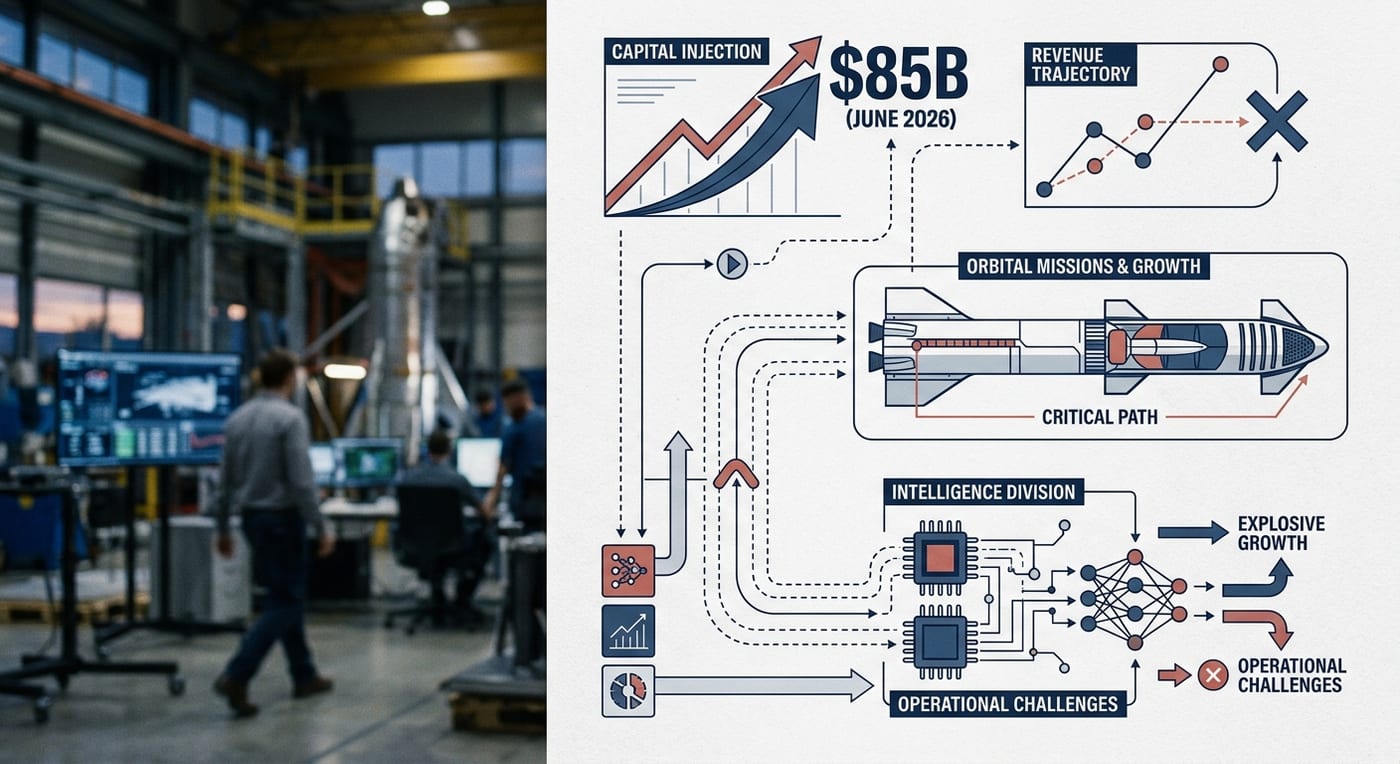
- SpaceX raised approximately $85 billion in its IPO in June 2026.
- Upcoming Starship mission vital for revenue and growth.
- AI division shows explosive growth amidst challenges.
Space Exploration Technologies Corp. (SPCX) is drawing attention as the latest developments come into focus. Space Exploration Technologies Corp. (SPCX) has embarked on an ambitious journey following its historic IPO, which raised approximately $85 billion in June 2026. As one of the most recognized names in aerospace, SpaceX is at a crucial turning point in its operational strategy and growth trajectory, especially with the upcoming Starship missions and advancements in artificial intelligence (AI). The company’s multifaceted approach to revenue generation, combining space, connectivity through its Starlink satellites, and advancements in AI, presents both exciting prospects and considerable challenges.
The IPO and Its Initial Reactions
The initial market excitement surrounding SpaceX's IPO was palpable. Shares, opening at $150, rapidly soared to over $226, reflecting investor enthusiasm for the company’s promising future. However, the stock quickly retreated, showcasing volatility typical of other high-profile tech IPOs, ultimately settling around the $150 mark. This rollercoaster ride has led to varied investor sentiment, as many begin to assess the viability of SpaceX's ambitious goals against its operational realities.
Starship: A Revolutionary Endeavor
A pivotal aspect of SpaceX's future is the Starship program. After 13 test flights primarily focused on proving its suborbital capabilities, SpaceX plans to launch Starship into orbit for the first time on September 28, 2026. This mission not only aims for orbit but is also significant as it marks Starship's first commercial venture, carrying 26 new Starlink V3 satellites. The success of this mission is vital for SpaceX's revenue aspirations, particularly since Starlink has been the company's sole profitable segment, generating about $4.29 billion in Q2 2026 alone.
Moreover, Starship’s design is focused on reusability, potentially allowing SpaceX to cut launch costs and significantly enhance profit margins. The upcoming flight aims to establish a new benchmarking opportunity, propelling the company into new markets, including the possibilities of space tourism and even interplanetary missions that are part of Elon Musk's grand vision. As such, Starship represents not just a technological innovation but also a pivot to additional revenue streams for SpaceX.
Starlink: Connectivity and Growth
The Starlink segment continues to be a crucial revenue driver. With plans to aggressively expand its satellite internet service, SpaceX is aiming to meet the demands of a global market hungry for connectivity. Currently, Starlink serves over 12 million worldwide subscribers, with a projected increase expected to reach 15 million U.S. customers by 2030. Such growth is indicative of the satellite internet segment's total addressable market, which is estimated to be around $129 billion.
In fact, the company’s strategy is profoundly influenced by its Starlink service, perceived as not just an adjunct to its aerospace operations but a fundamental component of its overall revenue strategy. With this segment operating efficiently, it is anticipated to contribute significantly to SpaceX's bottom line in the coming years. As Elon Musk noted, Starlink may demonstrate the potential to eventually dominate internet delivery in most regions globally.
Artificial Intelligence Journey
Perhaps less well-known, but equally pivotal, is SpaceX's exploration into the AI sector. Hyper-invested, the AI division has shown exponential growth, with revenue reportedly increasing by 213% in the most recent quarter. This division, particularly with the development of the Grok AI model and two Colossus data centers, emphasizes SpaceX's ambition to penetrate the burgeoning AI market, which could see an estimated worth of over $10 trillion in global infrastructure investments in the forthcoming years.
Being positioned in the AI space, especially as providers of high-performance computing capabilities, will enable SpaceX to secure substantial client contracts. Partnerships with significant players like Alphabet and Anthropic are already yielding contracts that amount to billions annually. There is an indication that SpaceX's AI revenues could amplify significantly, in line with forecasts suggesting a potential rise to $322 billion by 2030. This burgeoning proficiency in AI illustrates Spacex's long-term vision while reaffirming its positioning across multiple industries – aerospace, connectivity, and AI.
The Financial Landscape – A Double-Edged Sword
However, the robust growth patterns come with stark challenges. To support its innovation journey, SpaceX's capital expenditures have surged dramatically, particularly towards its AI division, accounting for almost 83% of its expenditures. This raises flags as many investors are often wary of high spending amid limited profitability, especially as the company currently isn't profitable. With yearly losses narrowing, projected targets point towards long-term profitability, with a stated net income margin target of 45%, albeit that remains reliant on successfully executing its expansive plans without missteps.
Moreover, fluctuations in stock prices echo broader market concerns. The shares remain highly volatile, underscoring speculative investor behavior and macroeconomic uncertainties that could impede the growth aspirations of companies like SpaceX. Investors must navigate the treacherous waters of high expectations versus operational complexity in a sector poised for rapid changes.
Conclusion: The Road Ahead
SpaceX is undeniably situated at a critical junction. With its multi-pronged approach spanning aerospace endeavors, connectivity solutions through Starlink, and advances in AI, the company represents a remarkable case study in modern business strategy amid fluctuating market confidence. The forthcoming launches, particularly the pivotal Starship mission, will play a crucial role in determining investor confidence and revenue generation capabilities. As the company maneuvers through opportunities and challenges, SpaceX's future remains an exciting narrative filled with both potential triumphs and obstacles in the ever-evolving aerospace landscape. Investors and spectators alike await how SpaceX will capitalize on its transformative IPO and navigate its bold ambitions in the years to come. The same pressure is reflected in recent reporting on the issue, which helps explain why the company's pricing decisions remain under scrutiny.