

Sandisk's Surge in the NAND Market
ED
Editorial
Cashu Finance·5 min read
TL;DR
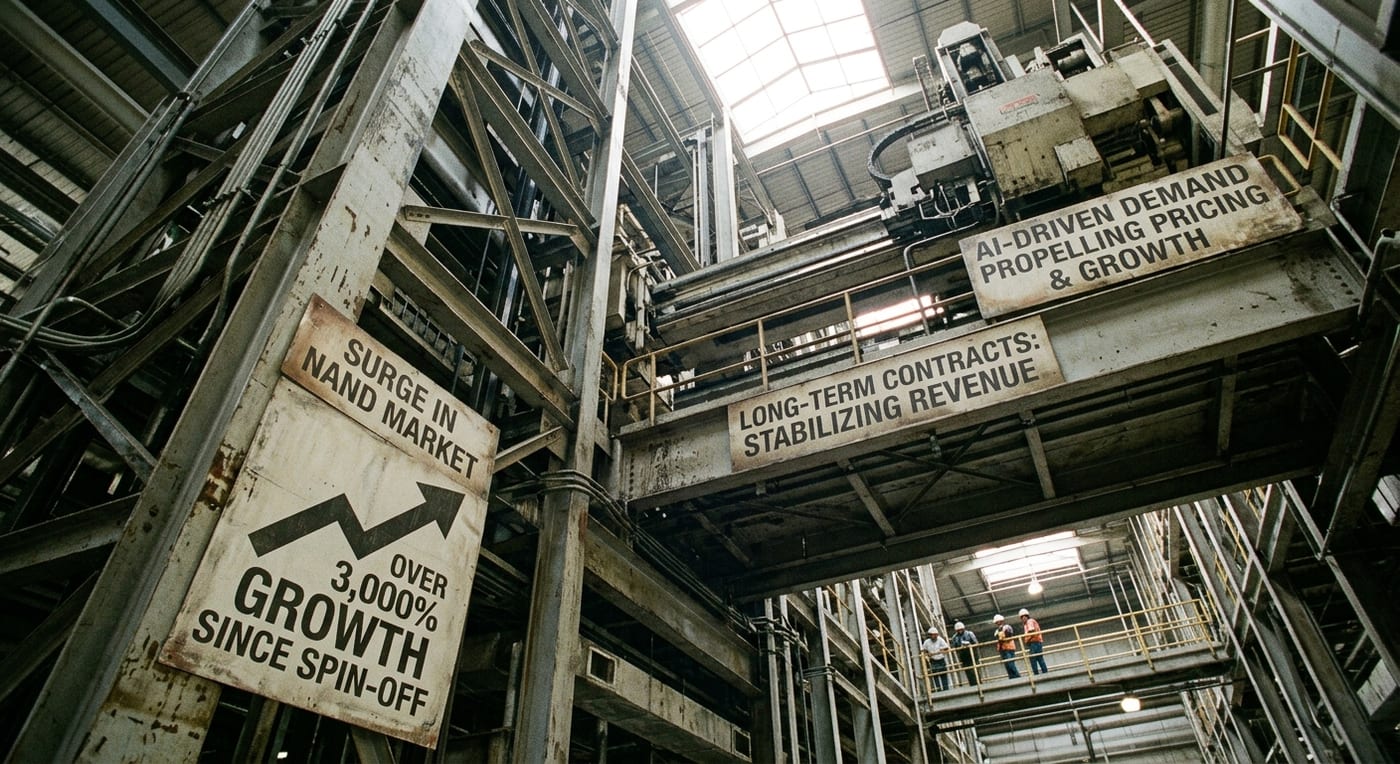
- Sandisk's stock has surged over 3,000% since its spin-off.
- Long-term contracts stabilize revenue amid market volatility.
- AI-driven demand propels NAND pricing and revenue growth.
Sandisk Corporation (SNDK) has made waves in the semiconductor landscape, reported substantial stock price increases, and carved out a strong position in the NAND flash memory market since its spin-off from Western Digital in early 2025. This meteoric rise, characterized by a staggering 3,000% increase since the spin-off, is not merely a statistic; it showcases Sandisk's smart navigation through a dynamic marketplace fueled by insatiable demand for storage solutions, particularly driven by the burgeoning artificial intelligence (AI) sector. This article delves deep into the factors behind Sandisk's phenomenal growth and what it might mean for the future.
The Financial Growth Trajectory
Upon its separation from Western Digital, Sandisk's share price was around $50, and as of recent reports, has climbed above $2,350. This remarkable growth is reflective of both investor confidence and a significant transformation in the technological landscape, particularly regarding storage solutions for AI applications. Notably, Sandisk's financial reports indicate that revenue surged 372% year-over-year to just under $9 billion for the fourth quarter of fiscal 2026. Such impressive figures primarily stem from the heightened demand for NAND flash memory, critical for AI data centers seeking efficient and vast data storage capabilities.
As the AI market continues its exponential growth, projected to significantly outpace previous trends, the demand for high-performance memory solutions becomes even more crucial. In fact, recent estimates suggest that the global NAND memory market could reach a staggering $300 billion this year and potentially approach $500 billion by 2027. This places Sandisk at a pivotal point, with immense opportunities looming in the near future.
Navigating Market Challenges
Despite the incredibly positive outlook, Sandisk is not without challenges. The semiconductor market, particularly NAND pricing, has been known for its boom-and-bust cycles. Though profit margins soared to nearly 85% in the last quarter, as demand outpaced supply, caution remains warranted in anticipating future fluctuations. For instance, Sandisk's margins have shown a rapid increase over the past year, supported by strong pricing power that allows it to charge premium rates for its high-performance memory products.
To mitigate risks associated with price volatility, Sandisk has adopted a strategy of securing long-term contracts with its clients. This technique not only guarantees revenue stability amid market uncertainty but also helps to balance out the potential impacts arising from variability in NAND pricing. These measures illustrate how Sandisk is strategically positioning itself within the marketplace while simultaneously addressing concerns tied to profitability in the face of competition.
Connection to AI and Data Centers
The growing demand for NAND flash memory is intimately linked with advancements in AI technology. Organizations are racing to enhance their data center capacities as they adapt to the influx of data generated by AI applications. With a prominent position in this sector, Sandisk is poised to capitalize on this trend. Companies in need of robust, reliable memory solutions are increasingly relying on Sandisk's products, evidenced by its notable financial performance. Early reports indicate that Sandisk's gross margins for the upcoming first quarter of fiscal 2027 are forecasted to remain strong, between 83% and 85%, further solidifying its commitment to maintaining high standards amid growing demand.
Interestingly, a report on Sandisk's resilience in a dynamic market underlines how external macroeconomic conditions can impact the company's operations and revenue streams. Factors such as consumer preferences, technological advancements, and competitive pricing strategies from other semiconductor companies collectively influence Sandisk's market positioning and growth trajectory. By remaining vigilant and innovative in its product offerings, Sandisk can continue to thrive even when the market fluctuates.
Future Outlook
Looking forward, analysts project that Sandisk's earnings will continue to soar. Predictions suggest that as the NAND flash memory prices remain elevated and continue to drive profitability, Sandisk could see its EPS jump dramatically, potentially reaching $52.79 in the second quarter of fiscal 2027. Based on current growth perspectives, Sandisk is anticipated to follow a strong growth trajectory that could lead the stock to a staggering price point of $3,422 by the end of 2026 according to investment forecasts that point towards expanded market penetration and the company's thriving engagements in the AI landscape.
Investors and analysts alike are grading Sandisk's performance favorably, as the company has emerged not only as a leader in the NAND market but also as an innovator at the intersection of advanced data storage solutions and AI technological advancements. With competitors like Western Digital emphasizing hard drive storage, Sandisk's focused investment in NAND flash memory showcases its competitive edge. As organizations actively shift towards high-performance storage solutions, Sandisk stands to benefit immensely from the global AI infrastructure spending trend set to rise significantly in the coming years.
Conclusion
In summary, Sandisk Corporation (SNDK) has achieved exceptional growth post-spin-off, showcasing its strength in the NAND market through increased revenues, strategic contract management, and a forward-looking approach towards AI advancements. These evolving dynamics present an exciting landscape for both the company and its investors, as Sandisk seemingly positions itself to capitalize on the next wave of technological change. The same pressure is reflected in recent reporting on the issue, which helps explain why the company's pricing decisions remain under scrutiny.