

Rocket Lab's Neutron: Delays and Opportunities Ahead
ED
Editorial
Cashu Finance·4 min read
TL;DR
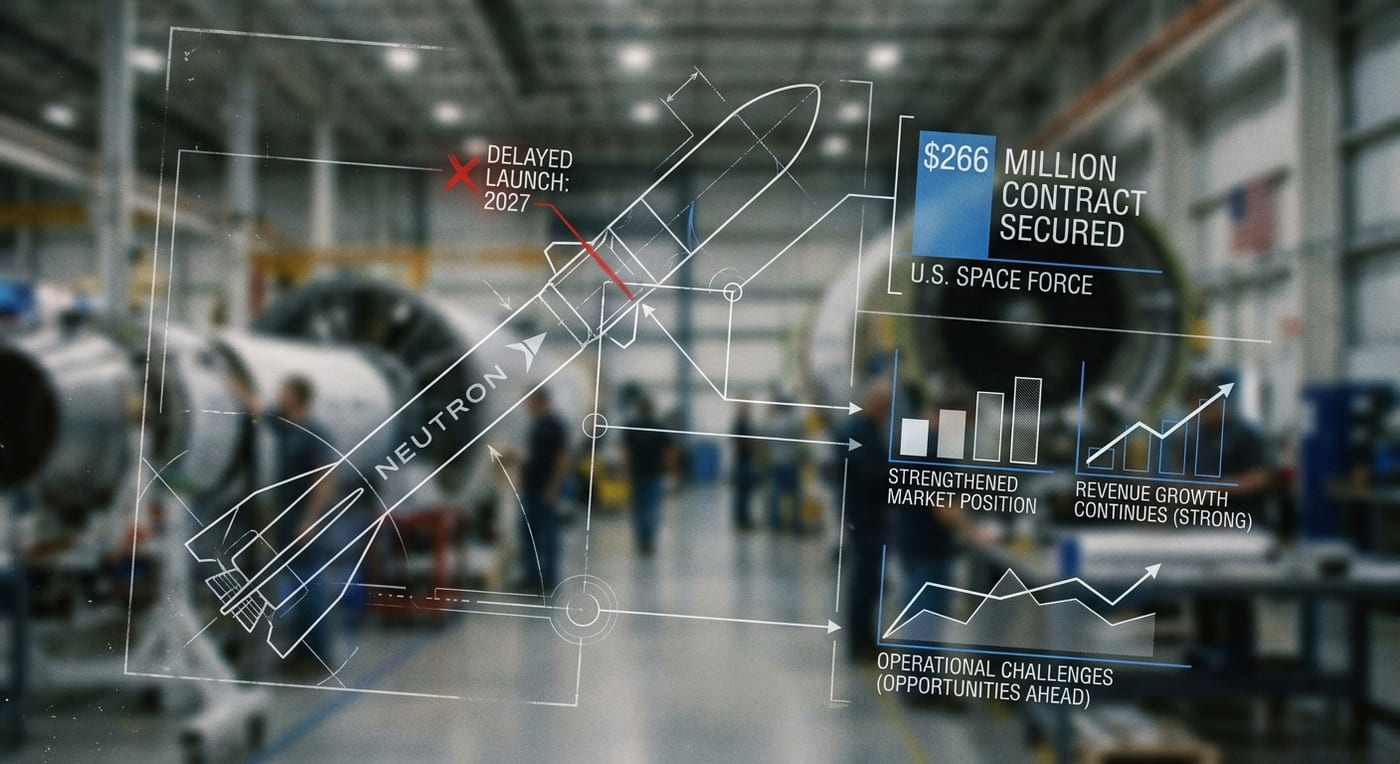
- Rocket Lab's Neutron rocket launch delayed to 2027.
- Secured $266 million contract with U.S. Space Force bolstering market position.
- Revenue growth remains strong amidst operational challenges.
In recent months, Rocket Lab has made headlines for securing a monumental $266 million multi-launch agreement with the U.S. Space Force. This landmark deal aligns with the increasing demand for defense-related launches, highlighting the company's reliability as a launch service provider. As Rocket Lab continues to expand its operational capabilities, the upcoming developments promise to elevate its competitive edge within the aerospace industry.
Neutron Rocket: A Game Changer Delayed
One of the most anticipated advancements within Rocket Lab is its Neutron rocket, designed to carry larger payloads than its current Electron rocket. However, the trajectory of this project has encountered significant delays. Initially slated for a 2026 launch, the company announced on October 14, 2026, that Neutron's first flight is now expected in 2027 due to identified manufacturing issues, specifically microscopic air voids in the propellant dome.
These setbacks impact more than just timelines; Rocket Lab's management had previously linked the first successful launch of Neutron to a potential turnaround to positive adjusted EBITDA. Consequently, the delay pushes back the timeline for achieving this crucial financial milestone. Indeed, the company's adjusted EBITDA remains in the negative, even as revenues continue to show impressive growth. In Q2 2026, Rocket Lab reported a record revenue of $234 million, a 62% year-over-year increase.
Strategic Contracts Fueling Growth
The recent contract with the U.S. Space Force symbolizes Rocket Lab's expanding role in the aerospace sector. This agreement enables the company to conduct several payload launches under the Rocket Systems Launch Program, further establishing its reliability amidst fierce competition. As outlined in Rocket Lab's latest article, such contracts provide a framework for ongoing growth despite the challenges posed by delays in the Neutron program.
Notably, Rocket Lab's operational growth is evident in its expanding second-quarter revenue. The company's space systems segment, which focuses on manufacturing satellites and spacecraft components, saw a 94% increase to $189.5 million. In contrast, the launch services segment experienced a decline of 4%, attributed to revenue recognition timing regarding Electron launches.
The Path Forward and Market Recovery
Despite the challenges, the outlook for Rocket Lab remains positive in the long term. Even with the Neutron delays, the ongoing demand for launch services is helping to sustain the company's operational growth. The adjustments in the launch schedule reflect a commitment to safety and reliability, critical attributes in securing future contracts. Meanwhile, Rocket Lab's stock price response to these developments illustrates investor sensitivity to timelines and milestones. After the announcement of the delay, shares dropped by over 6%, closing at $55.25.
As the aerospace landscape evolves, Rocket Lab must balance the execution of its current contracts with improving its launch delivery timeline for Neutron. Future success hinges on not only launching the Neutron rocket but doing so with consistent performance metrics that can secure additional customer contracts.
Looking Beyond Neutron
Looking ahead, Rocket Lab's anticipated acquisition of Iridium Communications, expected to finalize by mid-2027, could enhance the company's revenue potential significantly. Iridium, known for generating substantial free cash flow, represents a strategic opportunity for Rocket Lab to diversify its income streams and mitigate the risks associated with reliance on a single product.
As the company begins to stabilize its existing structures and incorporates Iridium’s services, there is potential for Rocket Lab to transform its financial narrative. While the immediate focus is on overcoming the challenges associated with Neutron, the long-term strategic vision incorporates both innovative technology and robust market presence.
Currently trading at approximately $53 a share, Rocket Lab's market valuation reflects complexities within its operational model, especially as significant resources are directed toward the Neutron project. Although the stock price has fallen 65% from its record high earlier in 2023, Rocket Lab's growing performance metrics may eventually realign investor expectations with market realities.
The company's success is intrinsically linked to its ability to execute on its current strategies while tackling newfound challenges due to the Neutron delays. Stakeholders will be watching closely as Rocket Lab continues to define its path within the competitive aerospace sector, balancing innovation with operational excellence. The same pressure is reflected in recent reporting on the issue, which helps explain why the company's pricing decisions remain under scrutiny.