

Robinhood's Strategic Shift in Financial Services
ED
Editorial
Cashu Finance·5 min read
TL;DR
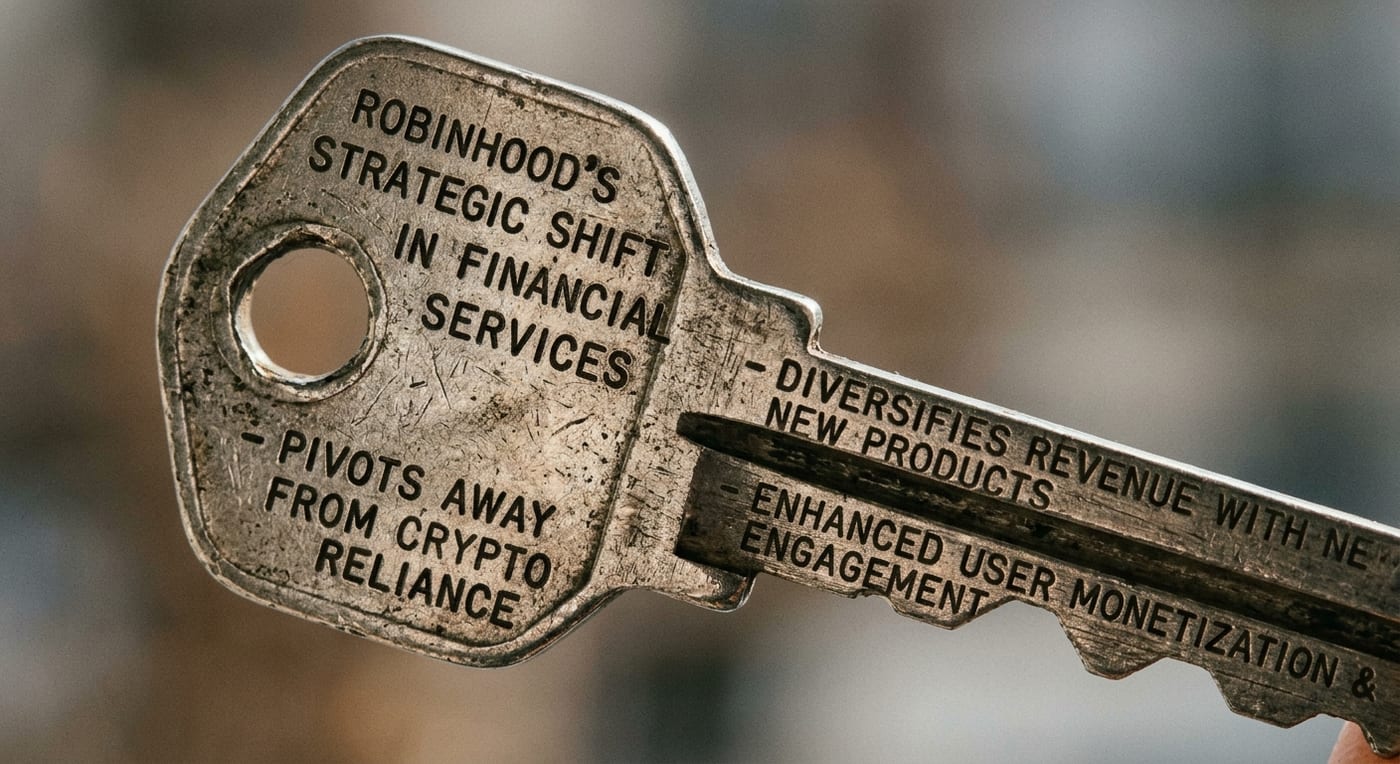
- Robinhood pivots away from crypto reliance to diversify revenue.
- New financial products cater to changing user demands and market trends.
- Significant growth in user base enhances user monetization and engagement.
Robinhood Markets, Inc. (HOOD) is navigating a significant transition from its roots as a cryptocurrency-focused brokerage to a comprehensive financial services platform. This evolution, driven by changing market dynamics and user demands, has allowed Robinhood to diversify its revenue streams and stabilize its financial outlook amid increasing competition and macroeconomic pressures.
Transitioning From Crypto Dependency
In the company's early days, a substantial portion of Robinhood's income was derived from cryptocurrency trading. Following its IPO, this segment accounted for approximately 41% of its revenues, showcasing how integral crypto trading was to its initial success. However, the recent downturn in cryptocurrency values and trading activity has forced Robinhood to reevaluate this heavy reliance. According to industry analyses, the volatility characteristic of the crypto market has prompted a shift in user engagement, compelling Robinhood to seek new opportunities beyond this segment to ensure sustainable growth.
The pressure weighs heavily on Robinhood as it works to replace the gap left by declining crypto revenues with other revenue-generating avenues, notably through option trading and its ongoing expansions into prediction markets and single-stock perpetual futures. As noted in a recent article, Robinhood's exploration into prediction markets is particularly promising. The introduction of features like weekend trading enhances user engagement, positioning the platform to capture a more extensive demographic of both novice and seasoned traders.
The Demand for Diverse Offerings
Robinhood is strategically advancing into various sectors, with recent initiatives showing strong promise. Notably, a Mizuho survey indicated that 94% of active Robinhood users expressed interest in trading single-stock perpetual futures if made available. This demand aligns with Robinhood's broader strategy of developing new financial products that cater to emerging market trends. As highlighted in a recent source article here, the potential introduction of single-stock perpetual futures reflects the company's focus on innovation and responsiveness to user needs.
With this shift, Robinhood is positioning itself to enhance user experience significantly by providing new avenues for trading that do not require excessive capital. Such products allow users to engage in trading strategies that were previously limited to larger institutional investors, thus democratizing access further than before.
As part of its diversification efforts, Robinhood's expansion into other financial services — including margins, cash products, and wealth management features — is also noteworthy. These offerings not only foster user retention but also enhance the overall customer experience, allowing users to engage more deeply with the platform. The concept of being able to offer multiple services from one account strengthens customer relationships and contributes to increased revenue per user, as explained in the analysis of Robinhood's ongoing growth strategy.
Achieving Financial Stability Amidst Market Volatility
The goal behind Robinhood's diversification strategy is not simply to innovate but also to stabilize revenues amidst market volatility. By broadening its operations from a single revenue source to multiple streams, Robinhood reduces its dependency on transactional trading revenue, which has often been highly cyclical and unpredictable. The company has successfully built several lines of business, with as many as 13 business segments generating at least $100 million in annualized revenue, compared to only one in 2019.
This diversification bodes well for Robinhood, particularly as transaction-based revenue alone has shown fluctuations in alignment with market conditions. For instance, in the latest performance report, Robinhood's transaction-based revenue increased by 44% year-over-year, complemented by substantial gains in net interest revenue. This two-pronged revenue structure helps reassure investors and stakeholders that Robinhood is on solid ground despite economic uncertainties.
Looking Forward: The Power of Customer Relationships
Another vital aspect of Robinhood’s strategy lies in its ability to foster strong customer relationships. The platform's initiatives designed to increase user engagement have resulted in a growing user base, now boasting 28.4 million funded accounts, a figure that represents a 7% year-over-year growth. To further this momentum, Robinhood is actively enhancing its product offerings. The introduction of features like Gold membership subscriptions and credit card products adds to the financial ecosystem that users are being encouraged to explore, ultimately increasing their dependency on and satisfaction with the platform.
According to recent findings, the average revenue per user has increased significantly, showcasing that Robinhood is not only attracting users but effectively monetizing them. As highlighted in discussions of Robinhood's strategic pivots, the approach of developing multiple revenue avenues creates a powerful pathway for sustained growth, akin to a flywheel effect that builds momentum over time.
Conclusion
In summary, Robinhood Markets, Inc. (HOOD) is firmly on the path to transforming its business model in response to market dynamics and user needs. With an increasing focus on expanding its service offerings and diversifying its revenue streams, Robinhood is not only mitigating risks associated with dependency on any single revenue source but also enhancing its appeal as a comprehensive financial services platform. With innovations like single-stock perpetual futures and deeper engagement strategies, the outlook for Robinhood appears optimistic as it continues to evolve and adapt in the highly competitive fintech landscape.