

Quarterly Activities/Appendix 5B Cash Flow Report

This article is disseminated on behalf of MRD.AX
Scandium Resource Expanded to 946Mt as SELECTROTM Delivers Breakthrough Recoveries
Highlights
- Scandium Inferred Mineral Resource expanded to 946Mt @ 50.1 ppm scandium (76.8 ppm Sc₂O₃), containing 47,357 tonnes of scandium metal and 72,637 tonnes of Sc₂O₃ at a 25 ppm scandium cut-off
- Phase 2 re-assay confirmation of shallow, high-grade scandium mineralisation up to 8km beyond the expanded Block 1 and Block 2 Resource boundaries
- Selectro™ Test 3 scandium recovery of 91.8% and average HREE recovery of approximately 84% at half the previous reagent dose, with gallium recovery of 41.5% compared with 55.8% in Test 2
- TIMA identification of rare earths predominantly hosted in discrete phosphate minerals within the tested Grass Patch composite, supporting potential concentration through flotation before leaching
- Progression of flotation testwork to inform beneficiation and subsequent bulk Selectro™ testing
- Lodgement of a provisional patent application for the proprietary Selectro™ Process, with intellectual property held through wholly owned subsidiary Mount Ridley Tech Pty Ltd
- Completion of a $2 million placement to support Selectro™ development, metallurgical testwork, scoping studies and resource definition activities
- Testwork program designed and led by newly appointed Chief Technology Officer – Metallurgy and Processing Chris Larder builds on historical baseline metallurgical testwork completed at the Winstons and Keiths Prospects
- CSIRO Kick-Start co-funding secured for a $104,000 project to advance downstream scandium development opportunities
Mount Ridley Mines Limited (ASX: MRD) (“Mount Ridley” or “the Company”) is pleased to provide an Activities Report for work undertaken during the September 2026 quarter.
PROJECT OVERVIEW
Grass Patch Critical Minerals Project
The Grass Patch Critical Minerals Project is located approximately 25 kilometres northeast of Esperance within the Grass Patch Complex. The Project comprises a large, contiguous landholding prospective for regolith-hosted gallium, scandium and rare earth element mineralisation, supported by extensive historical drilling and geophysical datasets.
The Grass Patch Project is a large-scale, multi-element critical minerals project in Western Australia, hosting one of the world’s largest JORC-compliant scandium resources alongside a globally significant gallium resource and emerging heavy rare earth potential. These minerals occur within the same saprolitic and lateritic horizons of the Grass Patch Complex. The rare earth resource contains significant heavy rare earth oxides, including dysprosium, terbium and yttrium, supporting the Company’s strategy to advance the Project with a focus on heavy rare earths, scandium and gallium.
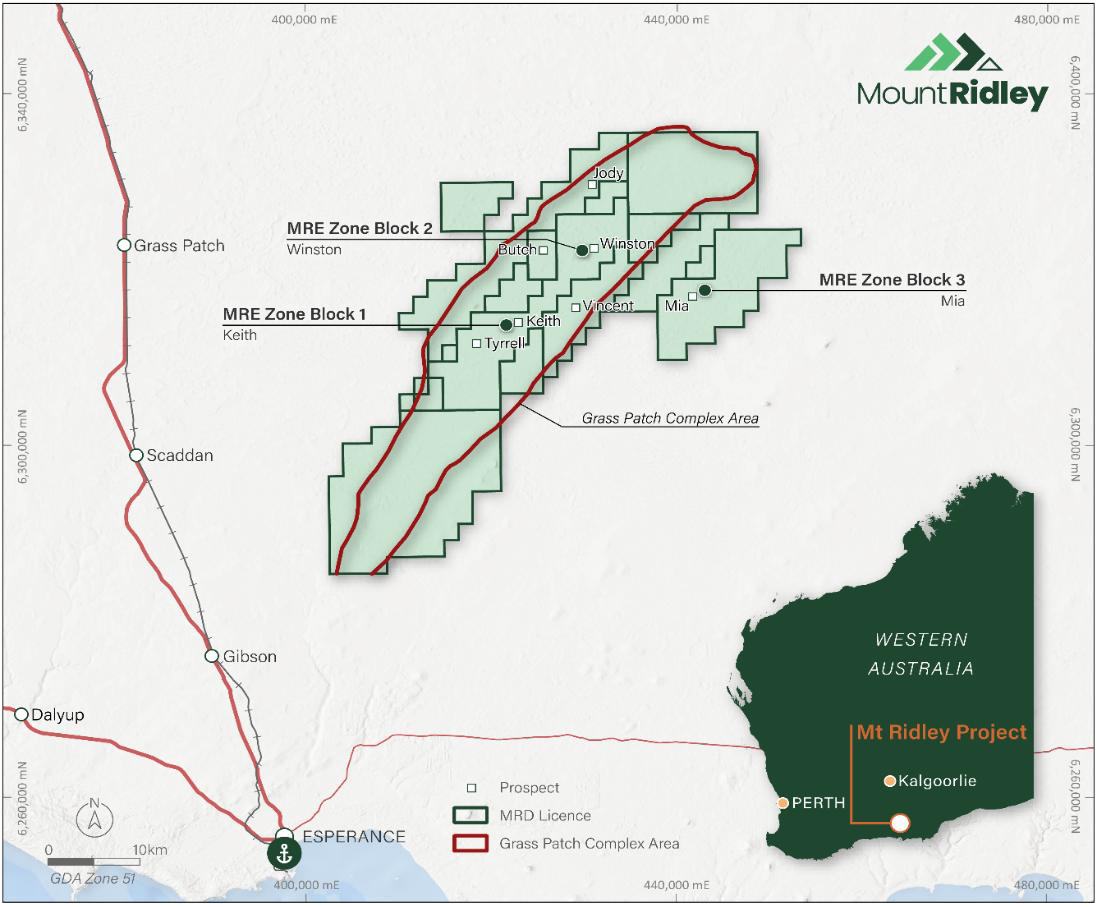
For personal use only Figure 1 – Location of the Mount Ridley Project in 25km north of Esperance, Western Australia
Phase 1 Scandium Re-Assay Program Further Phase 1 results from historical drill material at Block 2 were received during the quarter following the favourable heavy rare earth leach responses. The re-assays confirmed scandium mineralisation beyond the previous Resource boundaries in multiple directions.
Significant intersections included:
- 19m at 127.68ppm Sc₂O₃ from 20m in MRDD034;
- 24m at 114.54ppm Sc₂O₃ from 24m in MRAC0943; and
- 19m at 114.25ppm Sc₂O₃ from 33m in MRAC1030.
These intersections exceeded the previous Block 2 Resource average of 86.9ppm Sc₂O₃. Together with the previously reported Block 1 results, the findings completed the assessment of the Phase 1 reassay dataset against the footprint and grade of both Resource areas and provided a stronger technical basis for subsequent resource evaluation.
Re-Assay Results confirm High-grade Scandium Mineralisation The Block 2 scandium re-assay program improved the understanding of mineralisation across the deposit, confirming extensive near-surface, high-grade zones beyond the previous Mineral Resource Estimate (MRE) boundaries. Higher-grade mineralisation occurs throughout the deposit, with strong grade continuity across multiple drill traverses, validating the continuity of the scandium-rich laterite profile. The results demonstrate substantial potential for resource expansion through further reassaying, infill drilling and step-out exploration.
Phase 1 re-assays identified high-grade scandium mineralisation beyond the northern, southern, eastern and western margins of the previous MRE. Thick intersections along the southern and eastern extensions included multiple intervals exceeding 100 ppm Sc₂O₃, indicating that higher-grade mineralisation extended beyond the previously defined resource boundaries. The results showed mineralisation remained open to the south, with strong continuity of grade and thickness along the eastern margin.
Strong northern and western intercepts, together with relatively limited historical drilling, provide scope to define further mineralisation and convert unclassified zones into additional Mineral Resources. Collectively, the results indicate that the current MRE captures only part of a broader mineralised footprint, with strong potential to materially increase resource tonnage and contained scandium and provide multiple high-priority targets for follow-up drilling.
Strategic Plans and Forward Work
The Company is advancing Selectro™ towards pilot-scale validation, with engineering firms engaged in discussions on a scoping study to inform the design and costing of a planned demonstration plant. Testing on other deposit types and feedstocks is also being planned. For personal use only Process optimisation and ore-to-metal development are supported by a Materials Transfer Agreement with Oak Ridge National Laboratory, ongoing engagement with Lawrence Livermore National Laboratory and evaluation of Grass Patch samples by Fraunhofer in Germany.
Significant Scandium Mineral Resource Upgrade
The Grass Patch Project now hosts the world’s largest publicly reported JORC-compliant scandium resource. The upgraded Inferred Mineral Resource comprises 946Mt @ 50.1 ppm scandium (76.8 ppm Sc₂O₃), containing 47,357 tonnes of scandium metal and 72,637 tonnes of Sc₂O₃, reported at a 25 ppm scandium cut-off.
The upgrade incorporated re-assays of 3,271 historical aircore and diamond drill pulp samples across Blocks 1 and 2, confirming broad, near-surface scandium mineralisation beyond the previous Resource boundaries. Numerous intersections exceeded the previous average resource grade, while many drillholes ended in mineralisation, indicating further growth potential at depth and laterally. 3
Approximately 80% of the Project’s tenure remains untested for scandium mineralisation. The occurrence of scandium and gallium within the same regolith profile supports the Company’s Selectro™ processing strategy, which is designed to recover scandium, gallium and heavy rare earth elements through a single leach circuit. This co-location offers potential for shared material handling and processing infrastructure, which could provide capital and operating cost efficiencies compared with separate single-commodity operations. The Project’s proximity to Esperance and established deepwater port, road and power infrastructure provides logistical advantages for future development.
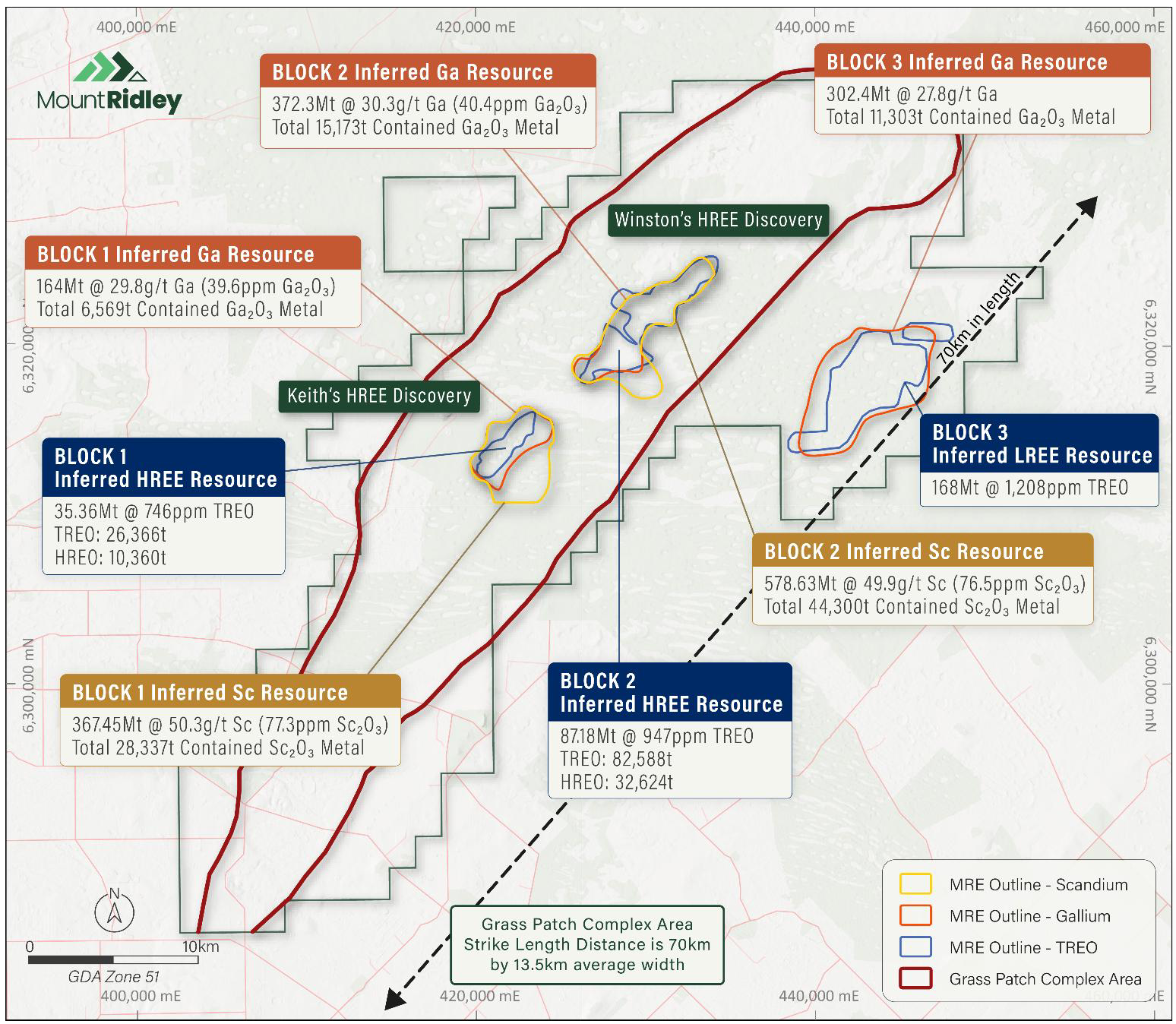
For personal use only Figure 2-Mount Ridley Scandium Topographic Location Map highlighting the MRE Zones
At Block 1, near-surface scandium mineralisation extends across the weathered zone, with scope for resource growth along an approximately 4km open trend to the south-west. The presence of established gallium and rare earth resources in the same area further supports the multi-element nature of the Grass Patch mineral system. 4
At Block 2, the extent of mineralisation has yet to be fully defined, with further re-assay work assessing potential extensions beyond the existing Resource boundaries. The area also contains defined gallium and heavy rare earth resources, including the 87.18Mt Winston HREE Mineral Resource.
TIMA Study Confirms Phosphate-hosted Rare Earths
During August, the Company reported results from an automated mineralogical study undertaken by AXT Pty Ltd using the TESCAN Integrated Mineral Analyzer (TIMA), an automated scanning microscopy platform to identify and map minerals at a microscopic scale. The study identified rare earth elements predominantly within three discrete phosphate mineral groups in the tested Grass Patch composite: xenotime, crandallite group phosphates and monazite/rhabdophane. 5
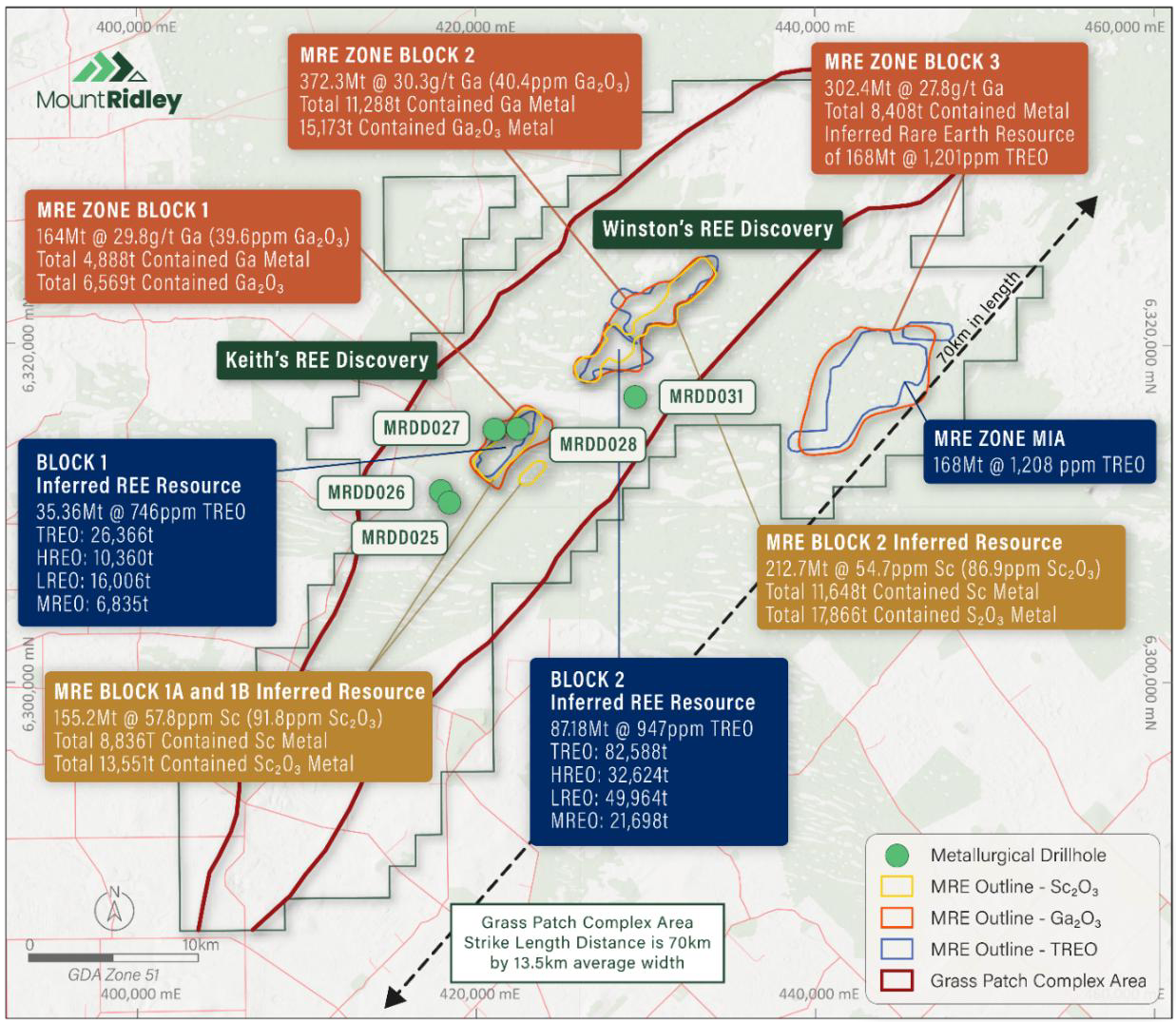
Figure 3 – Location of the Grass Patch TIMA samples
Xenotime, a potential host for valuable heavy rare earth elements, was the most common of the identified phosphate minerals. These minerals occurred within material composed predominantly of clay, with smaller amounts of pyrite and quartz. The findings support investigation of flotation to concentrate rare earth-bearing minerals before leaching. Bench-scale testwork across different For personal use onlygrind sizes is intended to assess mineral liberation, concentrate grades and recoveries, and determine whether beneficiation could reduce the volume of material requiring subsequent treatment.
SELECTRO™ PROCESS
The Selectro™ Process is Mount Ridley’s wholly owned and patent-pending leach technology. It was initially designed to recover multiple critical minerals simultaneously from a single leach circuit, operating as a closed loop system with reagent recycling and a materially lower reagent cost profile than conventional hydrochloric acid leaching. On the Company’s Grass Patch feed, Selectro™ has demonstrated high recoveries of scandium, heavy rare earth elements and gallium. Selectro™ has now also demonstrated its ability to recover other metals, including aluminium and iron, from a thirdparty bauxite feed, with further third-party testwork scheduled on a range of different feedstocks. 6
Initial Selectro™ Testwork Results
Independent metallurgical testwork undertaken by Nagrom Pty Ltd using the Company’s proprietary Selectro™ Process demonstrated recovery of heavy rare earth elements (HREE), light rare earth elements (LREE), scandium and gallium from unbeneficiated Grass Patch material through a single leach process. Reported recoveries included approximately 77–83% for HREE, 70–75% for LREE, 80% for scandium and 56% for gallium.
The comparative laboratory-scale tests used approximately 90g subsamples from a 16.8kg homogenised composite prepared from five historical Grass Patch diamond drill holes. Both the hydrochloric acid (HCl) baseline and Selectro™ tests ran for 24 hours at atmospheric pressure, with Selectro™ achieving maximum recoveries in under four hours.
Selectro™ recoveries materially exceeded the comparative HCl results, including gallium recovery, for which the baseline test returned no recovery. These initial laboratory results support further evaluation through beneficiation, reagent optimisation and larger-scale testwork.
Selectro™ Provisional Patent Application
The Company reported that a provisional patent application had been lodged for the Selectro™ Process on 19 August 2026, following initial unoptimised metallurgical results that more than doubled the average recovery across the Company’s critical mineral suite compared with the HCl baseline. The technology was developed over more than a decade by Chief Technology Officer Chris Larder.
The intellectual property is held through Mount Ridley Tech Pty Ltd, with Mount Ridley retaining full ownership under its consulting agreement with Mr Larder. No third party holds an ownership or coownership interest. The filing establishes a priority date and provides a 12-month window to pursue patent protection in Australia and overseas.
Selectro™ incorporates lower-cost reagents and a closed-loop recycling system, offering potential processing cost and environmental benefits through reduced reagent consumption and discharge. The Company has also initiated bulk testwork incorporating flotation and further process optimisation For personal use only to inform its processing strategy and scoping study inputs. Potential commercialisation pathways include development at Grass Patch, third-party licensing and technical collaboration.
Selectro™ Leach Test 3 Result
Selectro™ Test 3 delivered improved scandium and rare earth recoveries using approximately half the reagent dose applied in Tests 1 and 2. Scandium recovery increased from 80.0% to 91.8%, while HREE recoveries reached up to 86%, averaging 84%. LREE recoveries reached up to 81%, averaging 77%. Both HREE and LREE recoveries exceeded those achieved in Test 2.
Gallium recovery decreased to approximately 41.5%, compared with 55.8% in Test 2, highlighting the differing responses of individual elements to reagent concentration and leach chemistry. Further beneficiation and process optimisation may improve gallium recovery.
Testing used the same unbeneficiated Grass Patch composite. The Company considers these results a foundation rather than a ceiling. 7
Flotation Testwork
Mount Ridley has engaged highly regarded flotation specialist Dr Kwan Wong to assist with interpretation of the first flotation testwork data and to design the remaining tests in the program. Dr Wong brings extensive rare earth flotation experience, including flotation optimisation at Lynas Rare Earths’ Mt Weld operation and Hastings Technology Metals’ Yangibana project.
The first of three flotation tests on Grass Patch composite material had been undertaken at Nagrom, with the testwork data to be processed and interpreted by Dr Wong as part of the ongoing program. Dr Wong has also reviewed the Company’s TIMA mineralogical data and identified opportunities to optimise the flotation reagent scheme based on the characteristics of the Grass Patch mineralogy. These refinements will be incorporated into the remaining flotation tests.
The flotation program is designed to assess the potential to concentrate rare earth minerals ahead of Selectro™ processing. Subject to the successful production of a suitable flotation concentrate, the material will undergo Selectro™ leach testing to assess the potential benefits of processing a beneficiated feed. 8
Reagent Efficiency Process Optimisation
Higher scandium and rare earth recoveries at approximately half the previous reagent dose indicate potential to further reduce reagent costs and improve recycling efficiency as Selectro™ advances towards bulk sample and pilot-scale testing.
These results were achieved before any optimisation of the Selectro™ Process. In the Leach 3 Test, Selectro™ recovered 91.8% of scandium, up to 86% of HREE (averaging 84%) and up to 81% of LREE (averaging 77%). The improvement in recoveries at a lower reagent dose shows the process responds to adjustment of its operating conditions. The Company believes optimising Selectro™ for individual feedstocks has the potential to further improve recovery efficiency, providing significant headroom as the technology is scaled up and deployed on additional feedstocks.
Scandium Downstream Development – CSIRO Research
During the quarter, the Company secured co-funding under the CSIRO Kick-Start program for a collaborative research project evaluating downstream scandium development opportunities. The project has a total budget of $104,000, with CSIRO contributing up to $50,000 and the Company funding the balance.
The project, titled Scandium Alloys for Additive Manufacturing: Stage 1, will be undertaken by researchers at CSIRO’s Lab22 additive manufacturing facility. It will assess potential applications for scandium-containing alloys in aerospace, defence, advanced manufacturing and robotics. The research scope includes reviewing the patent landscape, identifying global suppliers of scandium materials, evaluating promising application areas and assessing emerging extraction, processing and refining technologies.
The resulting report will be the Company’s intellectual property and is intended to inform a subsequent Stage 2 program focused on scandium-based materials development. The initiative supports evaluation of higher-value downstream opportunities alongside the Company’s resource and processing activities.
Phase 2 Scandium Re-assay Program At the end of the quarter, Phase 2 re-assays of historical drill samples confirmed extensive shallow, high-grade scandium mineralisation beyond the expanded Block 1 and Block 2 Mineral Resource boundaries. Mineralisation was identified up to 8km beyond the existing resource areas, supporting further resource growth potential.
At Block 1, mineralisation extends approximately 4–5km south and south-east of the current Resource boundary. At Block 2, results identified extensions approximately 7–8km to the north and 4–5km to the west and north-west. Mineralised intersections between the two resource areas also indicate potential continuity across the intervening corridor.
Significant results included 22m @ 119.41 ppm Sc₂O₃ from 12m in MRAC1036 and 40m @ 102.09 ppm Sc₂O₃ from 18m in MRAC1040, with both holes ending in mineralisation. These results highlight opportunities for further evaluation through re-assaying, infill and step-out drilling. 9
Phase 2 results have yet to be incorporated into the current 946Mt Inferred Mineral Resource. Further modelling will assess potential resource expansion and classification upgrades. An additional 2,800 historical sample pulps were delivered to the laboratory on 21 September 2026 for Phase 3 reassaying.
Subsequent Events Selectro™ Third-Party Feed Testing
Following quarter end, on 15 October 2026, the Company reported initial Selectro™ testwork on a bauxite composite supplied by Australian Silica Quartz Group Ltd from its Darling Range project in Western Australia. Independent testing by ALS returned recoveries of 91.9% aluminium and 96.7% iron, marking the first application of Selectro™ to third-party material outside Grass Patch.
The test used an approximately 1kg composite prepared from 16 samples across four historical drillholes at the Athena and Ceres prospects. Leaching produced a small, pH-neutral, silica-rich residue representing approximately 25% of the original feed mass, with more than 90% of the silica remaining in the residue. These initial laboratory results highlight potential applications beyond Grass Patch, although the selected composite is not intended to represent the broader bauxite deposit.
The results support accelerating the design and construction of a demonstration plant to enable larger-scale testing of both Grass Patch material and third-party feedstocks. As further testwork progresses, the Company intends to assess commercialisation opportunities through strategic partnerships and licensing arrangements.
Further assays confirmed 95% gallium recovery from the same test. Aluminium, iron and gallium were For personal use onlyextracted into solution through a single leach conducted below 100°C, highlighting Selectro™’s potential to recover multiple metals from third-party bauxite feed.
Further work will focus on separation and purification pathways for bauxite and Grass Patch feeds, , alongside a second bauxite test to try and improve the leach chemistry. Additional third-party testing will assess the process across different feedstocks, while demonstration plant development will support evaluation at larger scale.
Second Selectro™ Provisional Patent Application Subsequent to the quarter end on 19 October 2026, the Company announced that its wholly owned subsidiary, Mount Ridley Tech Pty Ltd, had lodged a second provisional patent application with IP Australia on 15 October 2026. The application covers adaptations of the Selectro™ chemistry for industrial metal feedstocks, including bauxite. It is separate from the original application covering critical mineral recovery from Grass Patch material, allowing each application to progress independently and supporting flexibility in future licensing, partnerships and commercialisation. Both applications remain patent-pending. 10
Appointment of Chemist
Mount Ridley has appointed Ms Shirin Lashgari as Chemist on a full-time basis, commencing on 9 November 2026. Ms Lashgari holds a Master of Science in Chemistry and brings more than ten years of laboratory and research experience. Most recently she spent four years with ALS Metallurgy in Perth as an Analytical and Pilot Laboratory Analyst. At ALS she carried out bench and pilot scale hydrometallurgical testwork including leaching, solvent extraction and precipitation, along with assay and instrumental analysis using MP-AES and UV-Vis spectrophotometry. During this time she worked on the first Selectro™ test on bauxite feed.
Before joining ALS, Ms Lashgari was an R&D Chemist responsible for research programs, standard operating procedures and technical reporting. Her postgraduate research focused on surfactant behaviour in surface and colloid chemistry, with findings published in peer-reviewed journals. This background is directly relevant to flotation reagent chemistry as the Company redesigns its flotation program.
At Mount Ridley, Ms Lashgari will be responsible for the chemistry underpinning optimisation of the Selectro™ Process and reagent recycling. She will work with the Company's technical team on testwork design and support the broader Selectro™ Process commercialisation activities.
CORPORATE
Placements During the quarter, the Company completed a placement of 60,606,100 fully paid ordinary shares at $0.033 per share, raising approximately $2 million before costs. The shares were issued on 11 September 2026 following the placement announcement on 4 September. Proceeds support flotation, bulk metallurgical testwork, scoping studies, resource definition and optimisation of the Selectro™ Process, together with ongoing exploration at Grass Patch, corporate costs and general working capital. Directors also committed to an additional $100,000 on the same terms, subject to shareholder approval.
For personal use only Appointment of Chief Technology Officer On 22 July 2026, Mr Chris Larder was promoted to Chief Technology Officer (CTO), following his appointment as Technical Advisor – Metallurgy and Processing on 29 April 2026. The promotion recognises his significant technical contribution to the Company’s processing development and metallurgical testwork programs, which form a key part of its development pathway.
Mr Larder is a process engineer with over 30 years of experience in mineral processing, including the design and optimisation of complex hydrometallurgical flowsheets and gallium processing systems in Western Australia. His expertise spans metallurgical testwork design and oversight, flowsheet development and support for pilot-scale programs across a range of commodities. His appointment strengthens the Company’s internal technical capability and provides dedicated oversight of its metallurgical programs and processing strategy. 11
OTCID Market Quotation
On 17 July 2026, Mount Ridley announced that its ordinary shares had commenced quotation on the US OTC Markets platform under the OTCID ticker MRDMF, allowing US investors to trade its existing shares in US dollars through standard brokerage platforms.
The quotation forms part of the Company’s strategy to broaden access to US institutional and strategic investors as it advances its critical minerals portfolio and downstream development programs. It builds on investor engagement undertaken in New York during 2026. Mount Ridley retains its primary listing on the ASX.
Annual General Meeting Subsequent to the quarter end, on 19 October 2026, the Company released its Notice of Annual General Meeting. The AGM is scheduled for Thursday, 19 November 2026 at 11:00am WST, at Level 2, 7 Havelock Street, West Perth.
Additional ASX Information
Summary of Exploration Expenditure (ASX Listing Rule 5.3.1) In accordance with Listing Rule 5.3.1, the Company advises that cash outflows on mining exploration activities reported in item 1.2(a) of its Appendix 5B for the September 2026 quarter were $400,620, comprising $361,605 on the Mount Ridley Project and $39,015 on the Weld Range West Project.
Mining Production and Development (ASX Listing Rule 5.3.2) There were no substantive mining production and development activities during the quarter.
Payment to Related Parties (ASX Listing Rule 5.3.5) The Company advises the payments in section 6.1 of Appendix 5B for the quarter related to Director fees. For personal use only
This ASX announcement has been authorised for release by the Board of Mount Ridley Mines Ltd.
For further information, please contact:
Competent Persons Statement The information in this report / ASX release that relates to Exploration Results, Exploration Targets and Mineral Resources is based on information compiled and reviewed by Mr. Alfred Gillman, Director of independent consulting firm, Odessa Resource Pty Ltd. Mr. Gillman, a Fellow and Chartered Professional of the Australasian Institute of Mining and Metallurgy (the AusIMM) and has sufficient experience relevant to the styles of mineralisation under consideration and to the activity being reported 12 Exploration Targets and Mineral Resources. Mr Gillman is a full-time employee of Odessa Resource Pty Ltd, who specialises in mineral resource estimation, evaluation, and exploration. Neither Mr Gillman nor Odessa Resource Pty Ltd holds any interest in Mount Ridley Mines, its related parties, or in any of the mineral properties that are the subject of this announcement. Mr Gillman consents to the inclusion in this report / ASX release of the matters based on information in the form and context in which it appears. Additionally, Mr Gillman confirms that the entity is not aware of any new information or data that materially affects the information contained in the ASX releases referred to in this report. The information in this report that relates to Exploration Targets and Exploration Results is based on historical information compiled by Pedro Kastellorizos. Mr. Kastellorizos is a technical advisor of Mount Ridley Mines Ltd and is a Member of the AusIMM of whom have sufficient experience relevant to the styles of mineralisation under consideration and to the activity being reported to qualify as a Competent Person as defined in the 2012 Edition of the Australasian Code for Reporting of Exploration Results, Mineral Resources and Ore Reserves. Mr. Kastellorizos has verified the data disclosed in this release and consent to the inclusion in this release of the matters based on the information in the form and context in which it appears. Mr Kastellorizos has reviewed all relevant data for the aircore drilling program and reported the results accordingly. The information in this announcement that relates to metallurgical results is based on information compiled and reviewed by Mr Chris Larder, a Fellow of the AusIMM. Mr Larder is the Chief Technology Officer of Mount Ridley Mines Limited and has sufficient experience relevant to the metallurgical testwork and processing of the style of mineralisation under consideration to qualify as a Competent Person as defined in the 2012 Edition of the Australasian Code for Reporting of Exploration Results, Mineral Resources and Ore Reserves. Mr Larder consents to the inclusion in this announcement of the matters based on his information in the form and context in which they appear. The Company confirms that it is not aware of any new information or data that materially affects the Mineral Resource Estimates referred to in this announcement and that all material assumptions and technical parameters underpinning those estimates continue to apply and have not materially changed.
Forward-Looking Statement
This news release contains “forward-looking information” within the meaning of applicable securities laws. Generally, any statements that are not historical facts may contain forward-looking information, and forward looking information can be identified by the use of forward-looking terminology such as “plans”, “expects” or “does not expect”, “is expected”, “budget” “scheduled”, “estimates”, “forecasts”, “intends”, “anticipates” or “does not anticipate”, or “believes”, or variations of such words and phrases or indicates that certain actions, events or results “may”, “could”, “would”, “might” or “will be” taken, “occur” or “be achieved.” Forward-looking information is based on certain factors and assumptions management believes to be reasonable at the time such statements are made, including but not limited to, continued exploration activities, commodity prices, the estimation of initial and sustaining capital requirements, the estimation of labour costs, the estimation of mineral reserves and resources, assumptions with respect to currency fluctuations, the timing and amount of future exploration and development expenditures, receipt of required regulatory approvals, the availability of necessary financing for the project, permitting and such other assumptions and factors as set out herein. For personal use only Forward-looking information is subject to known and unknown risks, uncertainties and other factors that may cause the actual results, level of activity, performance or achievements of the Company to be materially different from those expressed or implied by such forward-looking information, including but not limited to: risks related to changes in commodity prices; sources and cost of power and water for the Project; the estimation of initial capital requirements; the lack of historical operations; the estimation of labour costs; general global markets and economic conditions; risks associated with exploration of mineral deposits; the estimation of initial targeted mineral resource tonnage and grade for the project; risks associated with uninsurable risks arising during the course of exploration; risks associated with currency fluctuations; environmental risks; competition faced in securing experienced personnel; access to adequate infrastructure to support exploration activities; risks associated with changes in the mining regulatory regime governing the Company and the Project; completion of the environmental assessment process; risks related to regulatory and permitting delays; risks related to potential conflicts of interest; the reliance on key personnel; financing, capitalisation and liquidity risks including the risk that the financing necessary to fund continued exploration and development activities at the project may not be available on satisfactory terms, or at all; the risk of potential dilution through the issuance of additional common shares of the Company; the risk of litigation. Although the Company has attempted to identify important factors that cause results not to be as anticipated, estimated or intended, there can be no assurance that such forward-looking information will prove to be accurate, as actual results and future events could differ materially from those anticipated in such information. Accordingly, readers should not place undue reliance on forward-looking information. Forward-looking information is made as of the date of this announcement and the Company does not undertake to update or revise any forward-looking information that is included herein, except in accordance with applicable securities laws. 13
About Mount Ridley Resource Estimations
The Company is not aware of any new information or data that materially affects the information included in the original market announcement and all material assumptions and technical parameters underpinning the Mineral Resources for all Projects continue to apply and have not materially changed.
Board
Principal Place of Business
Forward Shareholder Enquiries to Automic Registry Services
Issued Share Capital
As at the date of this report, the total fully paid ordinary shares on issue were 1,390,302,536.
TENEMENT INFORMATION (ASX Listing Rule 5.3.3)
1. Subject to the Zeedam Enterprises Pty Ltd Royalty Agreement. 2. Pending exploration licence application covering the area previously held under surrendered tenement E20/986. 15
Appendix 5B
Compliance statement 1 This statement has been prepared in accordance with accounting standards and policies which comply with Listing Rule 19.11A. 2 This statement gives a true and fair view of the matters disclosed.
Date: 30 October 2026 Authorised by: Kieran Witt