

NVIDIA's Dominance in AI Technologies
ED
Editorial
Cashu Finance·5 min read
TL;DR
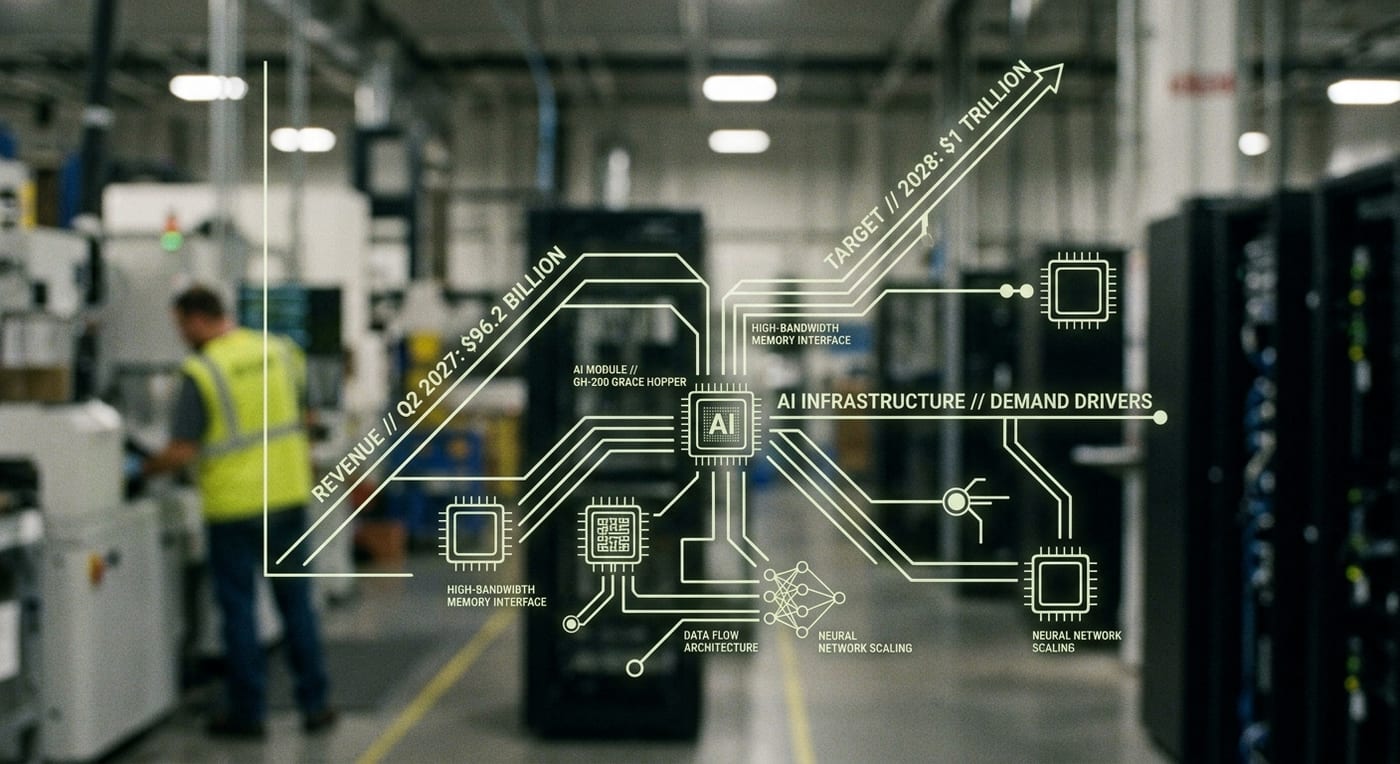
- NVIDIA reports $96.2 billion in revenue for Q2 2027.
- Strategic acquisitions and investments aim for $1 trillion in revenue by 2028.
- Strong demand for AI infrastructure fuels future growth prospects.
NVIDIA Corporation (NVDA) continues to illustrate its leading position within the rapidly evolving AI landscape. The company's recent financial performance showcases how it has effectively capitalized on the growing demand for powerful computing solutions necessary for advanced AI technologies. With a staggering revenue of $96.2 billion for Q2 2027, representing a 106% year-over-year increase, NVIDIA is not merely riding the AI wave; it is fundamentally shaping its course.
The company's impressive revenue surge can be significantly attributed to its robust data center operations, which alone generated $89 billion, reflecting a remarkable 117% growth. This pivotal area not only exemplifies NVIDIA's extensive market share but also highlights its essential role in powering the infrastructures that underlie numerous AI applications in various sectors such as healthcare, finance, and autonomous vehicles. As more businesses adopt AI technologies, NVIDIA's dominance in providing the necessary hardware positions it favorably for ongoing and future success.
Strategic Investments and Acquisitions
NVIDIA's strategy involves substantial investments in innovation and infrastructure to support its growth trajectory. Recent reports reveal that the company is on track to achieve an ambitious goal of $1 trillion in revenue by 2028, underscored by its strategic acquisitions and enhancements to its technology portfolio. Notably, the acquisition of Hugging Face for $12.9 billion reflects NVIDIA's commitment to enriching its software ecosystem, providing clients with cutting-edge AI solutions that integrate seamlessly with its hardware.
As noted in previous analyses, NVIDIA's growth has been commensurate with a booming demand for AI infrastructure, which, coupled with its strategic positioning, sets the stage for unparalleled future growth. Initiatives to secure supply chains and reduce dependency on external semiconductor manufacturers also reinforce NVIDIA's capacity to deliver on its promises. Such measures not only enhance operational resilience but also fortify its competitive edge in an industry characterized by constant evolution.
The Competitive Landscape
Despite NVIDIA's monumental achievements, the competitive landscape is fraught with challenges. The semiconductor industry is known for its cycles, prompting caution among investors regarding the sustainability of NVIDIA's current growth. However, key indicators suggest a persistent demand for NVIDIA's products. For instance, even older versions of its chips have maintained high rental values, illustrating their ongoing market relevance despite the introduction of newer technologies. In recent months, the rental prices for the H100 GPUs have risen by 22% over the previous month, signifying a robust demand even alongside the anticipated debut of the next-generation Rubin platform.
This remarkable durability stands in contrast to the bearish arguments championed by some investors, who fear that the company’s competitive advantage may erode as clients turn to in-house chip solutions. However, the resilience in the pricing of NVIDIA's established products indicates a deep-rooted value that transcends mere technological advancements. From a technical perspective, the notion that NVIDIA chips rapidly depreciate has been debunked; instead, their value remains buoyant in an environment where demand continues to climb.
Future Projections and Market Position
NVIDIA's projections for growth in fiscal year 2028 stand at an impressive 70%, which most analysts agree is conservative given the burgeoning need for AI technologies across industries. Despite its market cap exceeding $5 trillion, NVIDIA still trades at a relatively modest 25 times forward earnings, a valuation that implies the market hasn't fully priced its growth potential. Investors may find this a compelling opportunity, especially in light of NVIDIA's established leadership and proven track record in delivering high-performance computing solutions.
While comparing its valuation to the broader S&P 500 serves as a reminder of NVIDIA's attractiveness, it is essential to consider the potential for substantial growth as industries redefine their operational frameworks around AI. Meticulous analysis shows that the advancements made in AI processing capabilities are still in their early stages, with NVIDIA at the forefront of this transformation.
Conclusion: The Road Ahead
As NVIDIA Corporation continuously adapts to a volatile market landscape, its strong foundation in AI technologies underscores a narrative of persistent growth and innovation. The combination of rapid financial expansion, strategic acquisitions, and a durable product value holds promise for the company’s prospects in the years to come. As seen in its recent earnings and aggressive growth strategy, NVIDIA is well into a transformative journey that reinforces its role as a pivotal player in the AI industry.
Undoubtedly, investors and market analysts will be closely monitoring NVIDIA’s trajectory as it seeks to navigate both opportunities and challenges in this dynamic environment. The potential for continued revenue growth remains bright, and even amidst skepticism regarding long-term sustainability, the evidence increasingly supports the company's enduring leadership in the AI space. In essence, NVIDIA’s story reflects not only a financial behemoth but also an embodiment of technological evolution integral to future societal advancements. The same pressure is reflected in recent reporting on the issue, which helps explain why the company's pricing decisions remain under scrutiny.