

NVIDIA's Ascent in the AI Landscape
ED
Editorial
Cashu Finance·5 min read
TL;DR
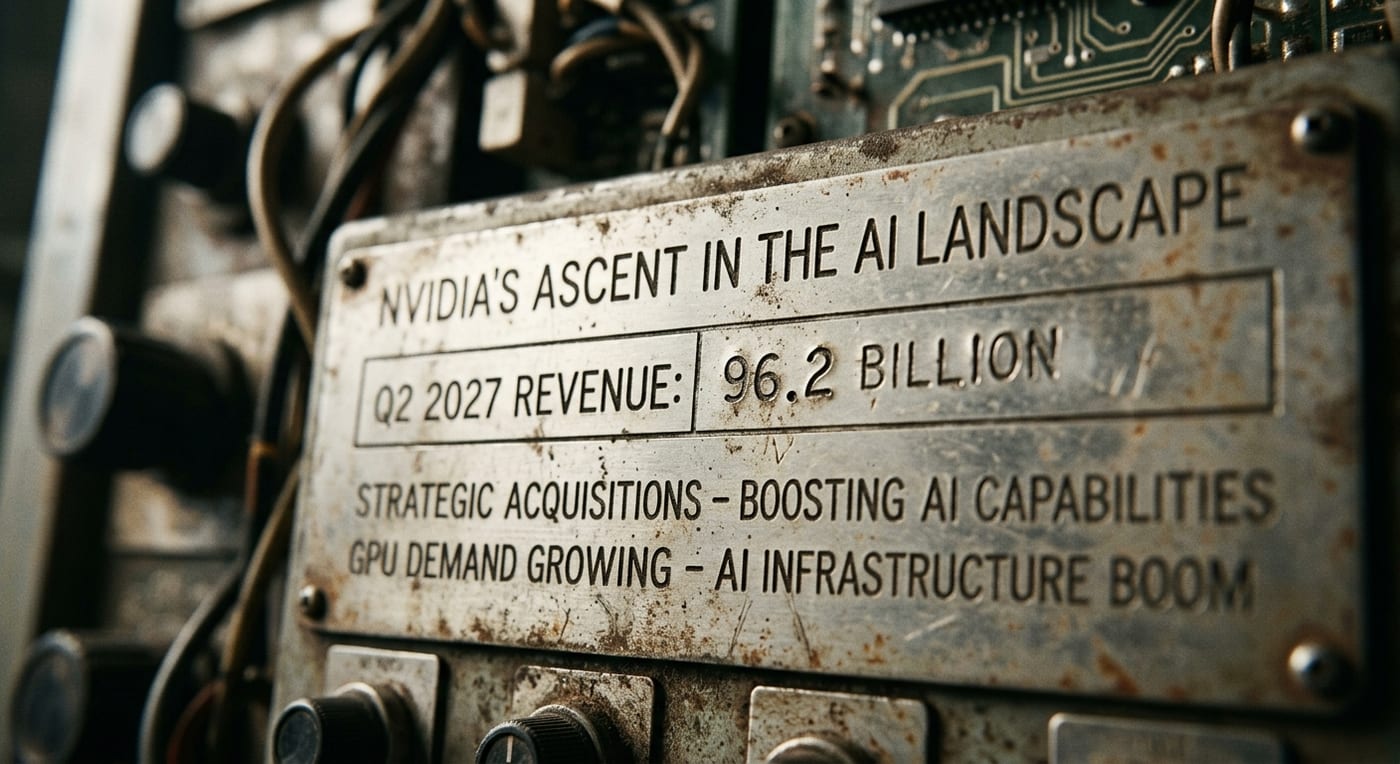
- NVIDIA reports $96.2 billion revenue in Q2 2027.
- Strategic acquisitions boost AI capabilities and market reach.
- Demand for GPUs expected to grow amid AI infrastructure boom.
NVIDIA Corporation (NVDA) has firmly established itself as a leading player in the artificial intelligence (AI) sector, showcasing remarkable growth and a strong outlook driven by surging demand for its advanced GPU technologies. The company's recent financial performance underscores its pivotal role in powering an AI-driven economy, as evidenced by record-breaking revenue that reveals where the tech giant is headed in the coming years.
Exceptional Financial Performance
NVIDIA's financial results for the second quarter of fiscal 2027 are nothing short of astonishing, with total revenue reaching $96.2 billion—an impressive 106% increase year-over-year. This remarkable growth can largely be attributed to the soaring demand for AI infrastructure, with its data center division alone generating $89 billion in revenue. This unprecedented demand is not just a short-term phenomenon; it's a fundamental shift in the tech landscape driven by a growing reliance on AI technologies across various sectors.
One of the most remarkable aspects of NVIDIA's success is its ability to outpace even its own ambitious forecasts. Management anticipates that sales could increase by 70% in fiscal 2028, yet there are indications that growth could double if supply constraints are managed effectively. This insight into NVIDIA's growth trajectory demonstrates its strategic approach and keen market positioning, with CEO Jensen Huang noting the extraordinary demand for its compute power. He stated, "The amount of compute necessary is just extraordinary" as AI applications evolve and the reliance on autonomous systems escalates.
As NVIDIA continues to capitalize on this growth, it remains crucial for investors to understand how these figures translate into strategic initiatives and long-term goals. Looking ahead, NVIDIA is aiming for an ambitious target of $1 trillion in revenue by 2028, a trajectory that underscores its leadership in the AI sector and reflects its broad vision for the tech industry.
Strategic Acquisitions and Expansions
NVIDIA's remarkable growth strategy includes not only an emphasis on innovation within its graphics processing unit (GPU) offerings but also strategic acquisitions. Notably, NVIDIA's acquisition of Hugging Face has significantly bolstered its AI capabilities, particularly in natural language processing. This acquisition aligns with NVIDIA's commitment to enhancing its software stack and solidifying its position in the AI market, enabling it to deliver advanced solutions to a growing customer base.
Furthermore, with the AI industry projected to see capital expenditure reaching between $3 trillion and $4 trillion by 2030, NVIDIA finds itself well-aligned with market demands. The big five AI hyperscalers alone are expected to spend nearly $800 billion on data centers this year, enhancing NVIDIA's prospects for continued growth amid increasing global competition for advanced AI technologies.
Competitive Landscape and Market Positioning
While NVIDIA stands out as a market leader, it also faces competition and regulatory challenges that could impact its growth trajectory. The recent U.S.-China dialogues surrounding AI advancement illustrate the broader geopolitical context in which NVIDIA operates. The discussions indicate a potential for cooperation between the two nations even as they navigate competitive tensions, particularly concerning advanced technology imports. This backdrop is critical for NVIDIA as it continues to seek growth opportunities in the international market while adhering to compliance requirements.
NVIDIA's GPUs remain the preferred choice for countless AI applications largely due to their versatility and performance capability. However, the development of custom AI chips by other firms, such as AMD, is gradually reshaping the competitive landscape. While these alternatives are emerging, NVIDIA’s existing infrastructure and ecosystem are considered unbeatable in providing comprehensive solutions that cater to a wide variety of workloads, which further solidifies its competitive stance.
Future Projections and Investor Outlook
NVIDIA's stock performance and growth potential have drawn considerable attention from investors, particularly in light of recent earnings and strategic moves within the company. The decision to raise the quarterly dividend from $0.01 to $0.25 represents a remarkable 2,400% increase. However, the practical return on investment remains relatively modest compared to the company's massive growth trajectory and share buyback strategy. While this dividend increase signals a commitment to returning value to shareholders, NVIDIA's primary focus remains on growth, innovation, and capitalizing on its dominant market position.
Conclusion: Navigating an AI-Driven Future
In conclusion, NVIDIA Corporation's position as a leader in the AI space is underscored by its remarkable financial performance, strategic acquisitions, and effective navigation of a complex regulatory landscape. As demand continues to soar for its GPUs and AI solutions, NVIDIA is poised to capture a significant share of a rapidly expanding market. The company's focus on innovation and adaptability emphasizes its long-term growth potential, making it a pivotal player in shaping the future of technology.
As we look to the future, NVIDIA represents more than just a growth story; it exemplifies the transformative impact of AI on various industries, making it a central figure in the ongoing AI revolution. Investors and industry stakeholders alike will be watching closely as NVIDIA continues to innovate and expand its reach in this dynamic landscape. The same pressure is reflected in recent reporting on the issue, which helps explain why the company's pricing decisions remain under scrutiny.