

Navigating Intel's AI-Powered Future
ED
Editorial
Cashu Finance·5 min read
TL;DR
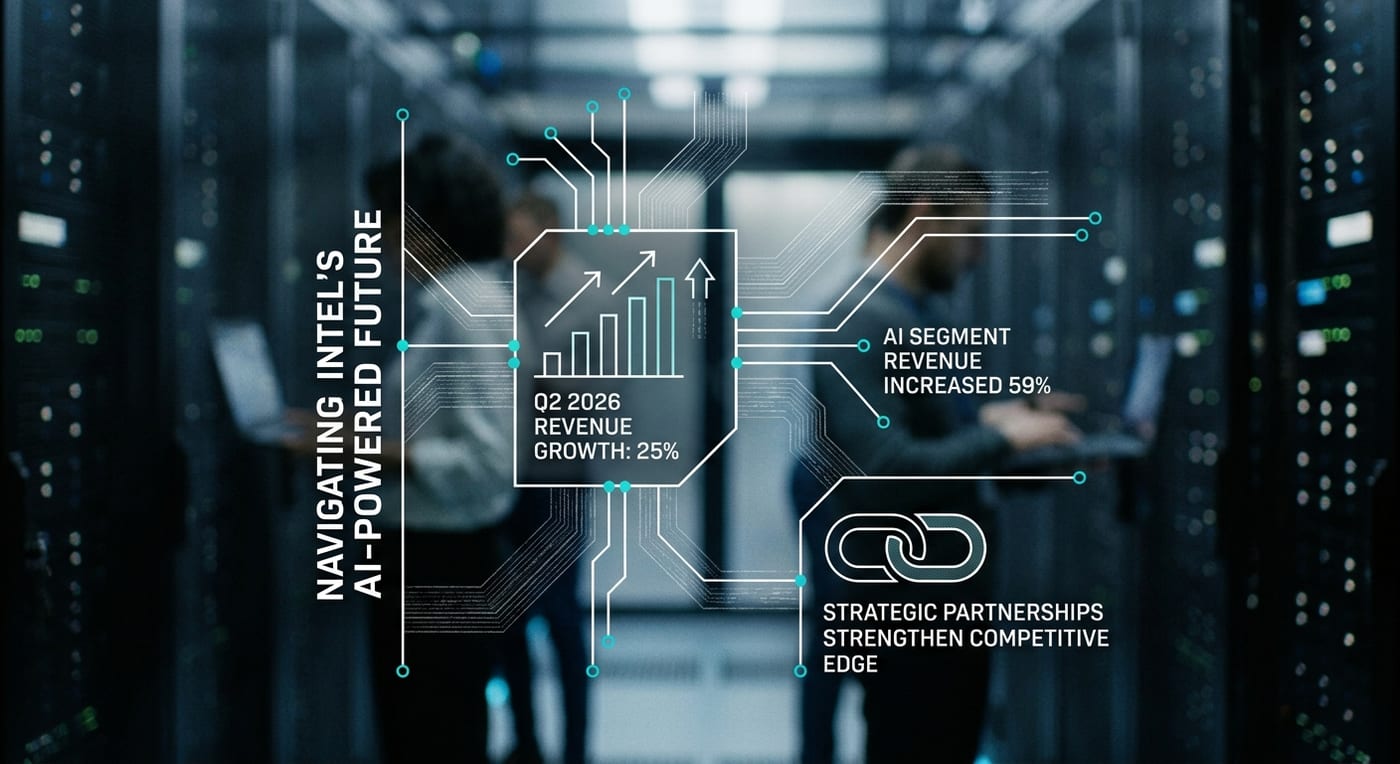
- Intel reports 25% revenue growth in Q2 2026.
- AI segment revenue increased 59%, boosting overall performance.
- Strategic partnerships strengthen Intel's competitive edge.
Intel Corp. (INTC) is undergoing a profound transformation as it pivots toward artificial intelligence (AI) technologies, reshaping its business strategy amidst an intensely competitive landscape. The recent financial results indicate a resurgence, showcasing significant revenue growth driven by its data center and AI segments. This article delves into the factors contributing to Intel's current trajectory, the competitive pressures it faces, and its strategic partnerships that enhance its market positioning.
The AI Transformation
The landscape of technology is rapidly evolving, and Intel is positioned at the forefront of this transformation. In the second quarter of 2026, the company reported an impressive total revenue of $16.1 billion, which represents a remarkable 25% increase year-over-year. Central to this growth is the AI and data center segment, which contributed $6.3 billion—a staggering 59% year-over-year growth that underscores Intel’s strategic pivot toward AI. This transition signifies a critical response to the escalating global demand for AI technologies, positioning Intel as a key player in an area once dominated by other tech giants.
As mentioned in a previous report, the substantial growth in AI revenue is not merely a reflection of recovering sales but also a testament to the effectiveness of Intel's new strategies and innovations. The strategic dedication to expanding its AI product line places Intel in direct competition with firms like AMD, which has been aggressively growing its market share in the data center segment. Intel's ability to innovate and adapt is essential for sustaining its competitive edge in the long run.
Competitive Landscape and Challenges
However, the transformation does not come without challenges. AMD’s recent surge in the data center market has surpassed Intel's expectations, leading to a tightening of competition. AMD's second-quarter revenue hit $6.7 billion, eclipsing Intel's AI revenues by $400 million. This shift illustrates how Intel is not only competing against established players but also contending with the repercussions of its historical manufacturing delays and strategic missteps that allowed competitors to gain ground.
Intel’s shift underlines a broader reaction to market dynamics. While AMD capitalizes on a faster manufacturing process through third-party foundries, Intel relies on its own fabrication capabilities, which have historically lagged behind. Intel has articulated plans to recover its competitive manufacturing advantage by committing to next-generation process technologies, which it believes will be pivotal in win-back market share lost to rivals.
Strategic Partnerships and Future Outlook
Intel's ongoing partnerships play a vital role in strengthening its market position. Collaborations with leading AI research organizations and tech companies aim to bolster its capabilities in both product development and market reach, ensuring a holistic approach toward meeting current demand and innovation needs.
Moreover, the financial stabilizing signals from Intel’s recent earnings report hint at a more robust operational focus moving forward. The reduction in losses within its foundry segment, which decreased to a loss of $2.1 billion in the last quarter, from $3.2 billion the previous year, indicates improvements in operational efficiency. This trend is seen as a foundation for long-term profitability as Intel continues to reposition itself within the semiconductor landscape.
The strategic partnerships forged with companies in the tech ecosystem fortify Intel's resources, aligning its innovations with consumer demands for advanced AI solutions. As Intel aims for leadership in the AI market, investor sentiment appears cautiously optimistic, reflecting the potential of these strategic twin routes of innovation and partnership formation.
Optimizing Revenue Streams
Intel's revenue and business model optimization are increasingly focused on the intersection of emerging technologies and customer needs. The substantial contribution of AI to total earnings is a clear indication of shifting consumer behaviors and expectations. As companies adapt to a more AI-integrated operational model, demand for high-performance computing continues to surge, which plays directly to Intel's strengths.
The ongoing reassessment of product lines to favor AI and high-performance computing solutions also signifies a broader strategy to capture greater market share from competitors and cater to evolving technology trends. This is evident as Intel enhances its research into AI-driven chip designs and expands its product lineup to capture the diverse needs of its expanding customer base.
Investor Sentiment
As Intel's financial landscape adjusts to incorporate its lasting pivot toward AI, investor sentiment has indicated growing confidence in the company's transformative journey. Understanding this shift in strategic focus allows stakeholders to grasp the potential for sustained growth in the upcoming quarters. Analysts emphasize that while Intel faces notable competition, its commitment to strategic innovation and the cultivation of partnerships are essential components for regaining its leadership position in the technology space.
In summation, Intel Corp. is navigating a critical transformation aimed at establishing a robust foothold in the evolving AI sector. The compelling trends indicated by recent financial results reflect not only a turnaround from past challenges but also the efficacy of a strategic pivot aligned with market demands. As Intel seeks to reconcile its legacy with contemporary innovations, the implications for its operational strategies remain profound. Stakeholders are encouraged to observe how Intel's narrative develops, especially in light of its competitive environment and the ongoing quest for technological leadership. The same pressure is reflected in recent reporting on the issue, which helps explain why the company's pricing decisions remain under scrutiny.