
Manhattan Gold extends Jaws gold system with shallow high-grade hits
ED
Editorial
Cashu Finance·5 min read
This article is disseminated on behalf of MHC.AX
TL;DR
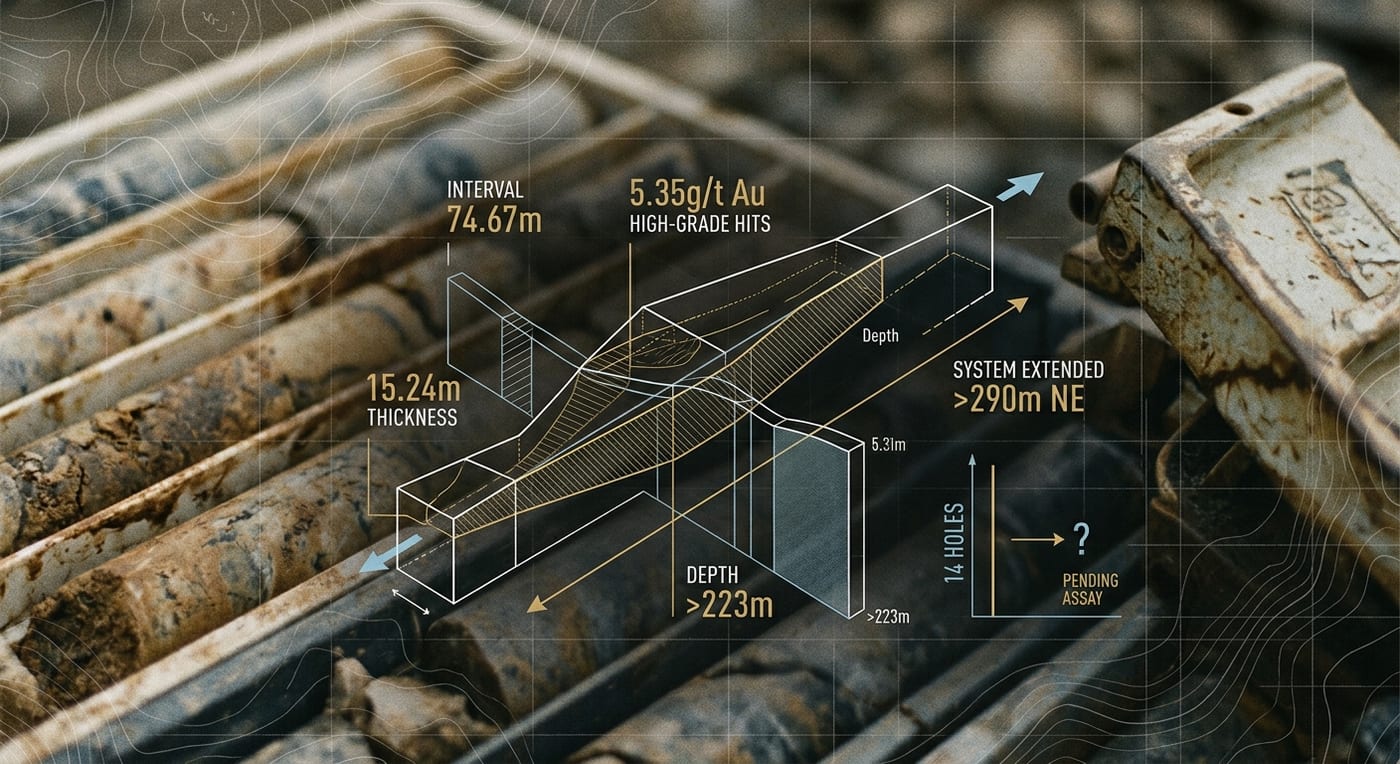
- Manhattan Gold reported 15.24m at 5.35g/t Au within a 74.67m interval at Jaws.
- Drilling extended the system more than 290m northeast and to greater than 223m vertical depth, with 14 holes pending assay.
- The results remain exploration-stage: reported widths are downhole lengths, and the historical estimate is not JORC-compliant.
On 7 September 2026, Manhattan Gold Corporation Limited (ASX: MHC) reported new reverse-circulation drilling results from the Jaws target at its Hook Lake gold and polymetallic project in Nunavut, Canada. Manhattan Gold reported 15.24m at 5.35g/t Au within a 74.67m interval at Jaws. The result came from hole JWS26009 and was reported from 35.05m downhole, reinforcing a shallow mineralised zone that the company says is continuous from nearby drilling.
Drilling expands both grade and scale
A second hole, JWS26008, returned 51.82m at 1.88g/t Au from 47.24m, including 7.62m at 7.05g/t Au from 82.30m. The same hole also intersected 41.15m at 1.06g/t Au from surface and 24.38m at 1.15g/t Au from 204.22m, including 1.52m at 3.66g/t Au. The release says this confirms mineralisation from surface to more than 223m vertically below surface, extending the system well below the depth of much of the historic drilling.
Drilling extended the system more than 290m northeast and to greater than 223m vertical depth, with 14 holes pending assay. Hole JWS26010, drilled to test quartz veining northeast of earlier work, returned 7.62m at 0.72g/t Au from 38.10m, including 1.53m at 1.39g/t Au. Manhattan says the 2026 drilling has taken the drill-tested strike at Jaws to 588m.
Eric Sondergaard, Manhattan Gold’s technical advisor, said, These results materially strengthen the case for both scale and grade at Jaws.
Why Jaws matters to Hook Lake
Jaws is the most advanced target within Hook Lake, a large exploration project in the Rankin-Ennadai greenstone belt. The project comprises 12 separate prospects covering 665 km², giving Manhattan Gold a sizeable regional exploration platform beyond the current drilling area.
The company’s release places Hook Lake in a district that also hosts Agnico Eagle’s Meliadine mine and BG Gold’s Vickers deposit. Manhattan describes Jaws as a late-1980s diamond-drilled target where historic work outlined a foreign estimate of 3.4 million tonnes at 2.38g/t Au, or approximately 285,000 ounces of gold.
That historical estimate is explicitly not reported in accordance with the JORC Code 2012. Manhattan says the underlying information and assumptions needed to classify it as a current Mineral Resource or Ore Reserve are unavailable, and that further work may not support reporting the estimate under JORC standards.
The distinction is important for interpreting the latest results. The drilling supports a larger and better-defined exploration target, but it does not establish a compliant resource, an ore reserve, or an economic development case. Manhattan’s broader portfolio also includes the Tibooburra Gold Project in New South Wales, where the company is pursuing gold exploration in the Koonenberry Gold District.
The next phase is still exploration-led
The immediate operating consequence of the Jaws results is a broader assay and targeting pipeline rather than a development decision. Manhattan says 14 drillholes remain pending assay and that drilling is returning to Jaws to test follow-up targets.
Metallurgical test work is also advancing, with samples selected for dispatch. In parallel, regional till sampling is underway across the strike extensions of Jaws and toward the Omega and Moonraker prospects. The company is using arsenic, antimony and tungsten pathfinder signatures, together with magnetic survey interpretation, to guide additional targets beneath glacial cover.
The technical disclosures provide several important qualifications. Manhattan reports that significant intercepts are calculated using a minimum gold threshold of 0.1g/t Au with no more than 4.56m of internal dilution, and that reported intervals are drilled lengths rather than true thicknesses. The company also acknowledges that some holes, including JWS26008, were drilled partly down dip and may contain an element of sampling bias.
The release further states that current data spacing is not yet sufficient to establish the geological and grade continuity needed for a Mineral Resource estimate. That means the priority remains systematic drilling, improved structural interpretation and reconciliation of modern results with the historic dataset.
JORC and Nunavut context
For an ASX-listed explorer, the JORC framework separates exploration results from Mineral Resources and Ore Reserves according to geological confidence and technical and economic considerations. The current JORC Code 2012 remains the mandatory reporting standard for Australian-listed mining and exploration companies, making Manhattan’s distinction between a foreign estimate and a compliant resource material to how the project should be assessed.
The Nunavut setting adds another layer to the development pathway. Manhattan says Hook Lake is held through mineral claims and exploration agreements, including arrangements involving Nunavut Tunngavik Incorporated, and that the project operates under land-use, federal and water-related permits. Nunavut’s regulatory framework uses the Nunavut Planning Commission as a central entry point for project proposals, with potential environmental screening by the Nunavut Impact Review Board and separate water-management requirements.
For now, the September results strengthen the geological case for continued work at Jaws while leaving the project firmly in the exploration stage. The results remain exploration-stage: reported widths are downhole lengths, and the historical estimate is not JORC-compliant. The next material milestones are likely to be the pending assays, follow-up drilling, metallurgical test work and the integration of regional geochemistry and geophysics into a more complete model of the Hook Lake system.