

Manhattan Gold expands Hook Lake case with a 4,592m maiden campaign
ED
Editorial
Cashu Finance·5 min read
This article is disseminated on behalf of MHC.AX
TL;DR
- Manhattan completed 25 reverse circulation holes for 4,591.85m at Hook Lake, with five assays pending.
- Jaws returned 41.15m at 4.66g/t Au, while Spectre delivered copper, gold, silver and zinc mineralisation.
- The next phase will combine pending assays, regional datasets and metallurgical work to guide 2027 diamond drilling.
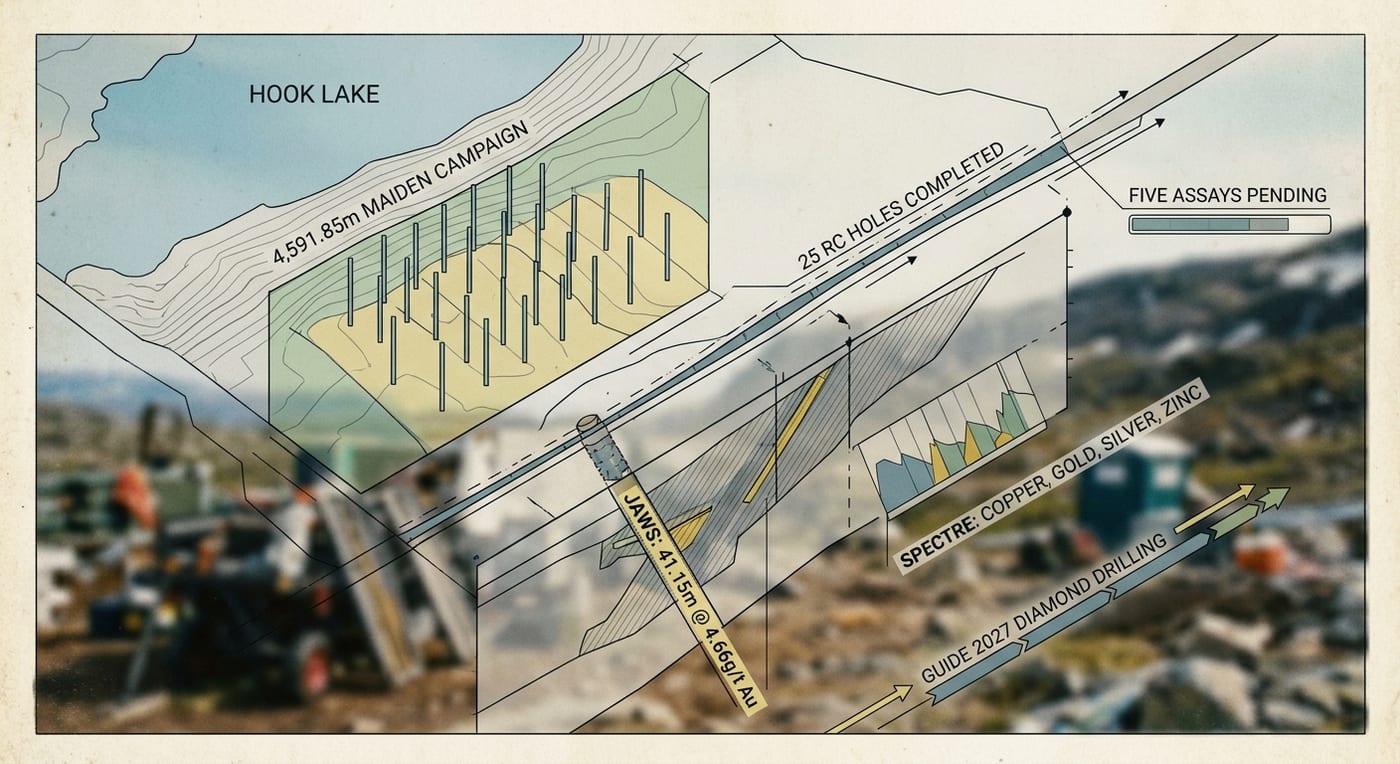
In its October 21, 2026 announcement, Manhattan Gold Corporation Limited (ASX: MHC) reported completion of a 25-hole reverse circulation campaign at the Hook Lake Project in Nunavut, Canada. The program drilled 4,591.85m across five targets, with assays reported for 20 holes and results pending for five.
The strongest reported result came from Jaws, where hole JWS26006b returned 41.15m at 4.66g/t Au from 83.82m, including 7.62m at 18.67g/t Au. Manhattan said the results have defined a 490m zone of higher-grade gold within 1.25km of drill-tested strike, while mineralisation has now been confirmed to 223m vertical depth.
Sam Vaughan, Technical Advisor for Manhattan Gold, said: Completing 25 drillholes for 4,592m in our first drilling season at Hook Lake, ahead of the 4,000m planned, is a strong outcome for the team.
What the campaign changed
The 2026 program was the first drilling at Hook Lake since 1988 and focused primarily on Jaws, which accounted for 17 of the 25 holes and 68% of the metres drilled. Fifteen Jaws holes have reported assays, while two additional holes are still pending and are designed to test the mineralised system across a broader strike extent.
The latest results also add depth and continuity to a system previously defined by historic drilling. Manhattan has referenced a historical estimate of 3.4Mt at 2.38g/t Au for Jaws, but the company clearly identifies that figure as a foreign estimate that was not reported in accordance with the JORC Code 2012. It has also cautioned that there is no certainty the estimate can be converted into a compliant Mineral Resource.
Jaws is not the only source of exploration momentum. At Spectre, a volcanogenic massive sulphide target located 26km southwest of Jaws, all three maiden holes intersected mineralisation. Hole SPC26001 returned 82.3m at 0.45% Cu, 0.21g/t Au, 22.7g/t Ag and 1.26% Zn from 38.1m, including 19.81m at 1.77% Cu, 0.80g/t Au, 84.3g/t Ag and 2.30% Zn.
Spectre also produced a separate shallow zinc-rich interval of 3.05m at 29.50% Zn from 12.19m. Mineralisation was intersected over a 340m strike length, remains open along strike and has not yet been tested at depth. That gives Manhattan a second mineralisation style and a potential polymetallic exploration pathway alongside its gold work at Jaws.
The campaign provided first drill tests at Quantum, Lotus and Omega. Quantum returned 3.05m at 1.69g/t Au and 18.2g/t Ag, while Lotus returned 1.53m at 0.12g/t Au and 23.8g/t Ag. The company described the gold at both prospects as anomalous but narrow, meaning additional mapping and geophysical interpretation will be needed before their scale can be assessed. Three Omega holes tested a banded iron formation target, with assays still pending.
From drilling to district-scale targeting
Manhattan is also building a regional pipeline beyond its two most advanced targets. At the newly staked Vanquish prospect, approximately 30km west of Jaws, first-pass sampling returned up to 20.0g/t Au in grab samples and 18.55g/t Au over 0.3m in channel samples. Gold mineralisation was identified across 131m of strike, although Vanquish has not yet been drill tested.
The company completed three project-wide datasets during the field season: a LiDAR and orthophoto survey, approximately 12,600 line kilometres of airborne magnetics and a 550-sample till program. Till assays remain pending, and Manhattan plans to integrate those results with the drilling, magnetic and LiDAR data during the fourth quarter of 2026 to guide its 2027 exploration program.
A permanent camp has also been established at Hook Lake. Operationally, that should allow equipment and supplies to be staged through Arviat over winter and support an earlier mobilisation for the next drilling season. Manhattan said planning is under way for a 2027 program that will use diamond drilling to better manage ground-condition issues encountered in some reverse circulation holes.
What it means for MHC
The announcement reinforces Manhattan’s position as an early-stage exploration company whose principal value proposition remains discovery rather than production. Hook Lake covers 665km² within the Rankin-Ennadai greenstone belt and contains 12 prospects spanning orogenic gold, banded-iron-formation-hosted gold and polymetallic VMS targets. The company also retains the 2,195km² Tibooburra Gold Project in New South Wales.
The results are encouraging from an exploration perspective because they expand the number of targets carrying meaningful geological information. Jaws now has evidence of shallow, deeper and laterally extended gold mineralisation, while Spectre introduces copper, zinc and silver exposure within the same project area. However, these results remain exploration results and do not establish an economic deposit, mine plan or current JORC-compliant resource.
There are also technical qualifications that matter when interpreting the headline grades. Manhattan reports the intervals as drilled lengths rather than true thicknesses, and acknowledges that some holes were drilled down dip, creating an element of sampling bias. The company further states that current data spacing is not yet sufficient to establish geological or grade continuity for Mineral Resource estimation.
The immediate work program is therefore clear: receive assays from the remaining two Jaws and three Omega holes, complete testing of 550 till samples, review metallurgical results from Jaws and Spectre, and combine the new datasets into targets for 2027. Hook Lake has moved from a largely historic exploration story to a more active, multi-target program, but the next stage will determine whether the early drilling results can be converted into a coherent resource case.