

Intel's AI-Powered Resurgence
ED
Editorial
Cashu Finance·5 min read
TL;DR
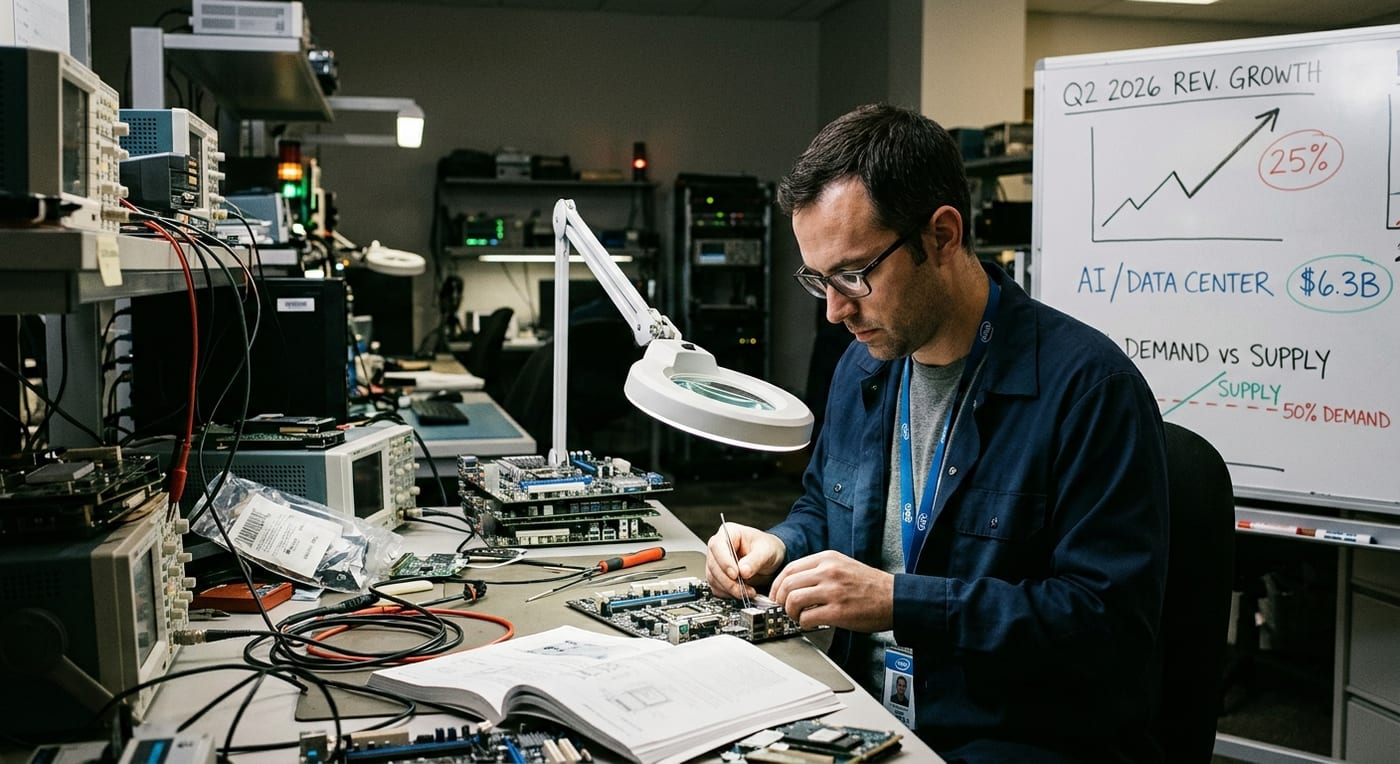
- Intel reports 25% revenue growth in Q2 2026.
- AI and data center products account for $6.3 billion in revenue.
- CEO admits capacity can meet only 50% of demand.
Intel Corp. (INTC) has recently experienced a remarkable transformation marked by a significant pivot towards artificial intelligence (AI) and data center technologies. After facing challenging market conditions over the last few years, Intel's current trajectory is demonstrating revitalized investor confidence, underlined by impressive financial results and the adaptation to evolving demand in the semiconductor space. This article delves into the factors contributing to Intel’s resurgence, its strategic positioning in the AI market, and the implications for its future growth strategy.
A Robust Financial Performance
The company has recently reported strong financial metrics that speak volumes about its recovery and strategic focus. In the second quarter of 2026, Intel announced total revenues of $16.1 billion, which reflects a remarkable 25% year-over-year increase. This financial performance is not just a result of recovering sales but underscores the effectiveness of the company's transition towards AI technologies. Intel's data center and AI-focused segments alone contributed $6.3 billion to this revenue, showcasing an astonishing 59% year-over-year growth.
This shift is particularly noteworthy as it aligns with broader trends within the technology landscape where the demand for AI processing capabilities is surging. This growth has been bolstered by an increasing need for CPUs to support AI inference, a task that many speculate could heavily influence the future computing paradigm. Interestingly, while graphics processing units (GPUs) have typically dominated conversations around AI, Intel's focus on CPUs is positioning it advantageously as agentic AI technologies become prevalent.
Addressing Demand and Capacity Challenges
However, this rapid growth has not come without its challenges. During recent remarks, Intel CEO Lip-Bu Tan revealed that the company currently can fulfill only about half of its customer demand for processors. This situation reflects a broader semiconductor supply issue where the need for chips, particularly for AI applications and data centers, significantly exceeds current production capacity.
Despite being a challenging circumstance to navigate, industry experts deem this as a ‘good problem’—one that reflects overwhelming demand rather than market saturation. The capacity constraints have also contributed to a notable turnaround in Intel's gross margins, which climbed from below 30% a year ago to approximately 41.8% in Q2 2026. This improvement in profitability signals that as production ramps up, Intel is likely to reap the benefits of this increased capacity.
Strategic Partnerships Fueling Growth
Intel's aspirations of seizing a commanding role in the AI market are also being facilitated by strategic partnerships. Collaborations aimed at enhancing capabilities within AI and data processing segments fortify Intel’s competitive position against key rivals like Nvidia and Advanced Micro Devices (AMD). As the demand for AI technologies continues to transform sectors, Intel’s investment in partnerships is critical for expanding its market footprint and driving innovation.
Recent financial forecasts suggest sustained momentum, indicating that Intel anticipates revenue growth to persist in the upcoming quarter, projecting earnings between $15.8 billion and $16.8 billion. Such projections align well with the robust foundation laid through historical data showing a significant uptick in the AI sector. This positive outlook reinforces Intel’s commitment to innovating its data center offerings, maintaining relevance in an increasingly competitive environment.
The Future Landscape of AI and Intel’s Positioning
As companies like Meta delve into the AI realm, innovations such as the Muse AI agent showcase the potential surge in AI-driven applications. This burgeoning demand signifies a shifting landscape, one where Intel stands to benefit as more consumer demands shift towards AI-centric technologies. Analyst projections indicate that the server CPU market could see growth rates of up to 35% annually, bolstered by Intel's ongoing adjustments to meet demands in this pivotal area.
The implications for Intel are clear. By strategically aligning its operations to capitalize on AI technologies, the company is not only addressing immediate supply and demand challenges but is also positioning itself as a market leader within a rapidly evolving tech industry. This transition marks a new chapter for Intel, which has long been viewed through the lens of traditional semiconductors and computing.
Conclusion: A New Era for Intel
Intel Corp.'s transformation into a formidable player in the AI landscape presents an exciting narrative for investors and industry analysts alike. As evidenced by recent financial performance and strategic initiatives, the company is no longer merely reacting to changes in the market but is proactively shaping its future in the AI domain.
With a combination of calculated partnerships, robust financial growth, and a focus on addressing supply challenges, Intel is navigating its way through one of the most significant industry shifts in recent history. The evolving demand for AI technologies continues to underscore Intel’s relevance in the global semiconductor arena, solidifying its crucial role as it ventures further into this new era. The same pressure is reflected in recent reporting on the issue, which helps explain why the company's pricing decisions remain under scrutiny.