

General Motors' Strategic Shift to Nasdaq
ED
Editorial
Cashu Finance·5 min read
TL;DR
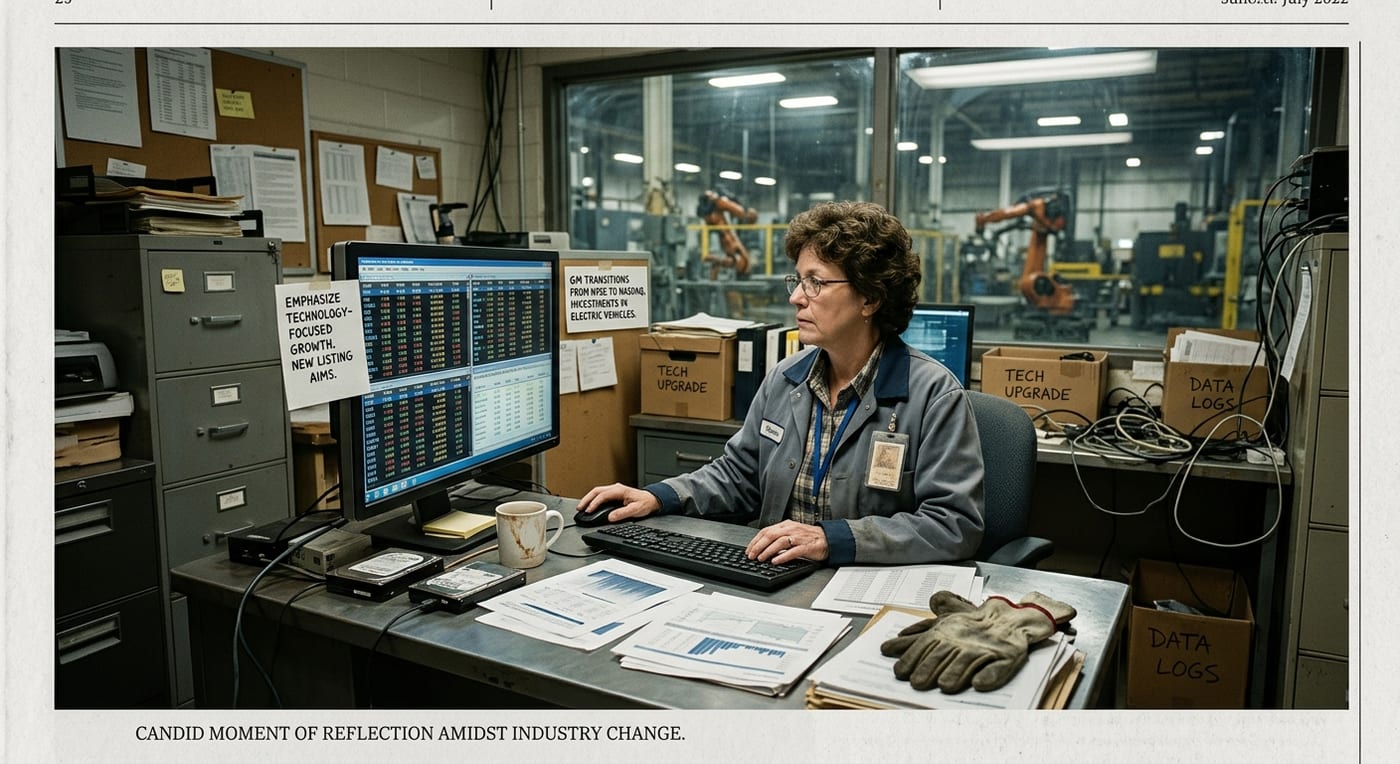
- GM transitions from NYSE to Nasdaq to emphasize technology-focused growth.
- Significant investments in electric vehicles and supply chain resilience.
- New listing aims to attract tech-savvy investors and enhance corporate identity.
General Motors Company ( GM) is embarking on a transformative journey as it prepares to transfer its stock listing from the New York Stock Exchange (NYSE) to the Nasdaq starting November 17, 2026. This significant move signals GM's commitment to evolving as a technology-driven automotive leader amid the rapidly changing landscape of vehicle manufacturing and innovation.
With the growing importance of technological advancements in vehicles, GM's switch aims to strongly align its corporate identity with forward-thinking initiatives. GM Chief Financial Officer Paul Jacobson emphasized that this transition reflects the company's ongoing strategy to enhance shareholder value through a customer-focused approach driven by technology. The decision positions GM to benefit from potential inclusion in the Nasdaq-100 Index, which tracks the performance of 100 of the largest non-financial companies on the Nasdaq exchange.
The listing change comes during a critical period for the automotive giant as it increasingly emphasizes electric vehicles (EVs), automation, and advanced technologies within its operations. As GM continues to invest heavily in these areas, the need to effectively communicate its dedication and potential for growth to investors can be a distinguishing factor in a competitive market.
Embracing Technological Transformation
The shift to Nasdaq not only marks a new phase for GM but also highlights the company's aggressive stance on innovation. As highlighted in a recent article, GM's list of advancements includes significant investments in electric vehicle technology, funds allocated for ensuring supply chain resilience, and a newfound focus on partnerships with tech firms to bolster its technological capabilities. This aspect of GM’s journey relates back to its longstanding objective of reshaping its image as not just an automaker but a technology-centric corporation. For instance, GM has announced a multibillion-dollar investment aimed at enhancing its semiconductor supplies. The partnership with Micron Technology, which entails a $2 billion collaboration to secure critical components for its modern vehicles, demonstrates GM's proactive approach to ensuring it stays at the forefront of innovation. GM’s executives have outlined their roadmap for deploying artificial intelligence and improving automated driving technologies, reinforcing the tech-centric identity the company is striving for.
Innovations in Electric Vehicles
As the automotive landscape becomes increasingly competitive with the rapid rise of electric vehicles, GM's focus on transitioning to a more innovative platform is particularly noteworthy. The company's hefty investments in EV development are indicative of its commitment to capturing market share in a segment where consumer demand is rapidly rising. General Motors has been ramping up its production capacities and diversifying its vehicle offerings under its various brands, including Chevrolet, Buick, GMC, and Cadillac.
Notably, GM plans to ramp up production of sodium-ion battery technology, which positions the company as a frontrunner in the energy storage market. This innovative technology aligns with GM's broader strategy of improving sustainability through advanced energy solutions. Moreover, GM's ability to adapt its manufacturing plants for large-scale production of sodium-ion batteries is an exemplar of its readiness for future market demands and technological trends.
Supply Chain Resilience
Addressing supply chain challenges continues to be a priority for GM as it navigates the unprecedented disruptions experienced since the pandemic. Recent announcements about the significant parts deal valued at approximately $4.5 billion underscore GM's strategy to optimize its parts procurement process. This initiative not only strengthens GM's operational capabilities but also ensures the company can meet production deadlines and consumer demands without significant delays.
The proactive measures GM is taking to bolster its supply chain may also position the company favorably compared to its competitors, who are similarly grappling with procurement issues. As previously discussed, this multibillion-dollar investment is pivotal for GM to reestablish its footing and furthering its ambition to lead in electric vehicle production. Such investments amplify GM's strategic narrative and reinforce investor confidence in its long-term profitability.
The Investor Outlook
As General Motors Company prepares for this notable transition, the broader implications for investors become increasingly fascinating. The general market perception surrounding GM's strategic shift to Nasdaq may attract a new class of investors particularly focused on technology innovations in the automotive sector. With GM’s market cap hovering around $64.4 billion and a stock price that has doubled since 2024, stakeholders are closely watching how the company will leverage its new listing to communicate its evolving narrative.
This transition isn't simply a rebranding exercise; it reflects a firm commitment to redefine GM's reputation as a technology leader in the automotive sector. It also marks a major step in GM's journey toward maintaining relevance in an industry often criticized for lagging behind in terms of technological adoption. Potential inclusion in the Nasdaq-100 could provide GM with further visibility and credibility in the eyes of tech-focused investors, which is essential as the company continues to navigate evolving market dynamics.
To summarize, General Motors Company’s listing transition to the Nasdaq illustrates its strategic commitment to a future characterized by technological innovation, electric vehicle leadership, and strong supply chain integrity. By engaging with investors through this new lens, GM is not just reaffirming its legacy as an automotive titan but is also crafting a forward-looking narrative that promises growth and sustainability. The same pressure is reflected in recent reporting on the issue, which helps explain why the company's pricing decisions remain under scrutiny.