

Disrupting the Exosome Industry: Syed T. Husain and Yoram Drucker on Manufacturing at Scale
ED
Editorial
Cashu Finance·5 min read
This article is disseminated on behalf of NurExone Biologic Inc.
TL;DR
- NurExone has entered a proposed U.S. GMP manufacturing partnership with Made Scientific for its exosome platform.
- The arrangement is intended to support ExoPTEN development and potential clinical manufacturing, but remains subject to a definitive agreement and regulatory work.
- Manufacturing consistency, financing and FDA authorization remain key execution risks before human testing can begin.
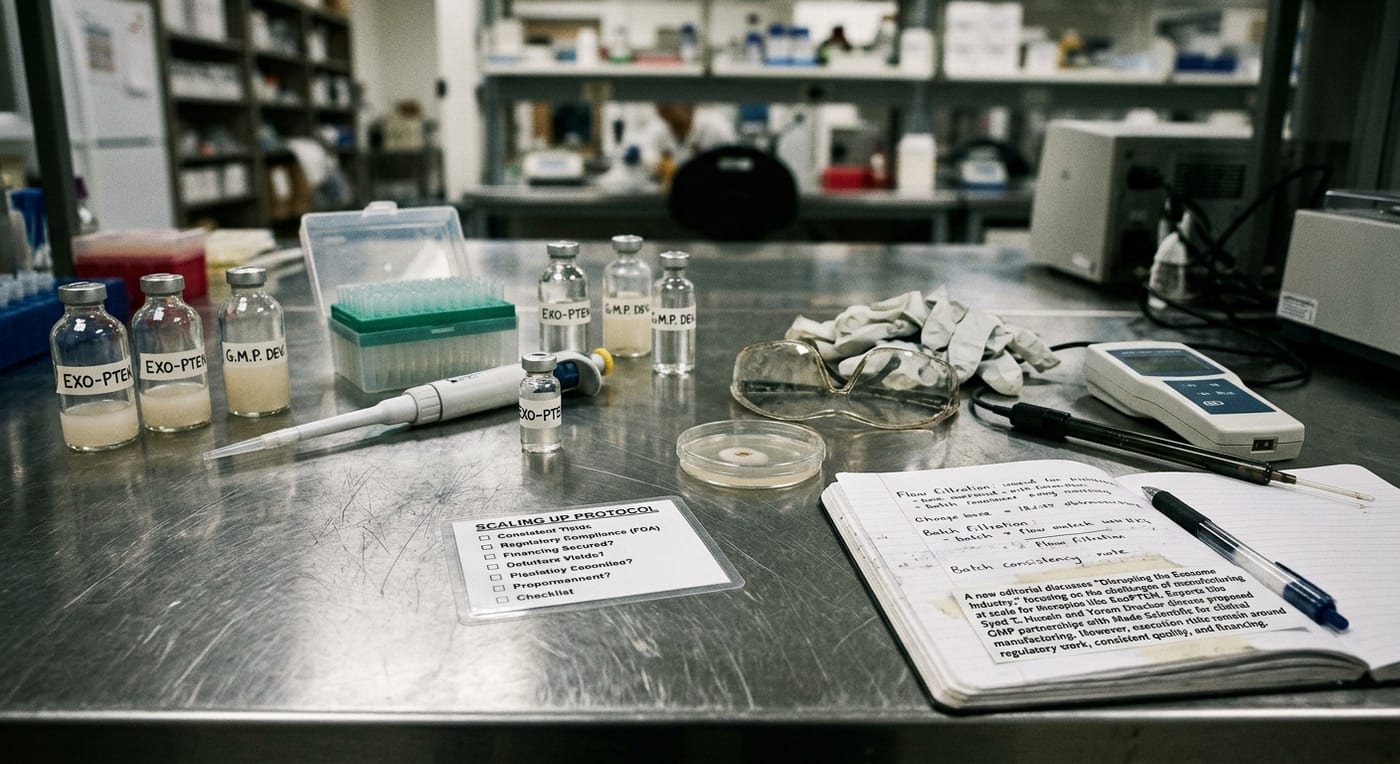
NurExone Biologic is moving its exosome platform into a more demanding phase: proving that a preclinical therapy can be manufactured consistently enough to support human testing and, eventually, commercial supply. The TSXV-listed biotechnology company has partnered with Made Scientific on a proposed U.S. manufacturing arrangement centered on bone marrow-derived exosomes, with the first GMP batches targeted for the first half of 2027.
A manufacturing agreement with a clinical purpose
On August 13, 2026, NurExone and its wholly owned U.S. subsidiary, Exo-Top, announced a binding memorandum of understanding with Made Scientific. The arrangement makes Made Scientific the proposed exclusive U.S. partner for manufacturing and aseptic fill-finish of NurExone’s bone marrow-derived exosomes.
Made Scientific operates a 60,000-square-foot facility in Princeton, New Jersey, described by the companies as compliant with U.S. Food and Drug Administration requirements and EU GMP Annex 1 standards. Technology transfer has begun, but the arrangement remains an interim framework while the parties negotiate a definitive agreement, approve statements of work and complete technical, quality and regulatory work.
The proposed relationship has an initial five-year term with renewal options. It is also conditional: the MOU provides that the arrangement, including its exclusivity provisions, can terminate if a definitive agreement is not completed within six months of signing. That distinction matters because the announcement establishes a route toward manufacturing, not a completed long-term supply contract.
Why scale and consistency are central risks
Exosomes are often described as cell-free delivery vehicles, but that does not make them simple to manufacture. The key development challenge is controlling the source cells, production conditions, purification steps, product characterization and release testing well enough to demonstrate reproducible identity, potency and safety.
NurExone has been building toward that requirement. In 2025, the company reported validation work involving a proprietary master cell bank and described consistent exosome yields and preserved biological potency across multiple production runs. The company has also pursued intellectual-property protection for its manufacturing process and plans to use Exo-Top as a U.S.-based operating arm for production and supply.
The Made Scientific partnership is therefore more than a capacity decision. It is an attempt to connect NurExone’s process knowledge with a specialized contract development and manufacturing organization that already has cleanroom infrastructure, quality systems and fill-finish capabilities. Whether that connection works will depend on successful technology transfer and the ability to reproduce the process outside NurExone’s existing development environment.
ExoPTEN remains the economic center of the story
NurExone’s lead candidate, ExoPTEN, is an exosome-based drug designed to deliver PTEN-targeting siRNA. The company is advancing it first for acute spinal cord injury, while also developing a preclinical optic nerve injury program. Exo-Top is being positioned separately as a commercial pathway for naïve exosomes, which do not contain added therapeutic cargo.
The company received FDA Orphan Drug Designation for ExoPTEN in acute spinal cord injury in 2023. That designation can provide development incentives and regulatory support, but it is not marketing approval and does not establish that ExoPTEN is safe or effective in humans.
NurExone’s second-quarter 2026 release said the company was working toward a potential investigational new drug submission in the first half of 2027, subject to completing preclinical, manufacturing, quality and regulatory activities. The same release reported research and development expenses of US$0.75 million, general and administrative expenses of US$0.93 million and a quarterly net loss of US$1.68 million.
NurExone also reported gross proceeds of approximately C$628,000 from a June private placement and approximately C$1.066 million from an August financing completed after quarter-end. The financings provide additional working capital, but the disclosed arrangements with Made Scientific do not specify manufacturing fees, minimum purchase obligations or expected revenue. The immediate financial significance is therefore operational rather than measurable commercial revenue.
Regulatory progress still runs through the FDA
The U.S. regulatory environment makes the manufacturing step consequential. The FDA states that exosome products intended to treat diseases or conditions in humans generally require FDA approval and that there are currently no FDA-approved exosome products. A GMP-compliant facility can support product quality and clinical readiness, but it does not authorize a therapy for patient use.
For NurExone, manufacturing data must ultimately sit alongside pharmacology, toxicology, biodistribution, safety and clinical-protocol information in an IND package. The company’s own disclosure also makes clear that the first-half 2027 timeline is conditional and that regulatory review could delay or prevent clinical initiation.
Recent preclinical work adds scientific momentum but does not remove that uncertainty. On October 9, 2026, NurExone reported retinal activity in rat optic-nerve injury models treated with naïve exosomes or ExoPTEN and said it was planning a larger-animal study, including a rabbit model. The company cautioned that the study design, funding and regulatory approvals remained outstanding, and that animal findings should not be interpreted as proof of safety or efficacy in humans.
The next milestones are execution milestones
The partnership gives NurExone a clearer manufacturing route, but the next evidence will be practical: completion of the definitive agreement, successful technology transfer, validated processes, acceptable batch data and a regulatory package capable of supporting an IND. Each step can consume capital and introduce new technical risk.
The broader investment narrative is consequently still built on execution rather than commercialization. Made Scientific may help NurExone avoid constructing a full U.S. manufacturing operation on its own, while NurExone’s platform and ExoPTEN program could provide a differentiated use case for the facility. But the arrangement remains subject to negotiations, validation, regulatory review and financing capacity.
For now, the announcement is best understood as infrastructure for a clinical ambition, not evidence that the ambition has been achieved. NurExone’s ability to convert a promising exosome platform into repeatable GMP material will be one of the most important tests separating its preclinical research story from a potential therapeutic business.