

Coastal Financial's Ongoing Struggles
ED
Editorial
Cashu Finance·5 min read
TL;DR
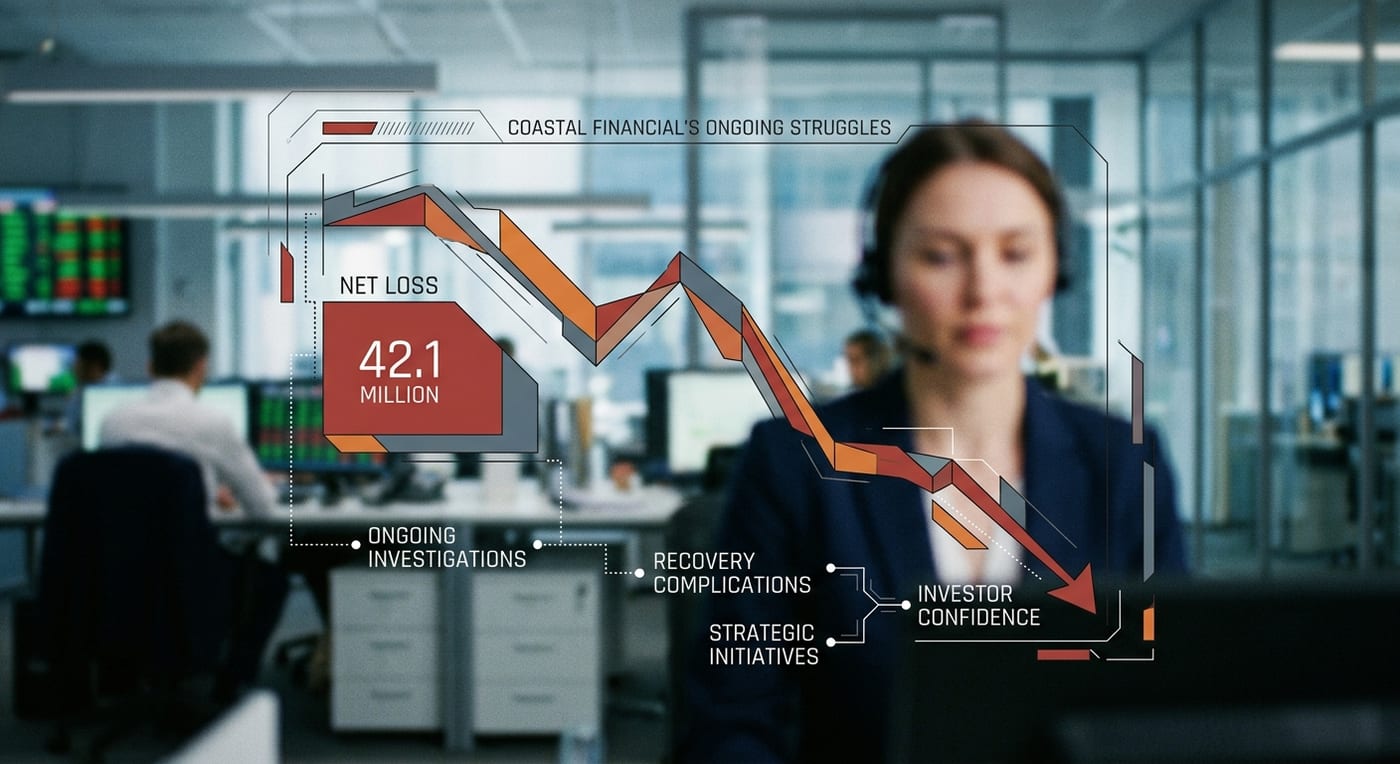
- Coastal Financial reports a staggering net loss of $42.1 million.
- Ongoing investigations complicate recovery efforts.
- Strategic initiatives are critical for restoring investor confidence.
Coastal Financial Corporation (CCB) is currently navigating a turbulent phase in its operational journey, primarily driven by significant financial distress recently disclosed. The company's recent revelations, including a staggering net loss of $42.1 million for Q2 2026—a considerable drop from the $12 million net income reported in the same quarter the previous year—have not only alarmed investors but also triggered a series of legal actions against the firm. As stock prices fell sharply by 43.5%, with a market cap decline of around $470 million, questions surrounding the integrity of Coastal's business practices have resurfaced. These losses are chiefly attributed to issues within its banking-as-a-service (BaaS) segment, particularly the CCBX business model, once hailed as a key driver of growth and innovation.
A Deep Dive into the Financial Crisis
Coastal Financial's recent performance clearly outlines the precarious nature of its CCBX segment. While banking-as-a-service offered lucrative possibilities for growth in the digital banking sector, internal assessments have revealed severe deficiencies in credit quality management. Allegations state that a partner loan portfolio—a critical element of the CCBX business—showed significant signs of deterioration which had not been previously disclosed to investors. Recent reports have emphasized that nearly 23% of all CCBX loans, totaling around $500 million, fall within this problematic credit quality framework.
Investor confidence took a hit following the alarming Q2 financial results disclosure on July 30, 2026, which triggered a robust response from the market. The lack of transparency surrounding credit risk management practices has led to investigations for potential securities fraud being launched against Coastal Financial, resulting in class action lawsuits seeking to hold the company accountable for these misleading assurances. For example, the lawsuit filed by Hagens Berman details claims that Coastal Financial misrepresented aspects of its operations, asserting it had effective strategies in place to enhance credit quality while these practices were evidently lacking. Following these developments, Coastal's stock suffered a significant drop, closing at $39.91 per share, a deep descent down from $70.66 in the preceding trading session.
As these financial setbacks unfold, the necessity for fundamental changes to Coastal's business strategies is becoming increasingly clear. This raises essential questions about its corporate governance, risk management protocols, and overall business model efficacy.
Legal Challenges and Future Outlook
The ramifications of Coastal Financial’s current predicament extend beyond financial distress; ongoing class action lawsuits are now an integral part of the landscape. With multiple plaintiffs alleging that the firm neglected its disclosure obligations related to credit risk management, classes are forming to pursue remuneration for these substantial losses. Legal representatives from various firms, including Kaplan Fox and Robbins Geller, have begun rallying investors who acquired shares between October 28, 2024, and July 29, 2026, to join in the class actions, calling for greater accountability and oversight regarding the disclosures related to credit risks associated with CCBX.
With deadlines looming for potential lead plaintiffs, there is urgency among affected investors. Desperate to recover their financial losses, investors are reminded to act quickly to secure counsel and join this collective legal movement. This dynamic reflects a shifting landscape where corporate transparency is paramount, especially when navigating the complexities of financial services. Investors are uncertain about the trajectory for Coastal, especially amidst persistent scrutiny of executive decision-making and risk management systems which purportedly failed at critical junctures.
In this environment, the sustainability of Coastal Financial's CCBX division is under continued examination. The effectiveness of the company’s prior approach to partnerships, perceived as a strength, has now emerged as a principal risk factor. Analysts and investors alike are questioning whether the company's ambitious growth strategies are realistic or, perhaps, overly optimistic given its recent operational experiences.
The Path Ahead: Strategic Restructuring
To recover from its current challenges, Coastal Financial must take extensive measures to rethink its strategies. This could involve a comprehensive restructuring of its BaaS segment, ensuring that its operational capabilities align with the realities faced in the current financial landscape. This includes reasserting operational controls over credit risk management and ensuring that details are adequately communicated to stakeholders to regain lost trust.
Strategically, Coastal needs to engage transparently with investors and adapt to their growing concerns. The evolving expectations within the financial services sector emphasize accountability and risk management, effective measures that Coastal must not only adopt but showcase actively to attract potential investor confidence in the future.
Amidst these transformations, external regulatory influences and market conditions will have a significant role in shaping Coastal Financial's recovery narrative. The successful implementation of robust risk management practices, along with compliance to regulatory standards, will not only help mitigate potential legal repercussions but also lay the foundation for a sustainable operational future. To this end, Coastal's management team has a formidable task ahead, balancing recovery efforts while steering clear of past missteps that have clouded its reputation.
The road to recovery for Coastal Financial Corporation is intricate, but with strategic alignments, renewed accountability, and a fortified risk management structure, it is achievable. Investors will watch carefully, anticipating concrete steps towards restoring credibility and operational stability amid these tumultuous waters. The same pressure is reflected in recent reporting on the issue, which helps explain why the company's pricing decisions remain under scrutiny.