

Chemours Navigates Legal and Market Challenges
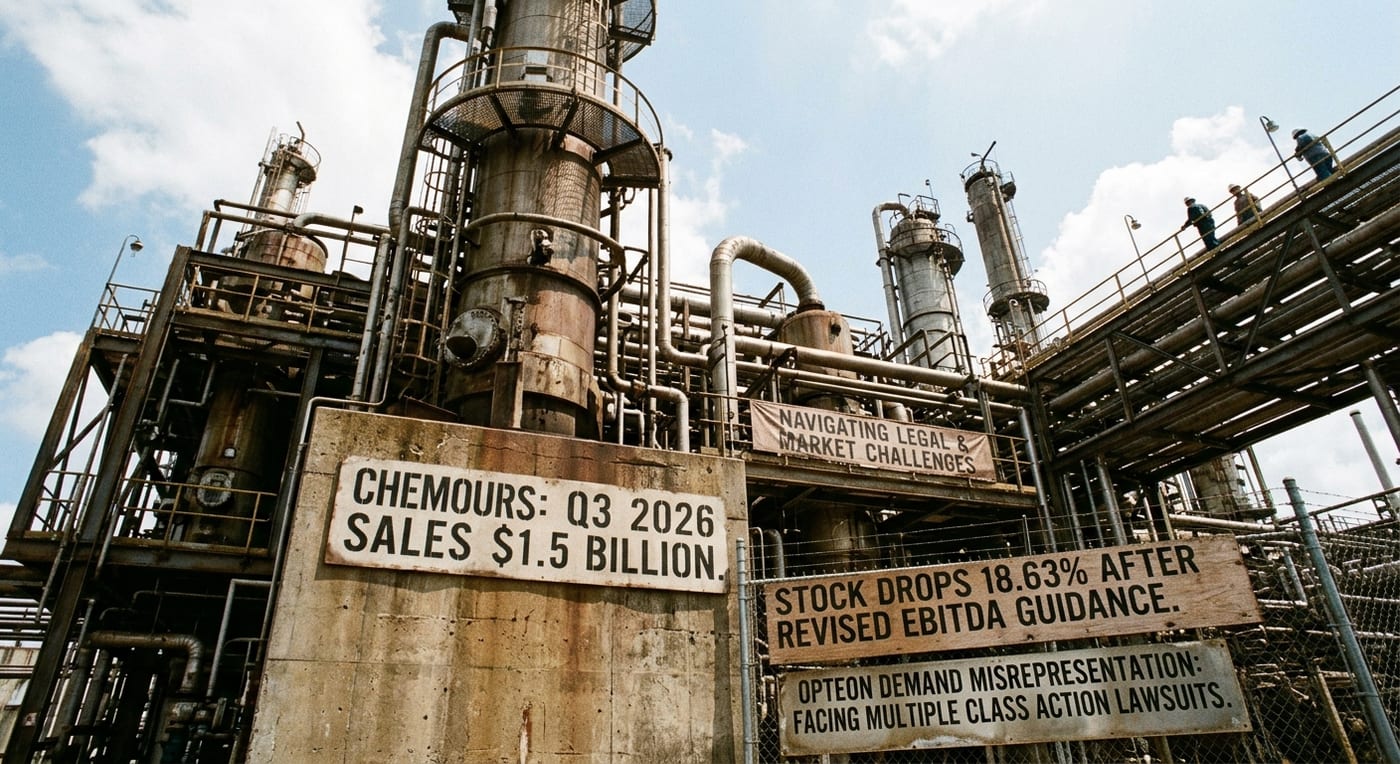
- Chemours reports $1.5 billion in net sales for Q3 2026.
- Facing multiple class action lawsuits over Opteon product demand misrepresentation.
- Company's stock drops 18.63% following revised EBITDA guidance.
In Q3 2026, Chemours reported net sales of approximately $1.5 billion, reflecting a slight increase compared to the last year. This performance, although indicative of the company's strong operational capabilities within the Titanium Technologies (TT) division and Advanced Performance Materials (APM) segments, comes amidst a backdrop of legal scrutiny. The company's TT division enjoyed a remarkable 10% growth in sales due to effective pricing strategies, while the APM segment saw an impressive 26% increase in performance solutions.
Despite these gains, Chemours' stock experienced a notable decline of 18.63% following announcements about deteriorating market conditions for its Opteon products. In early August 2026, Chemours disclosed a reduction in full-year adjusted EBITDA guidance, citing market saturation due to prior oversupply as a driving issue.
Legal Troubles Arise Amid Strong Financials
Legal woes have become a focal point for Chemours, with several class action lawsuits filed against the company following allegations that it overstated the demand for its Opteon refrigerants. The cases focus on the period from February 20 to August 4, 2026, during which Chemours' securities saw steep declines after it became apparent that the demand for Opteon had been misrepresented. Investors' reactions were swift, leading to a class action being consolidated in the United States District Court for the District of Delaware.
These lawsuits stem from Chemours' previous statements regarding the supportive regulatory environment established by the U.S. AIM Act, which aimed to drive adoption of alternative refrigerants. Chemours had projected robust growth in the Thermal & Specialized Solutions segment, which features Opteon, asserting that demand growth would be sustained thanks to renewed regulatory support. However, as uncovered in the lawsuits, this growth was misleadingly buoyed by prior inventory buildups rather than sustainable market demand.