

Boeing's Flight Path to Recovery
Cashu Finance·4 min read
TL;DR
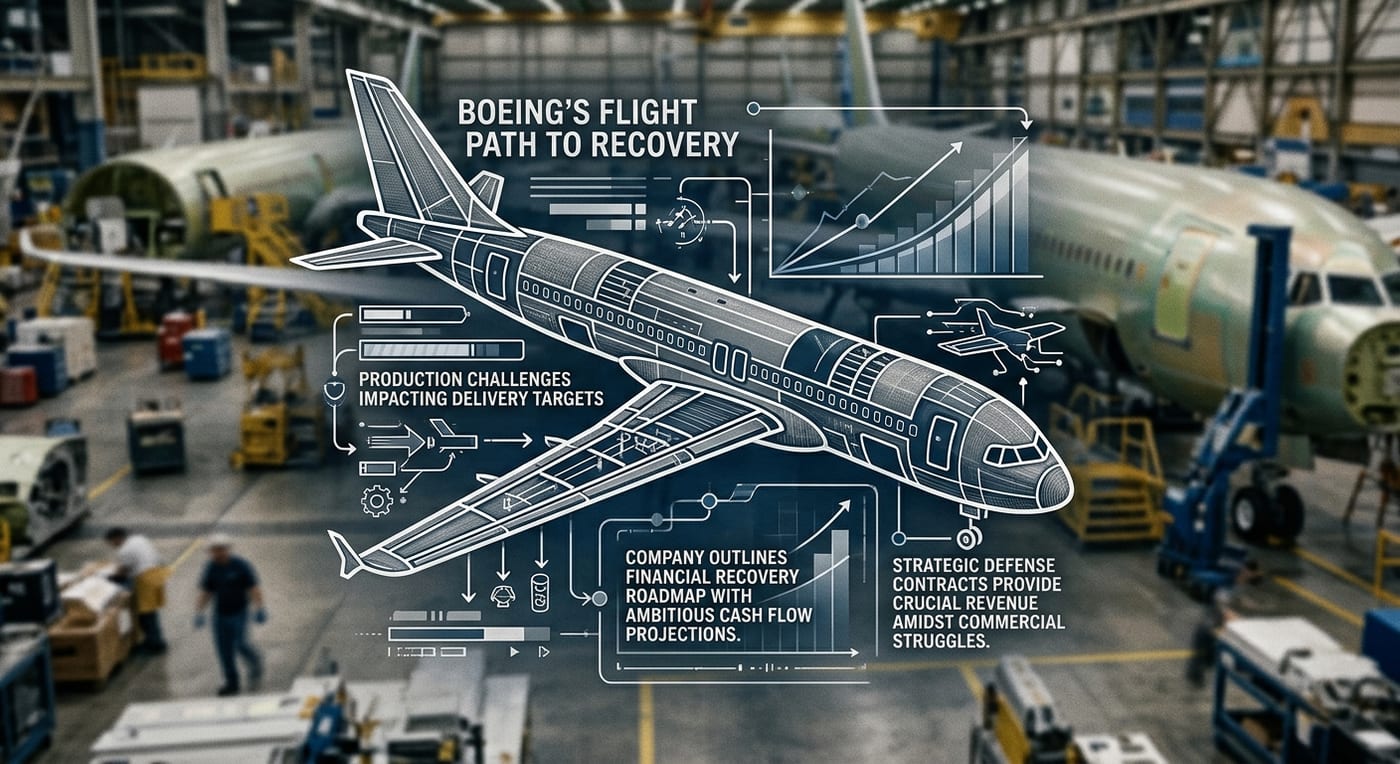
- Boeing faces production challenges impacting delivery targets.
- Company outlines a financial recovery roadmap with ambitious cash flow projections.
- Strategic defense contracts provide crucial revenue amidst commercial struggles.
The Boeing Company (BA) is currently steering through a challenging recovery phase, marked by production issues and investor apprehensions. While the aerospace giant had previously celebrated the certification of its largest narrow-body aircraft, the 737 MAX 10, recent developments have called into question its operational capabilities and strategic direction. This article delves into the complexities of Boeing's situation, examining the current production landscape, financial targets, and the broader implications for its future.
Navigating Production Challenges
Boeing's production outlook is marred by significant challenges, notably in the ramp-up of its 737 MAX aircraft output. Despite being able to certify the 737 MAX 10, the company has struggled to optimize its manufacturing processes, primarily due to delays in wing fabrication. Management has indicated that it will take longer to reach the target of producing 52 aircraft per month, pushing that milestone further into 2027. As articulated by Robert K. Ortberg, the President and Chief Executive Officer, achieving sustainable production levels is critical as the company works to rebuild its reputation and operational stability.
This slow production rate has had immediate repercussions. Boeing's stock recently plummeted by 11% following an earnings report that revealed a missed delivery target of 500 737 MAX jets for this year. This decline in investor confidence is further underscored by unfulfilled revenue expectations, reflecting a broader struggle to meet market demand while rectifying operational inefficiencies.
This slow production rate has had immediate repercussions. Boeing's stock recently plummeted by 11% following an earnings report that revealed a missed delivery target of 500 737 MAX jets for this year. This decline in investor confidence is further underscored by unfulfilled revenue expectations, reflecting a broader struggle to meet market demand while rectifying operational inefficiencies.
Financial Outlook and Investor Sentiment
Looking forward, Boeing's financial landscape appears cautiously optimistic, with management establishing multiyear targets for free cash flow aimed at reaching $10 billion by 2029. This ambitious roadmap is essential for the company as it confronts a $745 billion backlog of orders. The focus on financial transparency is critical; investors are keenly watching how these projections will translate into actual cash generation.
Despite facing operational headwinds, the roadmap provides a degree of visibility that may boost investor confidence in Boeing's ability to recover sustainably. Yet, the path ahead remains fraught with challenges, including the need to stabilize production following various setbacks. As noted in previous analyses, these financial targets are necessary to encourage long-term investment, indicating a recognition of the high stakes involved in their operational recovery.
Despite facing operational headwinds, the roadmap provides a degree of visibility that may boost investor confidence in Boeing's ability to recover sustainably. Yet, the path ahead remains fraught with challenges, including the need to stabilize production following various setbacks. As noted in previous analyses, these financial targets are necessary to encourage long-term investment, indicating a recognition of the high stakes involved in their operational recovery.