

ASML's Strategic Advancements in AI Semiconductor Market
ED
Editorial
Cashu Finance·5 min read
TL;DR
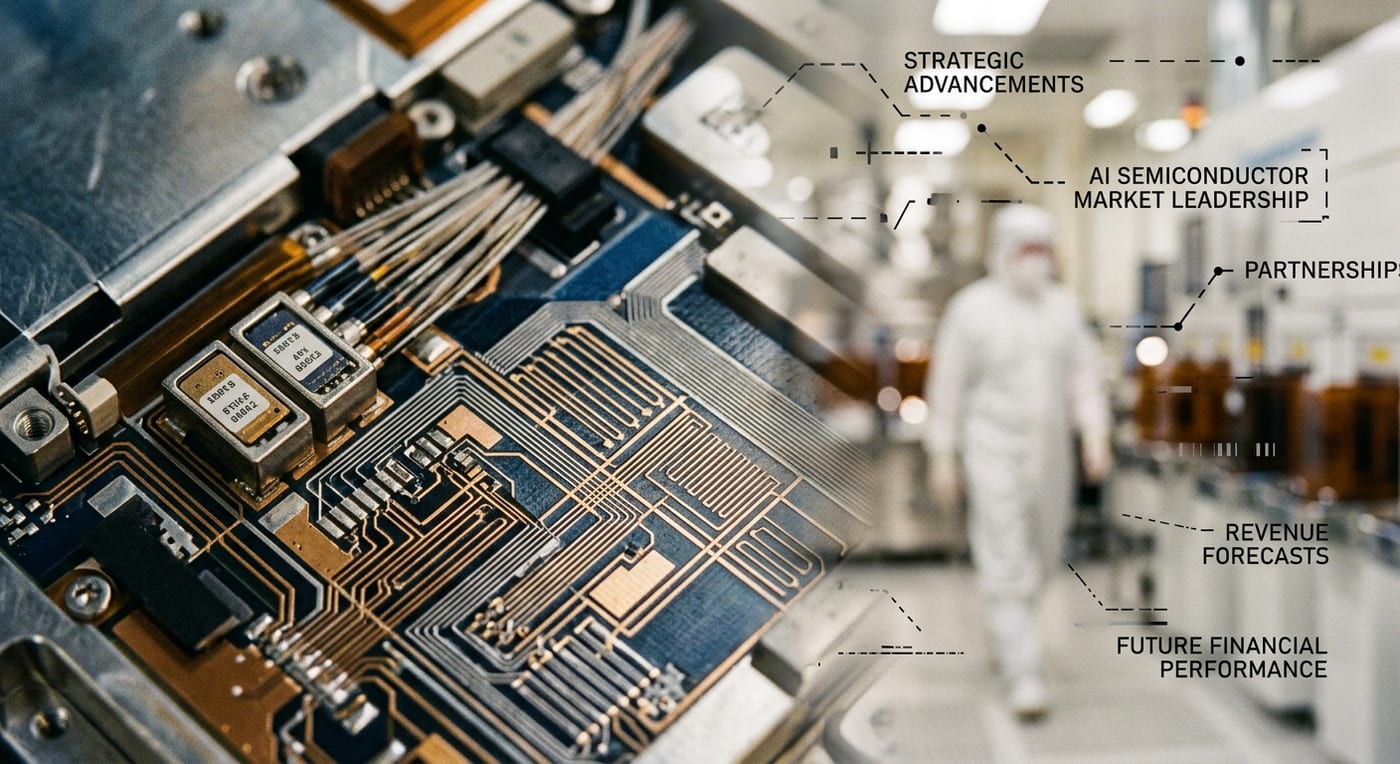
- ASML solidifies its leadership in AI semiconductor market.
- Strategic partnerships bolster its growth and market position.
- Revenue forecasts indicate strong future financial performance.
ASML Holding N.V. ASML is rapidly solidifying its leadership position in the semiconductor industry, especially amidst the booming demand for artificial intelligence (AI) technologies. As the only manufacturer of extreme ultraviolet (EUV) lithography systems, ASML plays a pivotal role in enabling the production of advanced semiconductors that power AI applications. This article explores how ASML is navigating the evolving technological landscape, its strategic partnerships, and the broader implications of these developments for its market position and investor outlook.
The AI Surge and Market Opportunities
The intersection of AI advancements and semiconductor demand has created a significant market opportunity for ASML. The increasing necessity for sophisticated chips to support AI applications has triggered a surge in demand for EUV lithography machines. Major clients such as Taiwan Semiconductor Manufacturing Company (TSMC) and Nvidia are leading the charge, positioning ASML as a critical player in the semiconductor supply chain.
ASML's unique monopoly in the EUV space is not only an advantage but a barrier to entry for potential competitors. The company's extensive investment—approximately $6.7 billion over 17 years—in developing EUV technology underscores the complexity and significant R&D efforts required to replicate its offerings. This has allowed ASML to maintain robust revenue growth, highlighted by a substantial increase in orders from clients driven by the AI boom. Recent projections indicate ASML could generate up to $90 billion in revenue by 2030, showcasing its strong growth trajectory.
Strategic Partnerships Enhancing Growth
ASML's strategic alliances, particularly with industry leaders like TSMC, significantly bolster its market position. By collaborating with TSMC on large-format photomasks for advanced manufacturing, ASML not only supports its existing customer base but positions itself favorably for future technological advancements. These partnerships serve to enhance the value proposition of ASML’s products, with clients drawn towards the advanced capabilities provided by EUV machines in producing cutting-edge chips.
Furthermore, as explored in previous pieces, ASML remains committed to nurturing relationships that are integral to expanding its market base and enhancing technological collaboration. Such strategic movements are imperative in maintaining a competitive edge amid a rapidly evolving landscape, particularly as competing technologies continue to emerge. The AI surge directly links back to ASML’s prominence in the industry, as companies rush to augment their capacities to handle the emergent demand for AI chips.
Revenue Trends Signal Strength
Recent revenue figures reflect ASML's robust market position. The company's consistent year-over-year growth, juxtaposed with competitors like Qualcomm, highlights its unique advantages within the semiconductor industry. Unlike Qualcomm, which is grappling with declining sales in certain market segments, ASML stands resilient, driven by sustained demand for its EUV systems. This striking contrast further emphasizes ASML's ability to leverage the burgeoning AI market effectively.
In fact, quarterly revenue reports show ASML's revenue climbing steadily, with forecasts indicating further growth in the coming years. For instance, sales figures of around $48 billion to $50 billion are expected for the current fiscal year, showcasing the strength of its product offerings and demand in the marketplace. Such developments not only assure investors of ASML’s robust business model but also highlight the long-term growth potential tied to AI advancements.
Navigating Geopolitical Challenges
Despite its formidable market presence, ASML is not devoid of challenges. Geopolitical factors present complexities that could influence its future operations. The semiconductor industry is often affected by international trade regulations and supply chain dynamics, which can introduce volatility into the strategic plans of companies like ASML. It will be crucial for ASML to navigate these complexities deftly to maintain its growth trajectory and market share.
Yet, the company's established strategies seem well-equipped to handle potential disruptions. Investments in diversifying supply chains and establishing flexibility within logistics will mitigate the impacts of external pressures, enabling ASML to continue capitalizing on market demands.
Long-Term Outlook for Investors
In light of the current trajectory within ASML, the long-term outlook remains optimistic. Given its unparalleled position in the EUV lithography market, ASML is set to benefit immensely from the ongoing AI revolution. With analysts projecting significant revenue growth, the narrative surrounding ASML is increasingly focused on its potential to deliver sustainable returns for investors.
Moreover, the innovative capacity coupled with an astute understanding of market dynamics has placed ASML in a unique position. As previously discussed, the company is poised to see its investment yield strong returns, making it an attractive prospect for growth-focused stakeholders. Amidst external challenges, ASML’s solidified market position and strategic initiatives lay a strong foundation for future successes.
In conclusion, ASML Holding N.V. ASML is at the forefront of a booming semiconductor market, driven by growing demand for AI technologies. Its distinctive market position not only validates the company's strategic initiatives but also sets a promising outlook for its future. With continued investments in innovation and strategic partnerships, ASML appears set to thrive in the emerging technological landscape, presenting significant opportunities for its stakeholders in the years ahead. The same pressure is reflected in recent reporting on the issue, which helps explain why the company's pricing decisions remain under scrutiny.