

AMD's Strategic Shift Towards AI Dominance
ED
Editorial
Cashu Finance·5 min read
TL;DR
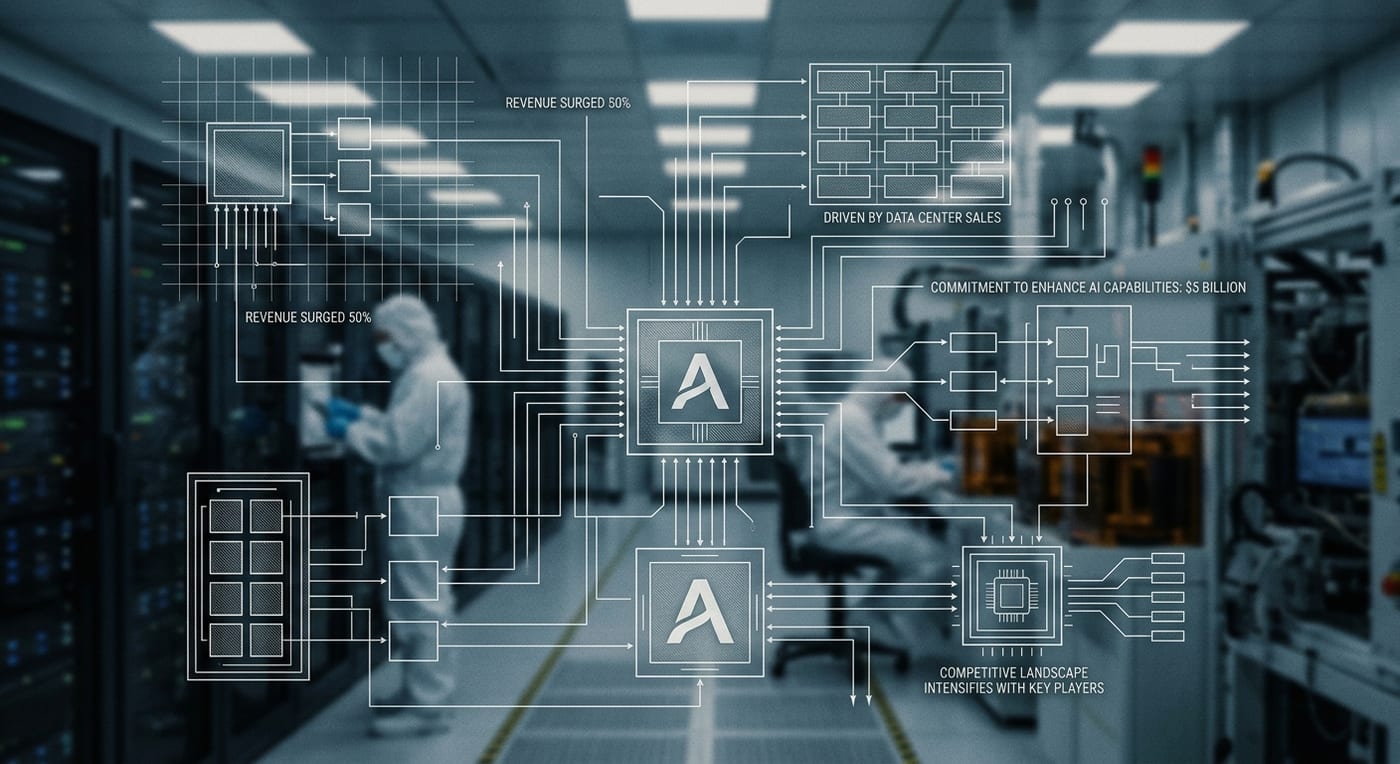
- AMD's revenue surged 50%, driven by data center sales.
- Company commits $5 billion to enhance AI capabilities.
- Competitive landscape intensifies with Nvidia and Intel.
Advanced Micro Devices, Inc. (AMD) is drawing attention as the latest developments come into focus. Advanced Micro Devices, Inc. (AMD) is undergoing a transformative journey in the semiconductor industry, with a sharp focus on strengthening its position in the lucrative artificial intelligence (AI) sector. This strategic pivot comes amid stellar financial performance, marked by a staggering 50% increase in revenue fueled primarily by rapid growth in its data center segment. As AMD carves its niche, the company is not only investing significantly but also forming key partnerships to solidify its competitive edge against industry giants like Nvidia and Intel.
Financial Performance Driving AI Investments
AMD reported revenues reaching $11.54 billion, surging year-over-year, largely driven by its data center segment which saw a remarkable 107% increase, thereby contributing $6.7 billion to the total revenue. This explosive growth is indicative of AMD’s ability to leverage the escalating demand for AI-driven solutions, placing the company on the cusp of a pivotal transition.
The second quarter of 2025 was particularly revealing, with data center products generating about 58% of the company’s revenue, a significant departure from previous quarters. Analysts predict that this segment could surpass 70% of AMD's revenue by 2027, underscoring an intense focus on data-driven technologies and highlighting AMD's shift to ensure its offerings are competitive in an evolving market. The implications for AMD's overall business strategy cannot be overstated, as the company is continually refining its product lines to meet the needs of a data-centric world.
AMD's Bold Commitments in AI
To complement its impressive revenue growth, AMD is deeply investing in AI technologies. The company has committed approximately $5 billion to advance its AI capabilities, focusing on collaborations that will enhance its product lines. Notably, AMD's partnership with Anthropic involves a commitment to deploy up to 2 gigawatts of AMD's Instinct MI450 series GPUs, with rollout scheduled for the first half of 2027. Such a commitment signifies not only a financial investment but also a strategic alignment with one of the most promising AI startups, poised for a significant IPO.
This linkage between investment and product deployment illustrates how AMD is not merely a participant but an architect in the burgeoning AI landscape. As reported, this initiative positions AMD amidst key players, as AI technologies are set to play a transformative role across various computing platforms.
Competing in a Rapidly Evolving Market
The competitive landscape intensifies with both Nvidia and Intel vying for a substantial share of the AI market. AMD’s aggressive pricing and innovative product developments are critical for its long-term strategy. The introduction of advanced GPUs designed specifically to handle AI workloads demonstrates AMD's commitment to delivering high-performance solutions tailored for demanding applications in the data centers.
Moreover, AMD’s competitive positioning is buoyed by strategic partnerships; the recent collaboration with Microsoft has placed AMD's chips at the forefront of cloud computing solutions, as organizations increasingly move to enhance their infrastructure capabilities in alignment with growing data requirements. As reported in previous articles, partnerships of this caliber are vital, not only for bolstering AMD’s technological advancements but also for creating a network effect that can amplify demand for its products across multiple sectors.
Revenue Growth in Data Centers: A Sustained Momentum
AMD's trajectory in its data center business is increasingly pivotal. As the company reported a 107% increase in revenue, this segment is anticipated to continue dominating AMD’s earnings profile. Part of the robust performance stems from the wide adoption of AI technologies across various industries, creating a ripe environment for AMD’s offerings.
Future forecasts predict that, barring any unforeseen hurdles, the data center segment could represent as much as 71% of AMD's revenue by the second quarter of 2027. Innovations such as the Helios rack-scale AI system powered by next-generation chips not only highlight AMD's technical capabilities but also underscore the strategic foresight in anticipating market demands early on.
Understanding these trends allows AMD to position itself favorably against competitors and capitalize on the growing need for efficient, high-performance computing solutions.
Challenges and Strategic Outlook
However, the path forward is not without challenges. AMD must navigate fluctuating demand in its traditional segments, such as gaming and client processors, which have shown less robust growth in comparison to the data centers. The decline in gaming sales, for instance, highlights a potential risk factor that AMD needs to address actively.
The company’s transformation strategy, particularly its focus on AI, is designed to mitigate these risks and maximize leverage in a sector that is poised for expansion. Continued investment in AI and data center capabilities is essential for sustaining competitiveness and driving future growth, ensuring that AMD remains integrally linked to the technology that will shape the next era of computing.
As AMD continues to evolve, its bold investments and strategic partnerships suggest a strong likelihood for sustained upward momentum, assuring investors of its commitment to leading the AI revolution within the semiconductor industry. The success of this transformative journey is contingent not only on the technological advancements but also on AMD's ability to manage competitive pressures and optimize every aspect of its operations.
In summary, AMD is firmly establishing itself as a key player in the AI sphere, with its financial growth driven by strategy, innovation, and collaboration. With significant investments and a focus on data-driven technologies, AMD's trajectory suggests a promising outlook for the coming years in an industry defined increasingly by its capacity for intelligent processing and data management. The same pressure is reflected in recent reporting on the issue, which helps explain why the company's pricing decisions remain under scrutiny.