

AMD's Strategic Ascent in AI Market
ED
Editorial
Cashu Finance·5 min read
TL;DR
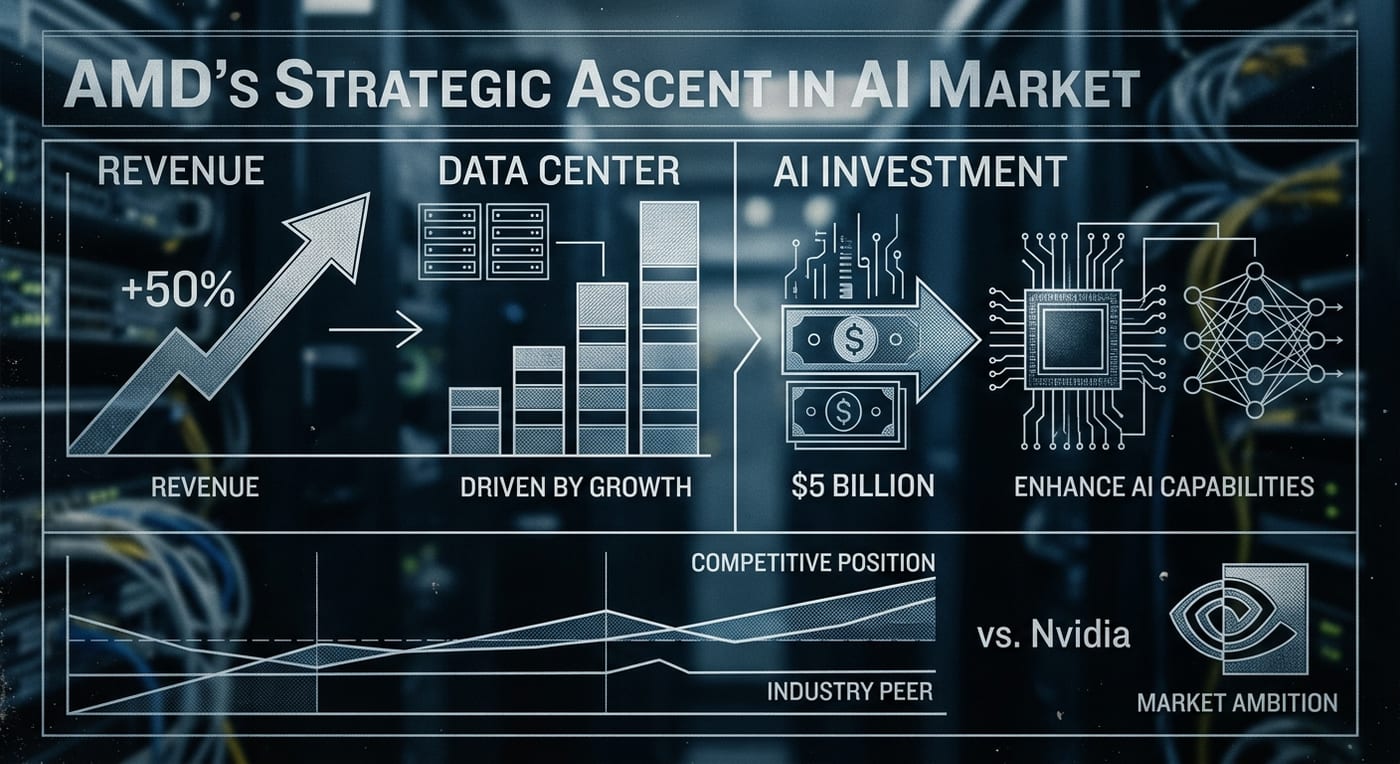
- AMD's revenue surged 50%, driven by strong data center performance.
- Investment of $5 billion earmarked for AI initiatives to enhance capabilities.
- Competitive positioning against Nvidia solidifies AMD's market ambition.
Advanced Micro Devices, Inc. ( AMD) is witnessing a remarkable transformation as it solidifies its standing in the burgeoning artificial intelligence (AI) market. The company's recent financial performance has been a testament to its strategic pivots, particularly in the data center segment, which has seen unprecedented growth. This article delves into AMD's financial success, its strategic investments in AI, and its competitive positioning against industry giants like Nvidia and Intel.
Financial Performance Surges
AMD's financial report from the past quarter reveals a striking 50% year-over-year increase in revenue, escalating to approximately $11.54 billion. A key driver behind this growth is AMD's data center segment, which has remarkably surged by 107%, contributing around $6.7 billion to the overall revenue stream. Such compelling growth underscores AMD's ability to harness the escalating demand for data-driven solutions, signaling a robust trajectory ahead.
This surge in data center revenue aligns closely with AMD’s strategy to invest aggressively in artificial intelligence initiatives. With a commitment to allocate $5 billion towards enhancing its AI infrastructure and product capabilities, AMD is clearly positioning itself as a formidable player in this rapidly-growing arena. The constructive market response to AMD’s financial performance indicates buoyant investor sentiment as well.
The AI Initiative: A Game Changer
AMD’s substantial commitment to artificial intelligence marks a pivotal evolution in its business strategy. The recent funding will not just enhance current capabilities but will also broaden its suite of AI-driven products. As noted in earlier articles about AMD’s strategic AI expansion, this investment is a response to the surging demand for AI technologies across multiple sectors, affirming that the company recognizes the transformative potential of AI in shaping the future of computing.
As AMD squares off against competitors such as Nvidia, which has long dominated the AI market through its innovative GPUs, the company's strategic realignment and investment signify a meaningful shift in the competitive landscape. AMD is not merely trying to catch up; it aims to redefine its competitive edge. This ambition is evident through the launch of its Helios platform, a state-of-the-art infrastructure designed to deliver significant compute and memory capacity, surpassing competitors’ offerings like Nvidia’s Vera Rubin NVL72 rack.
Comparative Landscape: AMD vs. Nvidia
Nvidia has historically been the leader in AI chip technology, leveraging its early entry into the market and relentless innovation. However, AMD is making substantial strides that position it as a strong contender. AMD's advancement in the AI segment has led to speculation that its stock may even outperform that of Nvidia in the next few years. Given that AMD’s data center revenue now exceeds $6.7 billion for a single quarter, this rapid revenue growth underscores the company's potential to disrupt Nvidia's well-established market dominance.
“We are still in the early innings of a multiyear AI adoption cycle, and the opportunity ahead is enormous,” remarked AMD’s chief, Lisa Su, during a recent earnings call. This sentiment captures AMD’s bullish outlook on AI and its transformative effects across various sectors, particularly in enterprise computing, which is increasingly reliant on sophisticated AI capabilities.
Market Sentiment and Investor Outlook
The investor community has responded favorably to AMD’s robust performance and aggressive investments. The company’s stock has been on an upward trajectory, reflecting the confidence investors have in AMD’s strategic initiatives and its potential for future growth. As discussed in prior analyses, this trend continues to garner attention as AMD's innovations unfold, further bolstering its market position.
AMD’s stock price has outpaced that of Nvidia substantially, highlighting a growing investor enthusiasm. In 2023, AMD stock has soared by 123% compared to Nvidia's 23% increase, reflecting optimism regarding its potential to capture market share and drive revenues in the AI sector. However, with such rapid stock price appreciation, concerns about valuation might influence value-oriented investors who have typically shown caution in high-growth segments.
Future Trajectories and Strategic Partnerships
Looking forward, AMD's emphasis on building capacities aligned not only with its technological innovations but also through strategic partnerships will be fundamental in navigating the competitive AI landscape. As AMD continues to optimize its technology portfolio, partnerships with leading companies in AI and data processing will be vital in capitalizing on the growing demand for AI capabilities.
As noted in earlier articles, AMD’s partnerships help in crafting a more robust platform for its AI ambitions, enhancing not just its product offerings but also its market presence against competitors, particularly Nvidia and Intel. This collaborative approach is likely to magnify AMD's competitive strengths, enabling it to meet extensive enterprise and consumer demands across diverse sectors.
Conclusion
In conclusion, AMD's proactive investments in artificial intelligence and its strategic reorientation towards strengthening its data center capabilities signal a definitive shift in the company's trajectory. With robust revenue growth, significant financial backing for AI initiatives, and an aggressive competition strategy against industry leaders, AMD is well-poised to redefine its market positioning in the dynamic semiconductor industry. As the AI landscape evolves, AMD's trajectory will be one to monitor closely, reflecting both the challenges and opportunities inherent in this fast-paced sector. With its investment strategies underpinning its ambitions, AMD's future appears promising amid the evolving demands of artificial intelligence and data processing in the tech world. The same pressure is reflected in recent reporting on the issue, which helps explain why the company's pricing decisions remain under scrutiny.