

AMD: Navigating AI Challenges and Growth
ED
Editorial
Cashu Finance·5 min read
TL;DR
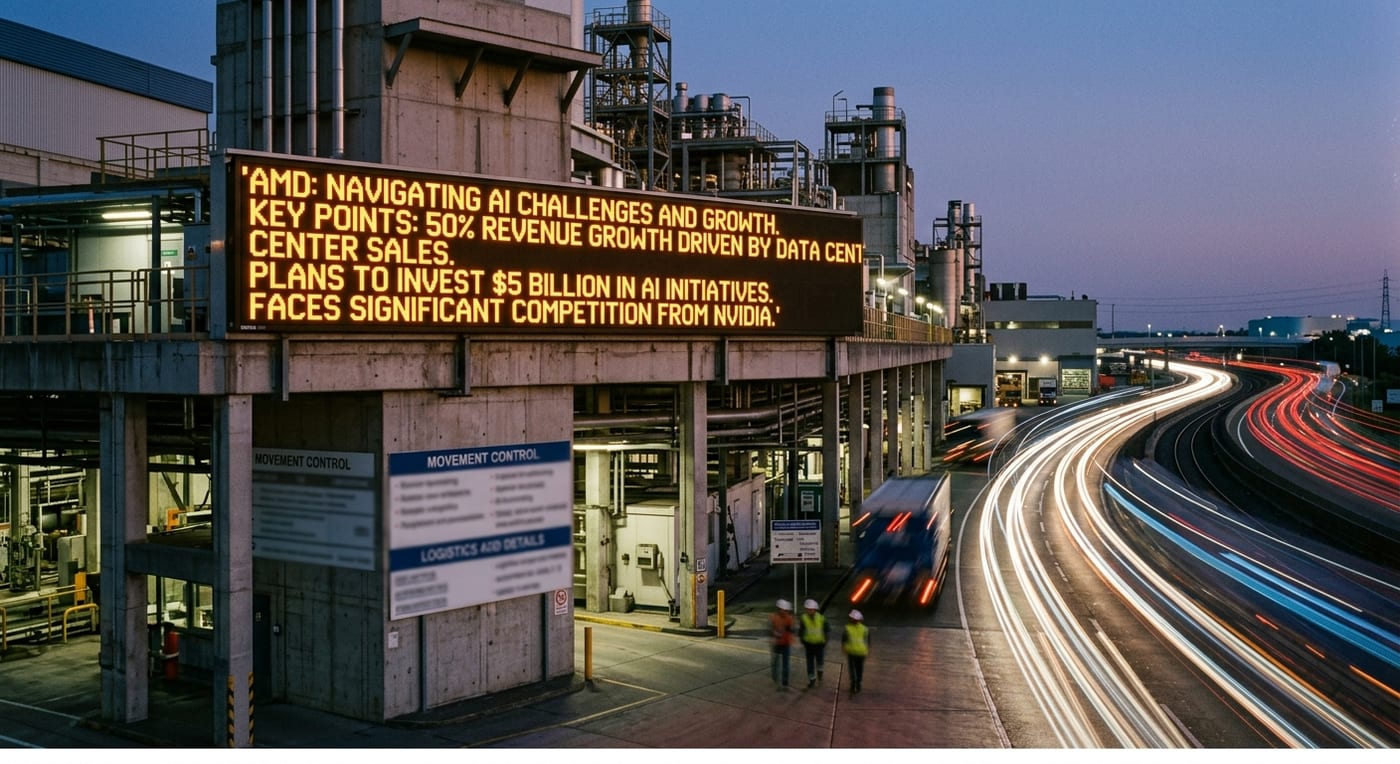
- AMD achieves 50% revenue growth driven by data center sales.
- Plans to invest $5 billion in AI initiatives to enhance market positioning.
- Faces significant competition from Nvidia as it carves out its share in AI and data centers.
Advanced Micro Devices, Inc. (AMD) is drawing attention as the latest developments come into focus. Advanced Micro Devices, Inc. (AMD) is navigating a dynamic landscape in the semiconductor industry, marked by rapid growth and stiff competition from industry giants. As AMD continues to carve its niche within the high-performance computing sector, particularly in artificial intelligence (AI) and data centers, it faces a blend of opportunities and considerable challenges that demand strategic finesse. With a recent announcement of a substantial investment in AI and a surge in data center revenues, AMD is at a critical juncture that could define its trajectory for years to come.
Financial Performance: Strong Growth Trajectory
AMD has recently reported a remarkable year-over-year revenue increase of 50%, with total revenues reaching approximately $11.54 billion, driven largely by its robust data center operations. Notably, this segment recorded a staggering 107% growth, contributing about $6.7 billion to total revenues. This growth underscores the rising demand for efficient and powerful computing solutions across industries, particularly as the reliance on data centers intensifies in the AI era.
The rapid growth in AMD's data center revenue reveals the strategic importance of this segment in the company’s overall portfolio, further cementing its role as a key player in the sector. Analysts believe that AMD's commitment to AI and data-centric solutions positions it well in a market increasingly driven by high-performance computing demands.
Strategic Investments in AI
In line with its growth strategy, AMD announced a planned investment of $5 billion into AI initiatives, aimed at enhancing its competitive positioning against larger rivals like Nvidia. This investment comes at a pivotal time, highlighting AMD's commitment to remain relevant and competitive in a rapidly evolving technology landscape. The company’s focus on artificial intelligence is seen not only as an avenue to bolster its market presence but also as a strategic maneuver to leverage its technological innovations.
Moreover, AMD recently doubled its total addressable market estimate to $220 billion, indicating confidence in the long-term potential of its AI solutions and further asserting its ambitions in this burgeoning field. Analysts from TD Cowen have cited growing adoption of AI workloads where AMD's CPUs are particularly suited for managing complex workflows in emerging applications, further supporting AMD's strategic pivot towards AI.
Competitive Pressures and Market Dynamics
While AMD has made significant strides in establishing itself as a leader in the AI and data center domains, it is not without formidable competitors. Nvidia, in particular, remains a key challenger, boasting a larger share of the AI chip market. The intensifying competition poses a threat to AMD's market share and margins, particularly as Nvidia enhances its offerings with the anticipated introduction of its new architecture chips, which could potentially widen the performance gap.
Despite these pressures, AMD's diversified business model—operating across gaming, client, and embedded segments—provides some protection from market volatility. While AMD's data center segment generated 58% of its revenue in the latest quarter, it still benefits from offering competitive products tailored to a range of budget-conscious customers. This adaptability may assist AMD in maintaining its foothold against a market that is testing the limits of demand.
The Current Stock Valuation and Future Expectations
Recently, AMD's stock has faced scrutiny as its price-to-earnings (P/E) ratio has soared, currently standing at 139, which is significantly higher than those of its main competitors. This inflated valuation raises concerns among investors about potential overreach in stock pricing relative to future growth. Analysts argue that while AMD's stock has performed well, it is crucial to monitor its valuation closely against growing market expectations.
As the company positions itself for growth, concerns have arisen about whether it can sustain this momentum. The disparity between growth rates and stock valuations suggests that investors may need to temper their expectations for short-term gains. Despite AMD’s current high valuation, it remains a compelling long-term investment opportunity driven by its strategic focus on AI and expanding market opportunities in data centers.
Conclusion: Charting the Course Ahead
In summary, Advanced Micro Devices, Inc. is at a watershed moment as it navigates the complex dynamics of AI and semiconductor markets. With an impressive financial performance bolstered by robust demand for data center solutions, AMD is primed for growth. However, it must also address the significant competitive pressures posed by established players like Nvidia while managing its valuation challenges. As AMD strives to capitalize on its investments in AI, the unfolding technology landscape will determine its future success and market positioning.
The company’s strategic focus on innovation, adaptability, and market responsiveness will be key as it builds on its current trajectory. The importance of maintaining a competitive edge in pricing and product performance cannot be overstated as AMD looks to solidify its role as a powerhouse in high-performance computing amid rapidly evolving industry demands.