

Amazon's Transformational Shift in Retail Delivery
ED
Editorial
Cashu Finance·5 min read
TL;DR
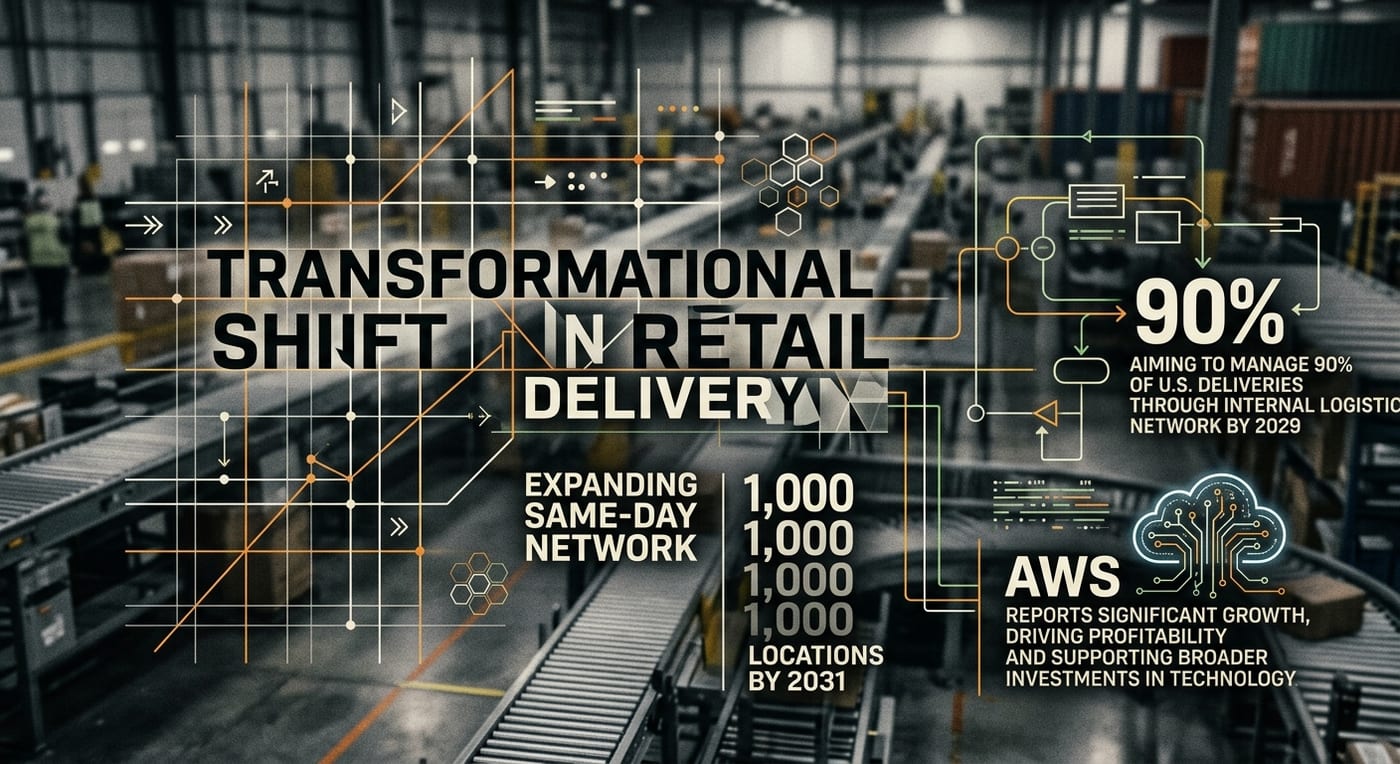
- Amazon is expanding its same-day delivery network to over 1,000 locations by 2031.
- The company aims to manage 90% of U.S. deliveries through its own logistics network by 2029.
- AWS reports significant growth, driving profitability and supporting broader investments in technology.
Amazon.com, Inc. ( AMZN) is at a pivotal juncture, transforming its logistics and operational strategies to enhance its competitive edge in the e-commerce landscape. Under the current leadership of CEO Andy Jassy, Amazon is accelerating its expansion into same-day delivery and is making significant investments in its logistics network. With ambitious goals set for 2029, Amazon aims to manage nearly 90% of its U.S. deliveries through its own fleet, a move poised to challenge the physical presence of traditional retailers like Walmart. Amazon's recent initiatives reveal a concerted effort to solidify its position as the premier provider of fast, reliable delivery services, thereby reshaping consumer shopping behaviors.
The Logistics Transformation
Central to Amazon's new strategy is Project Mercury, an initiative that seeks to expand its same-day fulfillment network dramatically. Currently, the company operates around 85 facilities, but with plans to reach over 1,000 by 2031, the scope of this project indicates a commitment to reconfiguring the logistics landscape in America. This transformative plan can potentially alter retail, allowing Amazon to offer faster delivery of everyday essentials to a larger customer base. This expansion is crucial for competing against companies like Walmart, which enjoy significant advantages due to their extensive store networks located close to consumers. Strategically, Amazon believes that being closer to its customers—within a 10-mile radius for 80% of its Prime subscribers—will enhance its service speed and make online shopping more appealing.
Walmart, boasting thousands of stores accessible to 90% of the U.S. population, maintains a competitive edge in everyday retail. However, Amazon's pivot to build smaller, specialized fulfillment centers, directly challenges that advantage by creating a denser web of delivery options. This shift is not only about improving delivery times but also about increasing customer satisfaction, which consequently drives sales. The initiative reflects a broader trend of retailing moving towards convenience, which aligns perfectly with consumer preferences for speed and efficiency.
Investment in Technology and Infrastructure
In addition to logistics, Amazon is focusing heavily on its cloud computing segment through Amazon Web Services (AWS). This division has been a crucial profit driver for the company, reporting a remarkable 37% year-over-year growth, generating $42.2 billion in revenue during the second quarter of 2026. AWS accounted for a staggering 60.5% of Amazon's total operating profit, validating the strategic focus on its cloud infrastructure as a vehicle for sustained growth. As the demand for cloud services continues to soar, propelled by innovations in artificial intelligence and machine learning, the investments in AWS are expected to yield long-term benefits.
Additionally, Amazon's investments in AI through its partnership with Anthropic are providing significant value. Following its substantial stake in the AI company, currently valued at around $965 billion, this strategic tie-up enhances Amazon's capabilities in generative AI and positions it to capture significant market share in the evolving tech landscape. Current assessments suggest that the value of Amazon's investment in Anthropic could potentially exceed $394 billion if the AI company achieves its projected IPO valuation of $2 trillion, further integrating AI into Amazon's service offerings and reinforcing strengths in cloud computing.
Navigating Market Dynamics and Competition
As Amazon navigates these transformative changes, its approach is not without challenges. The expansion into same-day fulfillment will require substantial capital investments and meticulous planning for execution. Critics may express concerns about the sustainability of such an aggressive growth trajectory while maintaining profitability. However, Amazon's history of strategic foresight suggests a robust plan is in place to optimize costs in the long term. The company’s persistent focus on efficiency could lead to lower operational costs, directly impacting its bottom line and maintaining competitive pricing against rivals.
This investment is echoed in recent reports that underscore Amazon’s shift towards self-delivery capabilities. Anticipating that 50% of deliveries will come from its Same Day Fulfillment Centers (SDCs) by 2035, Amazon is aligning its operational model to ensure fast delivery, which is increasingly becoming a crucial differentiator in the e-commerce sphere. This fulfillment strategy forms a critical part of Amazon's larger vision to ensure that when consumers think of fast delivery, they think of Amazon first.
Financial Outlook and Investor Sentiment
The current financial landscape offers Amazon a window of opportunity to capitalize on innovations in retail and technology. As it enhances its logistics networks and bolsters its cloud services through AWS, the outlook for growth remains positive. While concerns about inflation and economic headwinds loom large, consumer behavior trends suggest that demand for fast and efficient online shopping will continue to rise. Investments in logistics infrastructure, combined with advancements in AWS, mitigate potential risks and solidify Amazon’s market leadership.
Investors are watching closely, particularly as Amazon's stock valuation has become more attractive following recent price fluctuations. With a current market cap of $2.8 trillion and a price-to-earnings ratio dropping from 32 to 20, Amazon's stock appears to be poised for future gains as the company continues to leverage its strengths and retool its operations to meet emerging consumer needs. Looking forward, the trajectory suggests that as Amazon perfects its logistics prowess and accelerates its cloud computing capabilities, the path to increased profitability and shareholder value seems clear, potentially rewarding patient investors.
As Amazon.com, Inc. continues to expand its horizons, the landscape of American retail may never be the same again. Every strategically placed delivery center and state-of-the-art cloud technology is a stepping stone toward a future where convenience and efficiency reign supreme, all while challenging the status quo that physical retail giants like Walmart have long cherished. The same pressure is reflected in recent reporting on the issue, which helps explain why the company's pricing decisions remain under scrutiny.