

AI Demand Fuels ASML's Growth Surge
ED
Editorial
Cashu Finance·5 min read
TL;DR
- ASML strengthens position with AI-driven demand.
- TSMC partnerships boost production capacity.
- Strong financial outlook supports investor confidence.
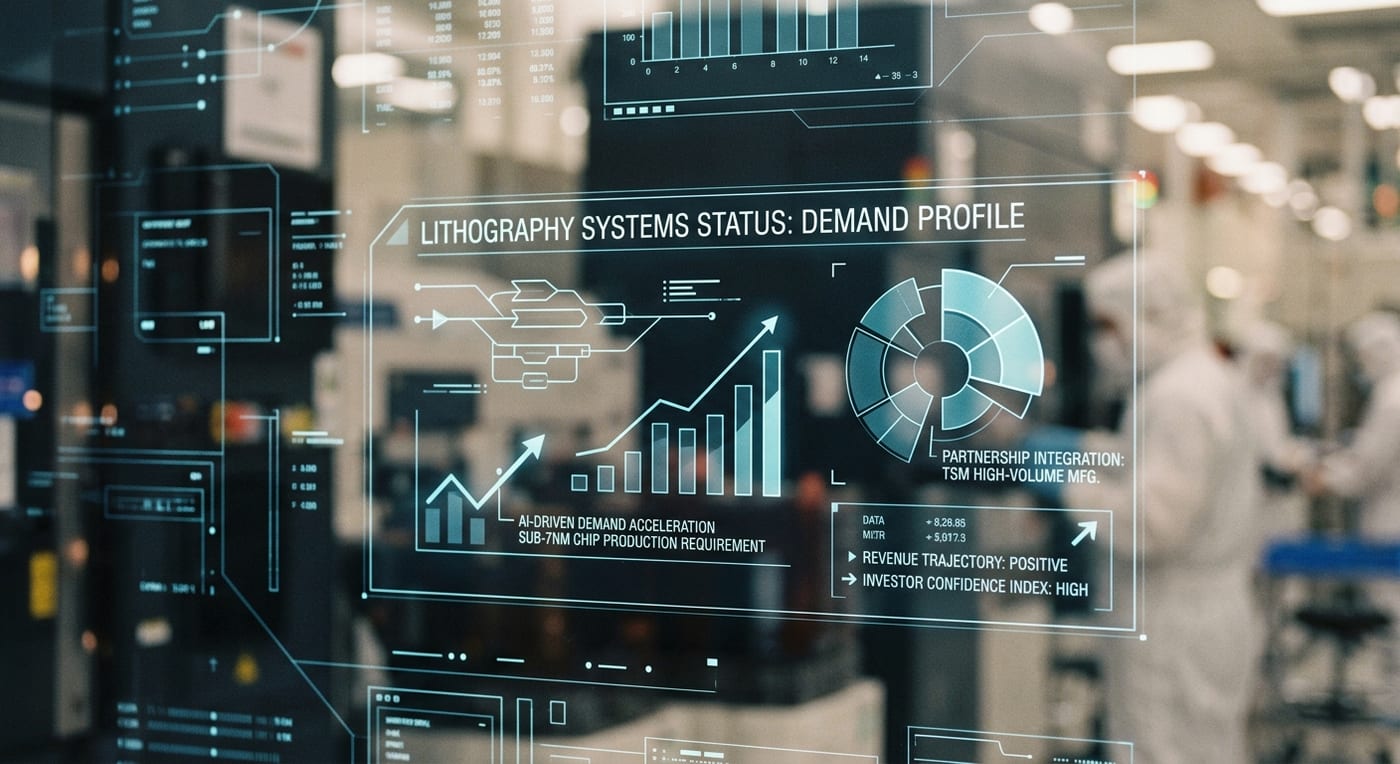
ASML Holding N.V. (ASML) stands as a critical player in the semiconductor industry, particularly in light of the unprecedented surge in demand for artificial intelligence (AI) technologies. The company is uniquely positioned as a result of its exclusive manufacturing of extreme ultraviolet (EUV) lithography machines, which are integral to producing the sophisticated semiconductors that power modern AI applications. This article delves into ASML’s strategic maneuvers, its partnerships with leading chip manufacturers, and the broader market dynamics that underscore its robust growth trajectory amid booming AI-driven demand.
The Semiconductor Industry Transformation
The landscape of semiconductor manufacturing is undergoing a profound transformation, propelled by rapid advancements in AI technologies. Major clients, like Taiwan Semiconductor Manufacturing Company (TSMC) and Nvidia, have significantly increased their investments in chip production capabilities to keep pace with this burgeoning demand. In fact, memory chipmakers, initially hesitant to expand, are now committing hundreds of billions of dollars to new facilities set to revitalize chip production beginning next year. This aggressive growth in capital expenditure provides a promising backdrop for ASML, whose lithography machines are essential for the manufacturing processes within these new facilities.
Moreover, ASML’s domination in the lithography equipment market—holding a staggering 90% share—positions it strongly against competitors. The company’s machines, designed to last up to 30 years, allow ASML to capitalize on the current demand cycle, given that its competitors will need time to develop comparable technologies. In this environment, ASML plans to expand its production capacity by 30% next year, reflecting its strategy to meet the soaring demand from customers.
The implications of these expansions are significant. As ASML ramps up production, it doesn’t just solidify its market leadership but also enhances its service revenue from an increasing installed base, thus supporting elevated margins. This strategy reaffirms ASML's forecast of strong earnings growth driven by high-end machine sales, specifically tailored for AI applications.
TSMC and Global Partnerships
TSMC plays a pivotal role in ASML's growth strategy, as the leading manufacturer of semiconductors globally. ASML's long-standing partnership with TSMC has become even more vital in the current landscape. ASML's next-generation High NA EUV lithography machines have garnered commitments from TSMC and Samsung, marking a critical endorsement of ASML's technology as crucial to the future of AI semiconductor production.
This relationship not only secures ASML a consistent demand stream but also reinforces its role as a trusted partner in the innovation of next-generation chips. With TSMC increasing its capital expenditure amidst rising AI-related demands, ASML can anticipate sustained growth, thereby attracting investments and bolstering its financial outlook.
The Role of AI in Semiconductor Demand
As companies across industries integrate AI into their operations, the demand for advanced semiconductors has surged. This growth is uniquely beneficial to ASML, as its exclusive manufacturing capabilities in EUV lithography systems become essential for crafting the complex chips that power AI applications. Given that ASML is the sole provider of these advanced machines, it stands to gain significantly as semiconductor manufacturers ramp up production to meet AI demands.
Recent reports suggest that ASML has strong visibility into demand through 2030, driven by the expansive need for semiconductor fabrication capabilities. CEO Christophe Fouquet indicated that customers are expressing interest in future orders, reassured by the long-term AI investment outlook. Such interest in future orders not only hints at the confidence in ASML's technology but also places the company favorably in the market for sustained profitability.
Financial Performance and Projections
ASML's recent financial performance underscores its ability to navigate market dynamics successfully. The company reported third-quarter profits that exceeded expectations, fueled by robust demand for its lithography equipment. This performance has enhanced investor confidence, as evidenced by the significant increase in ASML's stock value this year. In fact, ASML's shares have rallied by 56%, reflecting the market's positive reception of the company’s growth trajectory and the increasing investments in AI technologies.
For the full year, ASML has revised its revenue forecast, now expecting net sales between 44 billion euros and 45 billion euros, indicating heightened investor optimism about its operational capabilities. The anticipated sales for the fourth quarter are also promising, with projections ranging between 14.2 billion euros and 15.2 billion euros, which surpasses analyst consensus estimates.
Conclusion: A Bright Future Ahead
The convergence of AI advancements and semiconductor requirements signifies a flourishing market for ASML. With its unique market position, strategic partnerships with leading companies like TSMC, and a robust financial outlook, ASML is well-equipped to thrive in the rapidly evolving semiconductor landscape. As major players in the industry commit to substantial investments to meet AI-driven demands, ASML's critical role in manufacturing the tools necessary for producing advanced semiconductors positions it for a sustained growth trajectory.
As the semiconductor industry continues to innovate, ASML stands at the forefront, not merely spectators of change but as active shapers of the next technological wave that promises to redefine computing power and capabilities across various sectors. The same pressure is reflected in recent reporting on the issue, which helps explain why the company's pricing decisions remain under scrutiny.