

AeroVironment: Growth and Legal Challenges Ahead
ED
Editorial
Cashu Finance·5 min read
TL;DR
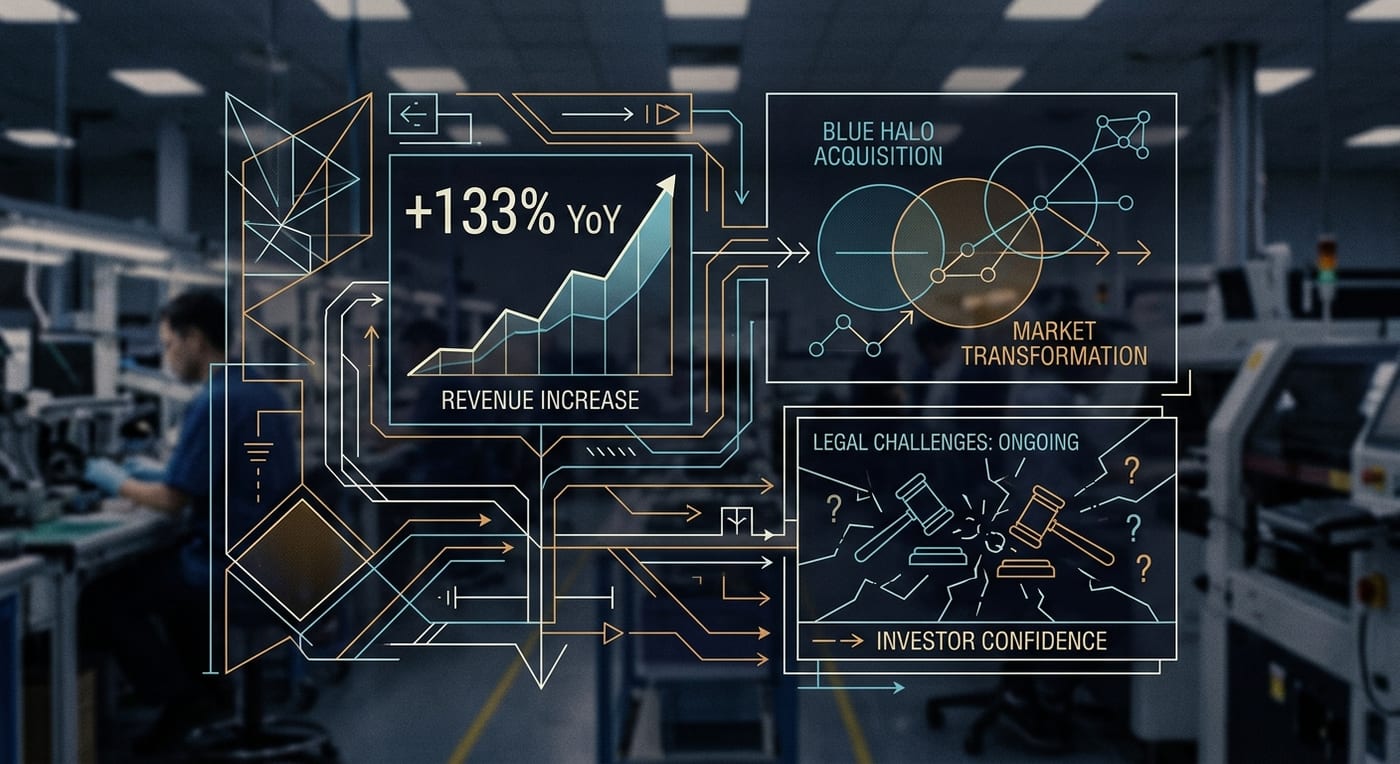
- Revenue increased by 133% YoY - Blue Halo acquisition transforming AeroVironment's market position - Legal challenges ongoing affecting investor confidence
AeroVironment, Inc. (AVAV) is drawing attention as the latest developments come into focus. AeroVironment, Inc. (AVAV) has risen to prominence within the unmanned aerial vehicle (UAV) sector, showcasing impressive financial growth amid significant legal challenges. The company has reported a remarkable 133% year-over-year revenue increase, reaching total revenues of $641.6 million in Q4 2023. This surge in revenue is primarily attributed to escalating military spending and the growing demand for advanced drone technologies. However, as AeroVironment celebrates its financial achievements, it must also navigate ongoing legal hurdles related to its contracts with the U.S. Space Force's Satellite Communication Augmentation Resource (SCAR) program. This article explores AeroVironment's transformational shift toward becoming a leading force in the defense technology sector, focusing on its successful financial performance, new technological advancements, and the challenges that lie ahead.
Financial Performance Overview
AeroVironment's latest earnings report has drawn attention from investors and analysts alike, with the company achieving total revenues of $641.6 million in Q4 2023. This remarkable financial outcome signifies a major leap from the previous year, and is primarily driven by increased military expenditures as nations fortify their defense capabilities. The demand for advanced drone technology has become crucial in this geopolitical landscape, further bolstering AeroVironment's revenue streams.
Despite the positive figures, AeroVironment faces significant legal challenges related to its SCAR contracts. Legal uncertainties can potentially hinder future growth, and both investors and stakeholders express caution regarding the company's trajectory amid the ongoing litigation.
The Acquisition of Blue Halo: A Market Game-Changer
Another transformative aspect of AeroVironment's growth narrative is its strategic acquisition of Blue Halo for $4.1 billion. This acquisition has expanded AeroVironment's operations beyond UAVs, establishing it as a major player in the broader aerospace and defense industry. Following this acquisition, AeroVironment declared its intent to position itself as a global defense technology leader, melding capabilities in air, land, sea, space, and cyber domains. The revenue impact from Blue Halo has been substantial, as 619 million dollars from its integration was reflected in AeroVironment's financials after the acquisition, pushing total revenues to approximately $2 billion.
Despite such promising projections, the integration has not come without its challenges. The SCDE division, which encompasses Blue Halo's operations, has reported losses, highlighting the complexities of assimilating a large acquisition into existing business practices. While analysts remain hopeful for a turnaround, the road to profitability for this division remains unclear.
Innovative Contracts and Future Outlook
AeroVironment has further solidified its position in the defense sector with recent groundbreaking contracts. Notably, the U.S. Army awarded AeroVironment a landmark contract worth $464.8 million for producing laser weapons under the Enduring-High Energy Laser (E-HEL) program. This contract marks a historic milestone as it is the first production contract for directed energy systems in the history of the United States military, emphasizing AeroVironment's innovative capabilities.
The E-HEL weapons are designed for counter-drone operations, targeting challenges that arise from increasing drone threats. As cost-effective solutions for military application, these systems could potentially transform traditional warfare strategies, offering advantages over older missile systems that are significantly more expensive to operate. The current discourse surrounding the financial implications of these contracts leads to increased optimism among investors considering the scalability and profitability of advanced solutions.
Reflecting on this recent ambition, the integration of Blue Halo is expected to significantly support the company's capacity to fulfill such contracts, enabling greater efficiency and revenue generation through its new technology offerings. Increased production operations in this arena could facilitate higher margins in a sector known for competitive pricing.
Legal Challenges: A Cloud Overhead
Despite the growth and success, AeroVironment's ongoing legal troubles cast a shadow over its achievements. The company is currently involved in various legal proceedings concerning its contracts, which could potentially undermine investor confidence. As highlighted in earlier studies, AeroVironment's ability to navigate these legal hurdles will determine not only its operational stability but also its reputation within the defense market.
As competition intensifies in the UAV sector and legal scrutiny continues, AeroVironment’s management must remain agile and focused, ensuring that innovative products are delivered while addressing any legal shortfalls that may arise. A combination of strong leadership, strategic planning, and investment in technology will be essential for the company to sustain its growth trajectory amidst adversity.
Conclusion
AeroVironment's journey towards becoming a substantial player in the defense technology sector is marked by exceptional financial performance coupled with significant legal hurdles. The impressive 133% revenue growth is a testament to the company's strong market position and potential for future success. However, the integration of Blue Halo and the production of directed energy systems, while promising, highlight the ongoing challenges that AeroVironment faces in achieving profitability. As the company is set to embark on this transformative path, stakeholders will be watching closely to see how it addresses its legal challenges while capitalizing on its strong market position and innovative technology offerings. The same pressure is reflected in recent reporting on the issue, which helps explain why the company's pricing decisions remain under scrutiny.